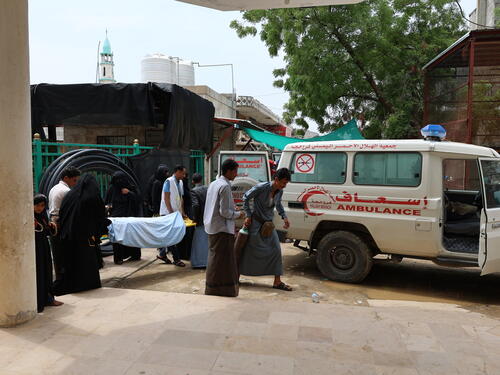
In Yemen, the long years of war, which have resulted in the destruction of homes, loss of lives, displacement of thousands, and deterioration of economic and living conditions, have taken a toll on people's mental health.
“People also struggle with family issues and traumas. The conflict and lack of access to mental health services leaves a significant impact on the patients who already suffered from chronic mental health disorders before the onset of the war,” says Muaadh Abdul-Ghani Al-Samawi, MSF mental health supervisor in Hajjah, Yemen.
Abdul Karim, 48, is a father of four. He lost his ability to work and support his family and isolated himself after experiencing a traumatic event. He started to suffer from extreme fear and anxiety.
“I started to question everyone around me. I couldn’t trust anyone,” he says. “I was lost and felt that life wasn’t worth living anymore.”
Abdul Karim, MSF patient in Hajjah, Yemen
“I would like to address people who are going through the same thing and tell them to pave their way through life again; talk about your feelings, seek treatment and psychological support, and commit to it. Your lives will soon get back on track.”

Abdul Karim's children and wife were his way out of his suffering. His wife talked him into seeking treatment. He used to travel more than 100 km from Hajjah to visit a doctor in Sana'a, since mental health services were not available in Hajjah and its surroundings areas.
“When I discovered that MSF provides mental health care in Hajjah, I started coming to the clinic every month and I have been going there for the past two years,” says Abdul Karim.
Our teams provide a holistic mental health programme at the Al-Gomhouri hospital in Hajjah city, northwest Yemen, in collaboration with the Ministry of Health. The programme includes psychological care, psychiatric treatment for severe mental health disorders, and psycho-education group sessions.
Video
Rebuilding Their Lives
“We receive patients suffering from various mental health disorders, with symptoms ranging from mild to severe, such as anxiety, depressive episodes, post-traumatic stress disorder, and behavioural problems, and we provide them with psychosocial care," says Aura Ramírez, MSF mental health activity manager.
“However, most patients arrive with severe conditions such as major depression, psychosis and bipolar disorder, that require psychiatric treatment in addition to psychological care. These cases amount to 70 to 80 per cent of our patients.”
Fatima*, 33 and a mother of five, suffered from severe hallucinations and constantly heard voices that made her cry, scream and act violently with her children. Sometimes, she couldn't even recognise them.
Fatima went through a divorce due to her mental health condition and moved from her husband’s house in Sana’a to her parents' house in Hajjah.
Fatima*, MSF patient in in Hajjah, Yemen
“These sessions provided me with information and helped me rely on myself. I became an independent woman after having depended on people for so long. I restored my self-confidence and I’m now able to complete my day-to-day activities.”

“I was a hopeless case. No one accepted me. I sat in the dark most of the time, and it was an absolute headache for my family. I turned their joy into sorrow on any occasion,” says Fatima.
Most people with mental health issues in Yemen often seek support and treatment at a late stage when their symptoms already impacting their and their families' lives. This can be attributed to many factors.
“Many patients don’t recognise the early symptoms and only become aware of them at a later stage. This is largely due to the lack of awareness of mental health disorders,” says Al-Samawi.
“Some associate mental issues with jinn and sorcery and resort to other traditional means before seeking support at the clinic. Linking mental illness to madness and stigmatisation also further discourages the patients and their families from seeking help,” he says.
It changed my life. I am no longer the person I was a few years ago. I got my job back, and my life is back on track.Abdul Karim, MSF patient in Hajjah, Yemen
The MSF mental health clinic in Hajjah receives about 400 patients per month. Men amount to around 70 per cent of the patients, which indicates challenges facing women in accessing mental health services, some of which might be related to social and family restrictions.
Women need the support of their husbands or families to receive treatment. In response, our teams work to raise awareness and highlight the importance of mental health care in the communities by conducting regular education sessions in various departments of Al-Gomhouri hospital for the patients, their families and visitors.
“I consider this place as my second home. These people are my family,” says Abdel Karim who participates in the men's group sessions at the care centre. “It changed my life. I am no longer the person I was a few years ago. I got my job back, and my life is back on track.
“After having isolated myself for so long, I started taking walks and visiting my friends and family. I attend these sessions three times per week. My story is living proof that hope still exists.”
*Name changed to protect identity
Yemen
Eight years of war create perfect storm for humanitarian crisis
Voices from the Field
31 Mar 2023