


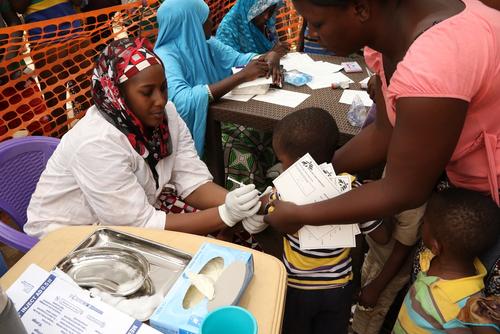

Ebola disease in DRC: find out how we're responding
Learn more
7998 Results
 
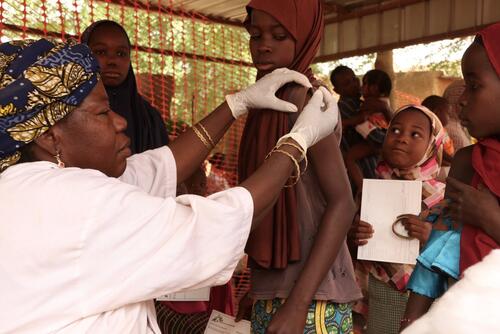
Between August and November 2015, MSF and the Ministry of Health of Mali launched a chemoprevention campaign against seasonal malaria, the leading cause of infant mortality in the country, which reached more than 45,000 children between three months and five years old in the Ansongo district, in the Gao region in the north of the country. During the campaign, MSF took the chance to complete the children’s vaccination records.
Mali

MSF warns about the use of humanitarian aid for political and military interests

The incursion of military and political actors in the humanitarian field is putting the provision of humanitarian aid at risk in Mali, according to a new report. Report - 24 Mar 2017
 
Sinethemba takes her daily regimen for XDR-TB at 10am each day. She also takes  two additional delamanid tablets at night.

Sinethemba, 16 years, lives with her grandmother, Vuyisiwa Madubela, and four other family members in a two-bedroomed home in Zone C29, Khayelitsha, Western Cape, South Africa.

Her grandmother’s determination and love, combined with receiving a six-month trial of one the newest DR-TB drugs on the market likely saved her life this year. 

Current regimen: delamanid, linezolid, pyrazinamide, ethambutol, clofazimine, high dose levofloxacin, terizidone.

Grandmother Vuyisiwa Madubela:

“Sinethemba’s mother died when she was 6 months old, she was taken [raised] by my elder daughter who also died last December.

She’s from PE  (Port Elizabeth) and when I arrived there for the funeral I saw Sinethemba was very sick – thin, weak, shaking, very pale, sleeping, very high temperature . She was very quiet. I hadn’t seen her for a long time, nearly three years. 

On the day of the funeral, the senior sister in the area called me – “Can you take her? This child is sick… “

I thought I was going to lose her. It was painful as I’ve lost three children. I used say ‘if I lose one child, I’ll die; I was thinking: I’ve lost her mum, and she’s going to die too.’

During her first month with us in Khayelitsha, it was terrible - she wouldn’t eat. We’d all just watch her. Everyone was sad. When I wanted to cry, I had to go outside.

On 12 December 2015, she had X-rays, and they took sputum. They called and said I had to come immediately, she had MDR-TB and they were putting her in Brooklyn Chest Hospital. 

That day, I lost hope. I thought she was going to die. If she stayed in PE, she would have died. 

By end December 2015 she started MDR treatment with kanamycin injections, as well as the other drugs  – they said she could go deaf because of the side effects of the injection. She had to go to the clinic Monday to Friday, every day. 

It was painful and some days she asked not to go.  In February 2016, her sputum showed that she was resistant to the injection, so they applied for new drugs to change her treatment.

In February 2016, MSF came and explained that they could apply for a new drug for Sinethemba called delamanid if I gave my permission for her to take part, because the drug is not usually available for TB patients in South Africa. We met with a counsellor, and got a lot of information. 

The first few days she had nausea, wanting to vomit. I sat her down and I said: “You have to accept this; you must talk to your tablets. You must give them an order: ‘I am in charge.’” 

Not even a month later, she started speaking, even dancing. She’s going to church, she’s singing in the church choir. Everyone could see there was an improvement and they wanted to know what happened. She’s going for an electrocardiogram (ECG) every month and it’s normal.

Last year was very hard for the whole family, but from February when she started delamanid, she didn’t take a long time to get better. 

The only problem is now she eats everything. We have to dish up twice! She’s gained weight.

When she went for her last x-ray they told me they don’t see any signs of TB in her chest. 

Sinethemba hasn’t been to school this year, I was told that she wouldn’t cope, that the treatment would make her drowsy, sleepy. We’ve been told she can go next year. 

Everyone could see there was improvement. Everyone wanted to know. 
What would I like to tell the manufacturer of delamanid?

I would ask the manufacturer of delamanid to give it to every patient who really needs it. I see lots of TB patients at the TB clinic. If people got this drug, they could really control DR-TB. TB is a giant but not a killer. TB can be cured.”
Tuberculosis

Fewer than five per cent of people in need are treated with new drugs

Only 4,800 people with DR-TB in 2016 were treated with two newer and much more effective medicines, which have been on the market for up to four years. Press Release - 23 Mar 2017
 
View from Al Thawra hospital in the besieged area of Taiz.
A siege has been impoased on the city by Houthis since late August 2015. MSF was not able to enter medical aid into the enclave area for five months. Only on January 16th, MSF got the authorization and delivered medical aid to Al-Thawra hospital inside the enclave area.
Yemen

MSF withdrawing from Ibb Al-Thawra hospital

"Due to our inability to run activities according to MSF’s principles of independence and impartiality, we have made the difficult decision to withdraw from Al-Thawra hospital in Ibb," says Hugues Robert, MSF Program Manager for Yemen. Statement - 23 Mar 2017
 
MSF teams in and around Mosul have received more than 1,800 patients in need of urgent or lifesaving care in the last two months. 1,500 of them needed treatment for conflict related trauma. As the scale of the non-trauma needs also became apparent, MSF opened maternity services in eastern Mosul at the beginning of February, and since then the teams have assisted 100 births and performed 80 C-sections.
Iraq

“Yesterday, it was calm; we only received 20 war-wounded patients”

Testimonies gathered on 18 March from two MSF surgeons working in the field trauma centre. Voices from the Field - 22 Mar 2017
 
MSF teams in and around Mosul have received more than 1,800 patients in need of urgent or lifesaving care in the last two months. 1,500 of them needed treatment for conflict related trauma. As the scale of the non-trauma needs also became apparent, MSF opened maternity services in eastern Mosul at the beginning of February, and since then the teams have assisted 100 births and performed 80 C-sections.
Iraq

Thousands of wounded and sick coming from western Mosul

“The need for emergency medical care has risen drastically,” said Dr Isabelle Defourny, MSF director of operations. Press Release - 22 Mar 2017
 
In parallel with the study into a new rotavirus vaccine, over 1,000 pregnant women are being monitored as part of a substudy that aims to evaluate the impact of the nutritional condition of pregnant women on the health of their babies. These mothers receive nutritional supplements. 
During their pregnancy, they attend four scheduled appointments with the medical team for monitoring purposes and so that vaginal swabs, blood specimens (malaria/thick smear/syphilis/HIV AIDS), and urine and stool specimens can be taken.
These mothers also give permission for their newborn to be included in the study and monitored for two years by the Epicentre medical teams. At each of the scheduled appointments the mothers receive a transport allowance, plus three bars of soap and a food parcel containing bread, a drink and a tin of sardines.
Niger

Innovative vaccine against rotavirus

This slideshow explains the challenges posed by rotavirus and the existing constraints of the existing vaccines. It shows the story of the Epicentre Study in Maradi district, Niger. Photo Story - 21 Mar 2017
 
MSF has responded to the urgent medical needs of this displaced population by opening a field hospital with an inpatient, an outpatient and an emergency department in Aburoch, where up to 15,000 people have settled. Two mobile clinics are also operating south of Kodok where part of the displaced population has settled. Over the last two weeks, MSF is providing an average of 300 consultations a day, six times the number that was provided in Wau Shilluk where MSF used to run a hospital. PHOTOGRAPHER: Riaz Hussain on the 6th of March 2017
South Sudan

Urgent humanitarian assistance needed for thousands of people who fled fighting in Wau Shilluk

“The humanitarian needs of those that fled are vast and are not being met,” says Abdalla Hussein Abdalla, MSF’s deputy head of mission for South Sudan. Crisis Update - 15 Mar 2017
 
For the last two years, Francis Ronyo has worked as a nurse in MSF’s Wau Shilluk hospital. He was one of the national staff on duty when the decision was taken to evacuate and leave for Kodok. Since he arrived in Kodok, he doesn’t have a place to stay and ends up sleeping in the open with the rest of the people from Wau Shilluk. He however decided to continue serving the sick and the wounded in any way he could and is now  providing medical are in the MSF clinic in Aburoch
South Sudan

“My future is unclear, and I don't know what will happen to all of us from Wau Shilluk.”

Francis Ronyo worked as a nurse in MSF’s Wau Shilluk hospital for two years. He was one of the national staff on duty when the order was given to evacuate and leave for Kodok. Voices from the Field - 15 Mar 2017
 
People walk down a street in Bustan Al Kasr neighbourhood after it was hit by airstrikes in mid-October 2016.
Syria

Warring groups must allow aid to population in need

MSF reiterates its call to warring groups to allow access to Syria so that victims of the war can receive medical assistance. Statement - 14 Mar 2017
Four mothers posing in a corridor of the Hospital in Bili. All four of them are staying in the hospital with their child, that's suffering from a severe case of malaria. Since the beginning of the project in 2016, the pediatric ward already treated more than 4.000 cases of complicated/severe form of malaria.
Médecins Sans Frontières (MSF)

Independent medical humanitarian assistance

We provide medical assistance to people affected by conflict, epidemics, disasters, or exclusion from healthcare. Our teams are made up of tens of thousands of health professionals, logistic and administrative staff - most of them hired locally. Our actions are guided by medical ethics and the principles of independence and impartiality. We are a non-profit, self-governed, member-based organisation.

Learn more