



Ebola disease in DRC: find out how we're responding
Learn more
8000 Results
 
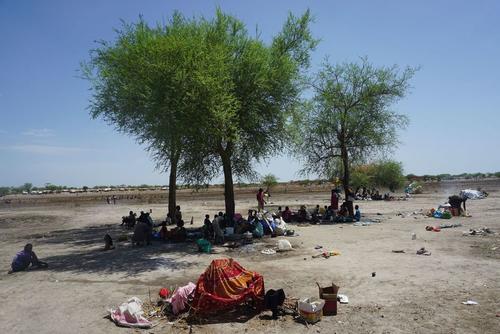
IDPs based in Aburoc take shelter under a tree. When people arrived from Kodok few had shelter.
In may 2017, South Sudanese from Aburoc’s internally displaced persons camp (IDP) started flooding across the border to Sudan.
South Sudan

Fighting and deplorable conditions in Aburoc force 20,000 people to flee

"The reasons why we are leaving are mainly the lack of security and the lack of food and water." Project Update - 11 May 2017
 
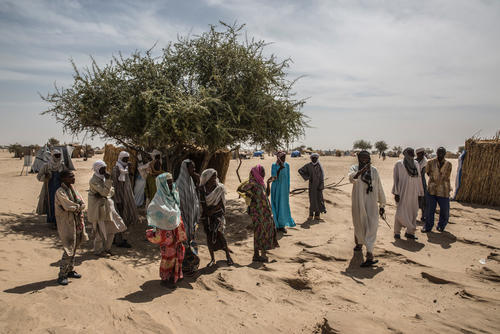
Site for displaced people and refugees in Garin Wazan.

In Garin Wazan, there is currently a displaced community of more than 8,000 people from the islands of Lake Chad. “Boko Haram stole some of the cattle, and we lost the rest because we had to leave,” explains the community chief.
Niger

The burden of violence in the Diffa region

Photo Story - 10 May 2017
 
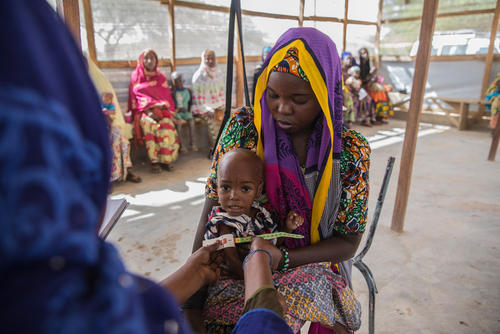
Diffa region. Chetimari IHC, supported by MSF. Screening for cases of malnutrition by the medical staff at the IHC.
Niger

Diffa - the burden of violence

"I had to leave one place after the other due to repeated attacks." Project Update - 10 May 2017
 
Besam’s child is 7 months old. She brought him to the health center because he keeps vomiting and has diarrhea and fever.  The child is malnurished and according to the doctor, such cases happen very often: « mothers stop breastfeeding and replace their milk with powder one but the water isn’t clean and the children get sick. We have to cure the sickness and they get immediately healthy again ».
Yemen

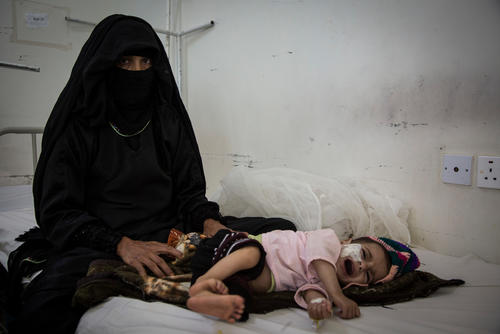
MSF calls for increased response to cholera outbreak

"We are very concerned that the disease will continue to spread and become out of control." Press Release - 9 May 2017
 
Zahardien Musa, a meningitis patient from Sokoto, being admitted at the Muhammed Murtala Specialist Hospital of Sokoto, with his father.
Nigeria

Fighting the worst meningitis C outbreak since 2008

Thousands of men, women, and children in northern Nigeria have been affected by a meningitis C outbreak, reportedly the largest to hit the country in the past nine years. Project Update - 9 May 2017
 
The strike on Tafas field hospital, some 12 km from the Jordanian border, took place on the night of 5 February. It caused partial damage to the hospital building, and put its heavily-used ambulance service out of action. In fear for their lives, more than 20,000 people from Tafas town fled to the surrounding countryside. The hospital is the latest medical facility to be hit in a series of airstrikes in southern Syria, which have been escalating over the past two months.
Syria

"MSF adapts to respond to the needs of a war-afflicted population"

Omar Obeid has been working as Project Coordinator for an MSF South Syria project, managing it remotely for the last 14 months. Over the past few weeks, fighting has intensified in southern Syria, as opposing forces contest to retake the city of Dara’a. As bombings and aerial attacks in Eastern Dara’a increased, hospitals and medical structures in the area have been forced to announce their closure to avoid being targeted Voices from the Field - 8 May 2017
 
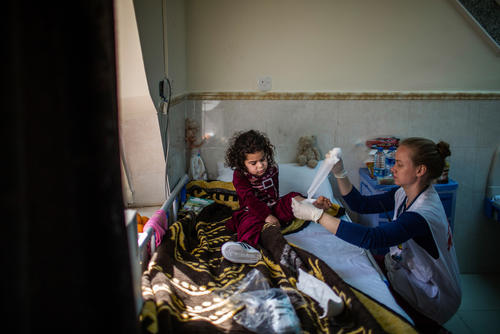
MSF staff member Patricia, changes 5 year old Faten's bandages. She was injured when she was playing in a garden. At the Medecins Sans Frontieres (MSF) Post Op Hospital South of Mosul, Iraq. 

Told by her father:

“When our neighbourhood in West Mosul was retaken by the Iraqi army we went back to our house. Faten was playing in the garden when a mortar bomb fell in the garden and exploded. Faten was injured in the leg by shrapnel from the bomb. First we took her to MSF in Hammam Al Alil where she received the first aid. From there she was referred to another field hospital in Bartella for further treatment. Now she is here in the post-operative ward in Hamdanyia hospital. Every day the staff here clean her wounds and puts new bandages on. Faten is a brave girl, she likes to play and laugh butt she misses her brothers and sisters at home and at night she cries. All her 7 siblings are doing well, praise to God”.
Iraq

Crisis update Mosul - May 2017

“Most hospitals in Mosul have been damaged or destroyed.” Crisis Update - 8 May 2017
 
13-year-old Dilbar in the new playground at the paediatric TB hospital in Dushanbe, Tajikistan. The playground was funded by MSF. For young TB patients or family members this is a very welcome distraction in the often long and difficult treatment process.
Tuberculosis

New report highlights need to better tackle world’s deadliest infectious disease

Two days ahead of the G20 summit in Germany, Médecins Sans Frontières (MSF) and the Stop TB Partnership released the third edition of Out of Step, a report highlighting the need for governments to increase efforts to combat tuberculosis (TB). Project Update - 7 May 2017
 
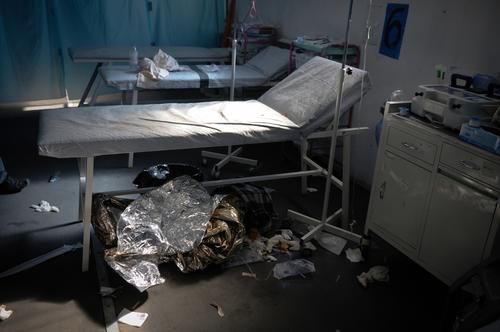
In the ER section of an MSF hospital in Syria, the aftermath of an emergency case, where the patient was stabilised and then immediately rushed into surgery.
Syria

MSF condemns incursion by armed men into supported hospitals in East Ghouta

Reports from doctors MSF supports in the area outline grave incidents on 29 and 30 April in which armed groups showed absolutely no consideration for the special protected status of patients, medical facilities and health workers. Statement - 1 May 2017
 
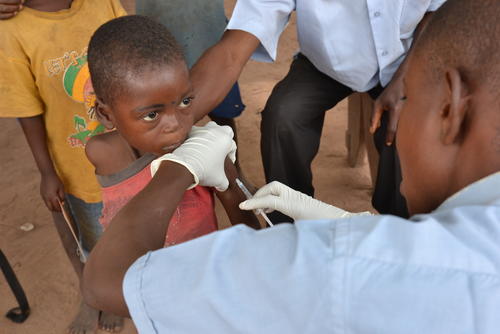
A Medecins Sans Frontieres (MSF) staff member vaccinates a child during a measles vaccination campaign in Samba and neighboring zones in Maniema region, DRC. 

26 MSF teams plan to vaccinate more than 58.000 children, in one week.
Democratic Republic of Congo

MSF staff treat measles cases across five provinces

“When measles arrived in our village, a lot of children died." Press Release - 28 Apr 2017
Four mothers posing in a corridor of the Hospital in Bili. All four of them are staying in the hospital with their child, that's suffering from a severe case of malaria. Since the beginning of the project in 2016, the pediatric ward already treated more than 4.000 cases of complicated/severe form of malaria.
Médecins Sans Frontières (MSF)

Independent medical humanitarian assistance

We provide medical assistance to people affected by conflict, epidemics, disasters, or exclusion from healthcare. Our teams are made up of tens of thousands of health professionals, logistic and administrative staff - most of them hired locally. Our actions are guided by medical ethics and the principles of independence and impartiality. We are a non-profit, self-governed, member-based organisation.

Learn more