Ebola disease in DRC: find out how we're responding
Learn more
8000 Results
 
Babucar Njie, 25, Gambia

I left Gambia due to the conditions at home. I went from Senegal to Mali, then to Burkina Faso, then Niger. 

From Niger some  smugglers brought us to  Algeria. There we were taken to a house and told we had to  pay 15,000 in Gambian money [approx 300 euros]. They made us call our family to send the money. Some of my Gambian brothers they knew a way to escape so I followed them and we made it to Tamanrasset [in Algeria]. There we were kidnapped again, and again we had the same problem; they wanted money. This time we had no way to escape so my family had to pay. 

They beat people if they don’t call their family. If your parents don’t pay they beat you and call them so they can hear the way you’re crying. After that, I was taken to Sabratah, in Libya: that place is more wicked than any other place. They didn’t even give us proper water to drink and the Libyans were  rude. Sometimes they would go and drink [alcohol] and come and start beating everybody.

I was living in a connection house with two or three hundreds people. It was horrible, there was no window and we slept on the floor. I had to work to receive food, then my parents sent the money for the boat.  One morning they said, “Your boat is ready.” When I saw it, it was a plastic boat and I thought, ‘I’m not getting in this,’ but there are guys with guns so you just go. There’s no way back. We were packed into it, the fuel was making everyone sick. The boat was going up and down some people were crying, at any minute we could have died. 

For us Europe is better than everything. There is hope there, but I have a younger brother and if he wants to come this way I will tell him no. If I had known all I had to pass through I would have stayed in Gambia.
Mediterranean migration

"The Crossing", night portraits on the rescue boat Prudence

"The Crossing" is a photographic project by Andrew McConnell/Panos Pictures based on night portraits and testimonies from people rescued by the search and rescue Prudence boat in international Mediterranean Sea waters in July 2017. Photo Story - 15 Nov 2017
 
msf-placeholder
Myanmar

Destruction of MSF Clinics in Northern Rakhine State, Myanmar

Maps detailing the destruction of MSF's clinics in northern Rahkine State, Myanmar Report - 15 Nov 2017
 
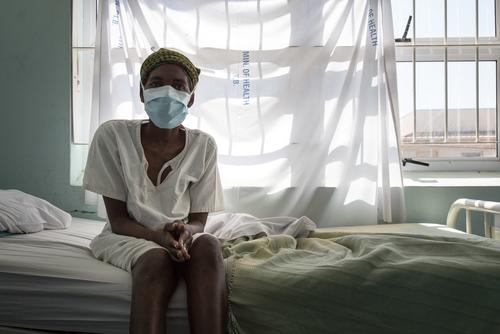
Ncamsile, 42, was diagnosed with DS-TB in 2013. She was cured after 6-months of treatment. But in a setback, in August 2016, she was diagnosed with MDR-TB. "When I was admitted, I weighed 45 Kg and I couldn't walk. I'm happy with my recovery, now I weigh about 55 Kg", Ncamsile says. National TB Hospital, Moneni, Manzini Region, Swaziland.
Tuberculosis

Governments given deadline to increase testing and treatment

"Most countries lag behind in implementing the existing and new tools that are available to tackle TB" Press Release - 15 Nov 2017
 
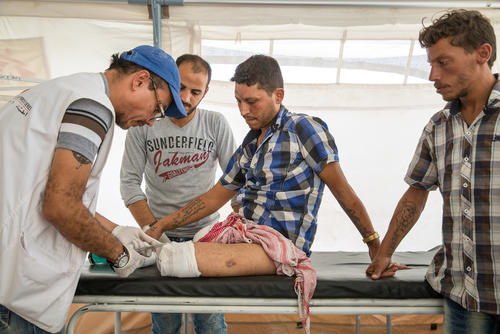
Ain Issa camp, Syria, September, 2017. Michaël Roriz, physiotherapist for MSF, looks after Ahmad.
Ahmad managed to escape from Raqqa, after three months of siege. He lost his wife and his two daughters in the bombardments of the coalition which destroyed his house. In his flight, he activated an explosive device hidden by the fighters of the group Islamic State and must be amputated by both legs.

Camp d'Ain Issa, Syrie, septembre 2017. Michaël Roriz, kinésithérapeute pour Médecins Sans Frontières, soigne Ahmad.
Ahmad a réussi à s'échapper de Raqqa, après trois mois de siège. Il a perdu sa femme et ses deux filles dans les bombardements de la coalition qui ont détruit sa maison. Dans sa fuite, il a déclenché un engin explosif dissimulé par les combattants du groupe Etat islamique et a dû être amputé des deux jambes.
Syria

Doing whatever it takes to escape

The Syrians Médecins Sans Frontières has talked to in Ain Issa camp have told us of the trauma they endured: the fighting, the atrocities perpetrated by Islamic State (IS) and the massive bombing raids carried out by the international coalition. Photo Story - 14 Nov 2017
 
Grozny, Chechnya, Russian Federation. Republican TB Dispensary. Khavani, 26, a mother of three from Grozny, is about to complete her treatment for pre-XDR TB. She was the first patient MSF put on a treatment regimen containing new TB drug Delamanid. Khavani was first diagnosed with TB in 2003 and then had a relapse ten years later after her third child was born. Her mother died of TB, her brother and sister had TB, but were cured. Her eldest daughter is 6, she’s starting school this year. ‘I couldn’t believe this day would come. The main thing is to have a goal in life. I did it for my children. It’s so hard without mommy, my mom died of TB. So I lived for them. You need a goal and patience. Of course it’s difficult, but you should keep on going. I wish everybody health and success!’
Russia

Tuberculosis treatments yield promising results in the Chechen Republic

In 2015, MSF’s Maria Borshova spoke to patients who had just started their new two-year-long treatments for extensively drug-resistant TB. She recently met them again. Voices from the Field - 10 Nov 2017
 
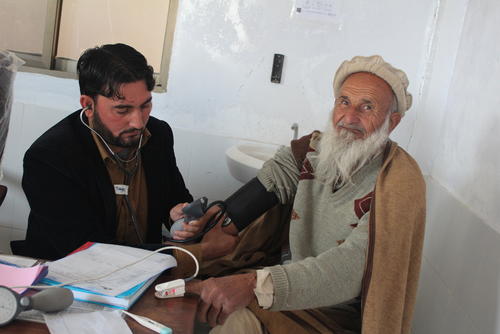
MSF staff examines a patient at the triage room in the Nawagai Civil Hospital, Bajaur Agency.
Pakistan

Closure of MSF project in northwest will leave thousands without healthcare

"The closure of MSF’s activities will leave a major gap and have serious negative implications for the health of people living in Bajaur and the surrounding areas." Statement - 10 Nov 2017
 
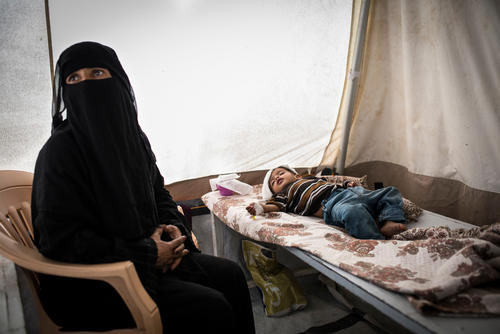
This is the second time within few weeks Reda brings her son Muhatasein to the MSF cholera treatment centre. Cholera, war, poverty, malnutrition: Reda’s life is a daily fight to feed her six children, especially since her husband left them seven months ago. To come to the CTC, Reda had to wait to collect enough money. « I didn’t have enough, I had to wait a couple of days to sell two chicken ». Qaeda hospital / Ibb Governorate.
Yemen

Saudi coalition urged to immediately allow humanitarian access during blockade

“Access for humanitarian personnel and cargo into Yemen is essential to deliver desperately-needed assistance to a population already severely affected by conflict.” Press Release - 8 Nov 2017
 
The former operating theatre in the Mayi Munene health centre. This was built by the Belgians in early 20th century and served as a referral centre for the whole health district, covering 128,000 people. In April 2017 armed militiamen took over Mayi Munene, looted the health centre and later set fire to the building. All the patients and medical staff fled, including the only doctor, who has not yet been replaced.
Democratic Republic of Congo

The work of mobile medical teams in Kasai

MSF mobile teams are travelling to villages across Kasai province to treat people in need of medical care, particularly malnourished children. Project Update - 8 Nov 2017
 
Joao Martins, general coordinator of MSF projects in Angola.
Angola

“People in the camp had one goal – to stay alive”

People were highly emotional and in shock: many had lost family members to extreme violence or had become separated from family members as they ran away. Many children arrived at the camps alone. Voices from the Field - 6 Nov 2017
 
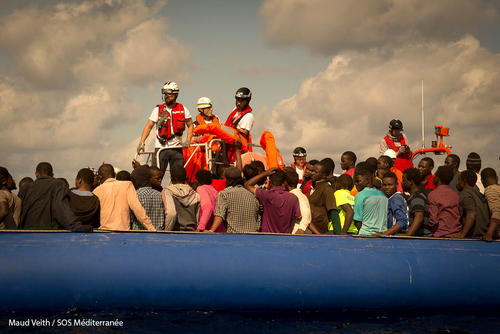
More than 500 people are now safely onboard Aquarius, a search and rescue vessel run by Médecins Sans Frontières (MSF) and SOS MEDITERRANEE, but an unknown number of people are missing presumed drowned after a gruelling day of rescues in the Mediterranean. Teams rendered assistance to three rubber boats in distress that were overloaded with men, women and children, 1 November 2017.
Mediterranean migration

Nearly 600 people rescued but unknown number missing presumed drowned

Five hundred and eighty-eight people are now safely onboard Aquarius, a search and rescue vessel run by Médecins Sans Frontières (MSF) and SOS Méditerranée , but an unknown number of people are missing, presumed drowned, after a gruelling day of rescues in the Mediterranean on 1 November. Project Update - 3 Nov 2017
Four mothers posing in a corridor of the Hospital in Bili. All four of them are staying in the hospital with their child, that's suffering from a severe case of malaria. Since the beginning of the project in 2016, the pediatric ward already treated more than 4.000 cases of complicated/severe form of malaria.
Médecins Sans Frontières (MSF)

Independent medical humanitarian assistance

We provide medical assistance to people affected by conflict, epidemics, disasters, or exclusion from healthcare. Our teams are made up of tens of thousands of health professionals, logistic and administrative staff - most of them hired locally. Our actions are guided by medical ethics and the principles of independence and impartiality. We are a non-profit, self-governed, member-based organisation.

Learn more