



Ebola disease in DRC: find out how we're responding
Learn more
8000 Results
 
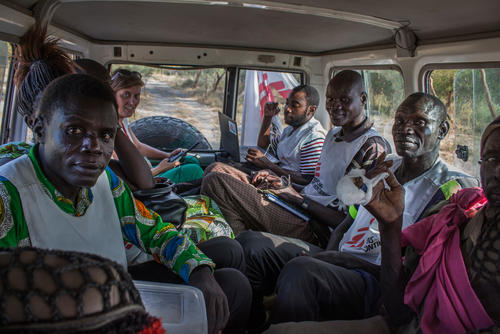
The team dispatched is made up of drivers, a logistical coordinator, a doctor, a nurse and a community health advisor.
South Sudan

Decentralised healthcare in Upper Nile State

In South Sudan’s north-east Upper Nile State, medical care for people living in remote areas is almost non-existent. Years of civil war and budget cuts have lead to chronic underfunding and a near collapse of pre-existing medical structures. Photo Story - 13 Feb 2018
 
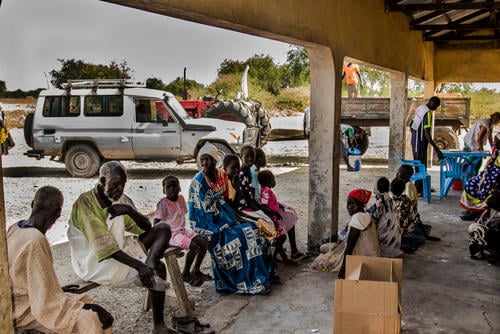
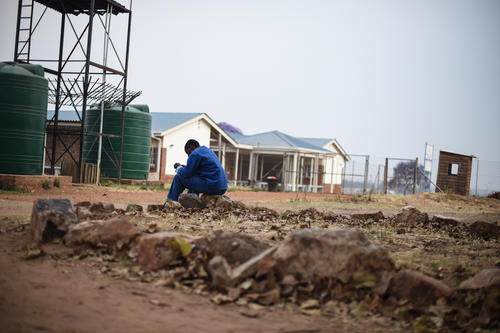
Those that arrive have a multitude of different problems, from broken fingers, to strokes, to diabetes. What is clear is that for most of them their conditions are somewhat neglected. For most the arrival of MSF is a lifeline. Despite the long wait everybody gets to see the a doctor or nurse
South Sudan

The stark choices facing displaced people in Aburoc

"This constant fleeing from one town to another has taken its toll on the community. While some are planning ahead, others are still mentally and physically exhausted by the ordeal of last year." Project Update - 13 Feb 2018
 
msf-placeholder
Syria

The situation in the northwest is quickly going from very bad to worse

"This is another step towards disaster in this troubled zone."  Voices from the Field - 9 Feb 2018
 
Simphiwe holds his medication, he takes up to 26 pills a day to treat XDR-TB. Here he holds his morning selection, which includes delamanid, one of the newest DR-TB drugs, which Simphiwe is taking for the first time today. 

Simphiwe Zwide, 43 years, lives in a one-bedroom house with his wife, Nomonde Tyala, and children in Kuyasa, Khayelitsha. Simphiwe was first diagnosed with MDR-TB in 2011. He completed six months of treatment, but when he learned that he had pre-XDR-TB and would need even more treatment, he lost heart and returned to work. 
In June 2016, he presented back to his Khayelistha clinic as he had fallen ill again. This time test results showed he had XDR-TB. He took his first delamanid tablets on 12 October, as part of a strengthened regimen for XDR-TB.
Simphiwe’s current regimen: Delamanid, bedaquiline, linezolid, levofloxacin, terizidone, clofazimine, ethionamide
Simphiwe Zwide:

“In 2011, my wife had TB and they admitted her into Jooste District Hospital. I visited her for over a week. When she came out of hospital, I fell sick. 
I couldn’t eat, my body was painful, my throat was sore – I thought I had a virus. My wife tried to cook – sour milk and maize meal. I couldn’t swallow. I had to drink many cups of water. I was sweating – I couldn’t walk even couple of metres. 
My wife was very supportive of me. She would leave me taxi money and go and stand in the hospital queue for me from 5am.
I started to feel my health returning and I felt like I could work again. I’m the breadwinner, and we were all suffering. I was the only one who could work for my family. I was taking clofazamine injections which meant that I had to attend the clinic every day and this was preventing me from finding a job.  
I was between Johannesburg and Cape Town looking for work between 2012 to the end of 2016. Then in January 2016, I started to get sick again. I couldn’t work like I’m used to.  I came back to Khayelitsha, now I’m here at Kuyasa clinic getting treated for XDR-TB. I’m joining a support group soon. 
I’m a jack of all trades - I learned to be a cleaner, I was piping donuts down at Monte Vista. I do construction, I bake cakes. My big brother taught me how to bake and my cousin is a confectioner. 

I’ve been on treatment (including linezolid and bedaquiline ) for  two months now. Sometimes I take 26 pills a day. 

When I take them, I have to sleep the whole day. But I’m feeling much better, I can’t say I’m 100% but this is only my third month. I know who I am, I’m strong and I want my health back.”
Tuberculosis

Drug-resistant TB: “Some of our patients simply can’t wait for clinical trials"

Drug-resistant tuberculosis (TB) remains a major threat to global health: Of the ten million people who fell ill with TB in 2016 alone, over half a million are estimated to have resistance to the most effective drugs used to treat TB, rifampicin and isoniazid. For those with highly resistant strains of TB, very few treatment options exist. Project Update - 9 Feb 2018
 
Cholera Vaccination at St Joseph Churh, one of the 15 sites of vaccination in Kanyama districts.
Zambia

Encouraging new results further demonstrate effectiveness of the single dose oral cholera vaccine

“While the availability of vaccines has improved in recent years, the number is still far from being sufficient to tackle the large-scale outbreaks we are currently seeing" Press Release - 9 Feb 2018
 
Patient sitting in the courtyard of the Harare Central hospital psychiatric unit.
Zimbabwe

Zimbabwe mental health project

In 2011, an MSF medical team was shocked by what they saw during a visit to the overcrowded Chikurubi Maximum Security Security Prison’s Psychiatric Unit on Harare’s outskirts. Here’s what happened next. Photo Story - 8 Feb 2018
 
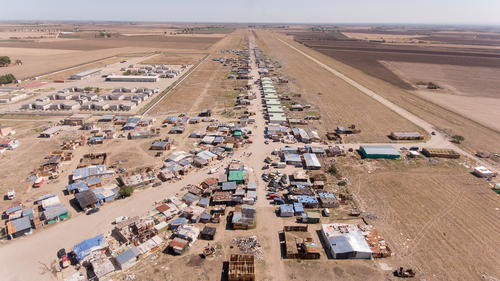
In Borgo Mezzanone, near Foggia, there is a governmental reception center with more than a 1,000 asylum seekers (on the left). Around the center, along an abandoned airport runway, a shantytown is growing: tens of containers and plastic, zinc and paper-made shacks. From 500 to 2,000 migrants and refugees are living in the informal settlements mostrly coming from Sub- Saharian Africa and Somalia: many of them are involved in the agricultural seasonal works, mostly in summer time.
Italy

Migrants and refugees on the margins of society

“Two years after it was first published, the ‘Out of Sight’ report is still a sad survey of vulnerability and marginalisation.” Report - 8 Feb 2018
 
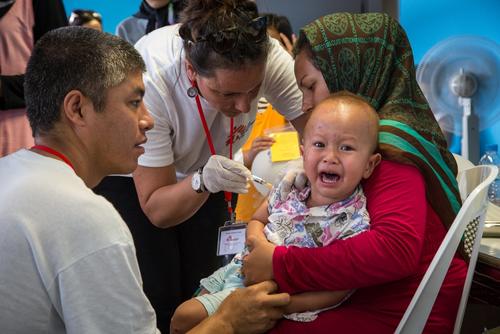
young child receiving vaccine.
Pneumonia

MSF challenges Pfizer’s monopoly on lifesaving pneumonia vaccine in South Korea

“In our work, we see many children with life-threatening respiratory infections; many deaths could be prevented if more kids were vaccinated with PCV.” Press Release - 6 Feb 2018
 
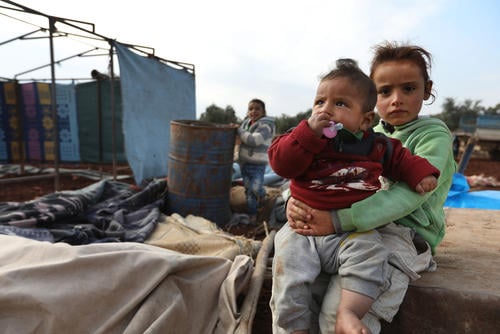
These Syrian children have just arrived at their new home, a makeshift tent that is not yet completed but will house their family indefinitely. Fleeing renewed fighting in northwest Syria, the children are wearing the only clothes they have. They have no access to clean water, drinking from a rusted barrel.

وصل هؤلاء الأطفال السوريون للتو إلى منزلهم الجديد، وهو عبارة عن خيمة مؤقتة لم تكتمل بعد، ولكنها ستؤوي عائلتهم إلى أجل غير مسمى. ومنذ نزوح عائلاتهم نتيجة تجدد القتال في شمال غرب سوريا ولا يزال هؤلاء الأطفال يرتدون قطع الملابس الوحيدة التي يمتلكونها. كما أنّهم لا يستطيعون الوصول إلى مصدر مياه نظيفة، ولذلك يشربون الماء من برميل صدئ.
Syria

Idlib’s population suffers the consequences of heavy fighting and airstrikes

Bit by bit, these families have lost everything; some only have their tears left. Voices from the Field - 5 Feb 2018
Four mothers posing in a corridor of the Hospital in Bili. All four of them are staying in the hospital with their child, that's suffering from a severe case of malaria. Since the beginning of the project in 2016, the pediatric ward already treated more than 4.000 cases of complicated/severe form of malaria.
Médecins Sans Frontières (MSF)

Independent medical humanitarian assistance

We provide medical assistance to people affected by conflict, epidemics, disasters, or exclusion from healthcare. Our teams are made up of tens of thousands of health professionals, logistic and administrative staff - most of them hired locally. Our actions are guided by medical ethics and the principles of independence and impartiality. We are a non-profit, self-governed, member-based organisation.

Learn more