



Ebola disease in DRC: find out how we're responding
Learn more
8000 Results
 
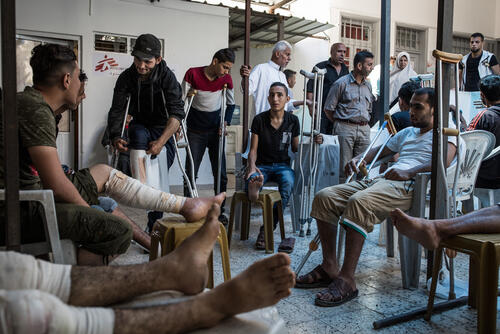
Gaza le 16 mai 2018, centre post opératoire de MSF. Chaque jour des blessés par balle de la grande marche du retour, viennent se faire changer les pansements.  Plus de 3600 blessés par balles sont à déplorer depuis le début de la grande marche du retour. Salle d'attente.

Gaza on May 16th, 2018, post-operating centers of MSF. Every day the wounded persons by bullet of the big walking of return, come to be made change bandages. More than 3600 wounded persons by bullets are to be regretted since the beginning of the big walking of return. Waiting room.
Palestine

Gaza’s numbing routine of injury and death

MSF’s field communications manager in Jerusalem, Jacob Burns, reflects on what it means when such a devastating toll of injuries comes to be considered a “good” day in Gaza. Voices from the Field - 4 Apr 2019
 
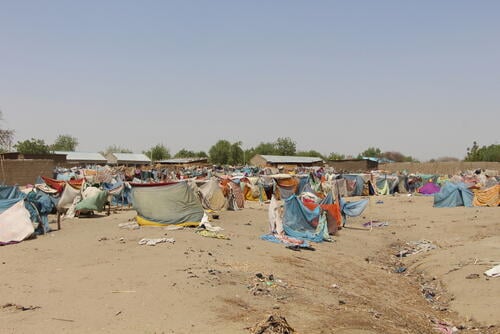
Eyewitnesses and local authorities from Nguigmi reported that two people carrying improvised explosive devices blew themselves up in two different locations of the town on in the evening of 26 March. At the same time, several gunmen allegedly set fire to makeshift shelters and tents in camps for internally displaced and refugees, who saw their homes and personal effects reduced to ashes. This was just the latest of a series of violent episodes in the region, as escalating volatility is intensifying people’s suffering and forcing many to flee. 

Following the attack, MSF stepped in to support the treatment of the wounded at Nguigmi hospital, evacuating the most severely injured to the regional hospital in the town of Diffa in three ambulances and another MSF vehicle. MSF teams have distributed essential relief items including mosquito nets, jerry cans, kitchen utensils, blankets and hygiene items to 380 families. Our psychologists offered immediate mental health support for children and adults, organising individual and group psychosocial sessions for nearly 400 people. They found that many were struggling with depression, insomnia and other symptoms linked to the traumatic experiences they had undergone.
Niger

Violence, humanitarian needs and fear mount in Diffa

In just four days, attacks across Diffa region in southeastern Niger has left at least 30 dead, dozens injured and more than 380 shelters burned or destroyed. The worsening conflict around Lake Chad is taking a heavy toll on people in the region. Project Update - 4 Apr 2019
 
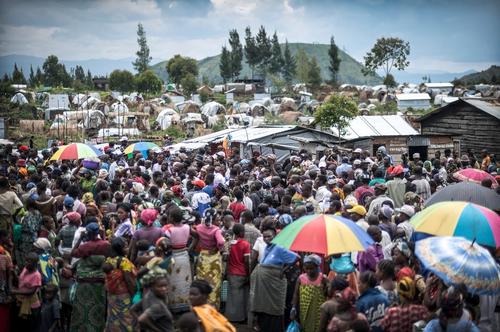
Displaced people at a health centre.  Mugunga 1 camp, Goma, North Kivu.
Democratic Republic of Congo

The daily struggle for survival in DRC

As the Democratic Republic of Congo (DRC) faces the largest Ebola outbreak ever recorded in the country, MSF operations manager Annemarie Loof highlights the recurring emergency health needs that go well beyond Ebola. Op-Ed - 4 Apr 2019
 
Over 30,000 people who were forced to flee to the town of Monguno following clashes that erupted in Nigeria’s Borno state in late December are in acute need of shelter, water, sanitation, food, protection, medical care and mental health support.
MSF is running a 10-bed emergency room for adults in a ministry of health facility in Monguno as well as providing people with mental health support. MSF teams have also set up 100 tents and are ready to put up 700 additional shelters.

People in Borno state are caught up in a cycle of violence, which has forced tens of thousands from their homes, fields and livelihoods, and left them struggling to survive with very little means.
Nigeria

Over 30,000 people in acute need in northern Borno state

Displaced people in Monguno, northern Borno State, Nigeria are living in poor conditions, with little sanitation, and a lack of safe drinking water and adequate shelter as the rainy season approaches. Press Release - 4 Apr 2019
 
Yemen, Aden, 16 December 2018 – Entrance of OT and ICU of MSF trauma hospital in Aden. The hospital opened in 2012.
Yemen

Medical admissions in Aden suspended after patient kidnapped and killed

MSF has suspended admissions to our hospital in Aden, Yemen, following deteriorating security in the city, including the kidnapping and killing of a patient. Press Release - 4 Apr 2019
 
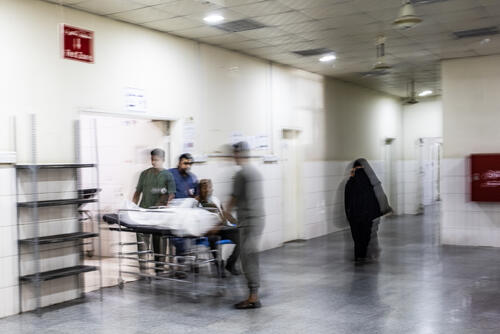
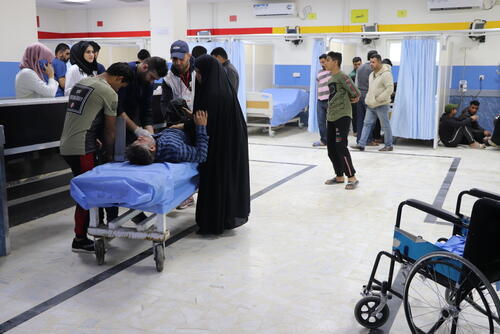
A new patient just arrived with his relatives to the ER of Imam Ali hospital, in Sadr City (Baghdad, Iraq). He is assisted by Iraqi doctors who are supported by MSF.
Iraq

Triaging patients in one of Baghdad's busiest emergency departments

South African doctor Sian Geraty describes the six months she spent in a busy hospital in Iraq's Sadr City, training local doctors and staff in implementing a triage system for an emergency room that sees 20,000 visits a month. Voices from the Field - 2 Apr 2019
 
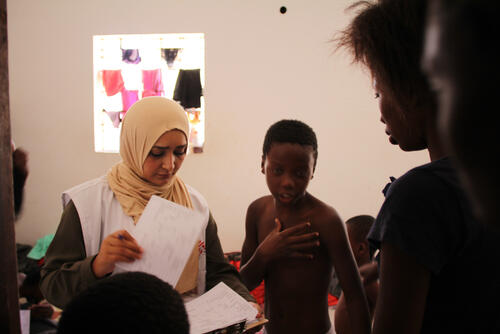
Women cells in the detention centre. MSF nurse is doing triage in order to identify patients who require a medical follow-up.

On September 2nd, 276 people were brought by the Libyan coast guard to Khoms (120 km east of Tripoli). They were then transferred to detention center where MSF works. Reportedly, they were in two rubber coats, one stopped due to engine failure, while the other boat continued to navigate for several hours before deflating and sinking. Survivors told MSF teams that over a hundred people died in the shipwreck.
Libya

Migrants in Libya: “We were able to make their time in that horrible place slightly better.”

Australian nurse Jai Defranciscis, describes the scenes in detention centres in Libya, where MSF provides care for migrants, refugees and asylum seekers facing arbitrary detention and extreme suffering. Voices from the Field - 2 Apr 2019
 
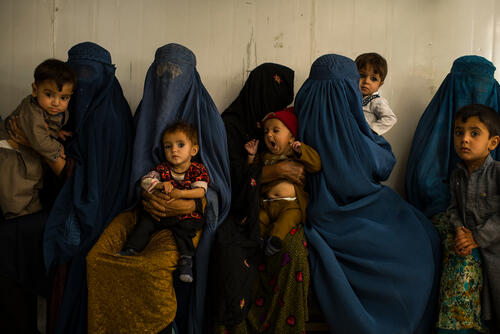
Mothers wait with their children outside the paediatric outpatient department of Ahmad Shah Baba Hospital in the area of the same name in Kabul's outer eastern suburbs.
Afghanistan

Ahmad Shah Baba project is handed over to the Ministry of Public Health

After working in Ahmad Shah Baba hospital, eastern Kabul, since 2009, MSF has handed over the last of our activities in the hospital to the Ministry of Public Health in Afghanistan. Project Update - 31 Mar 2019
 
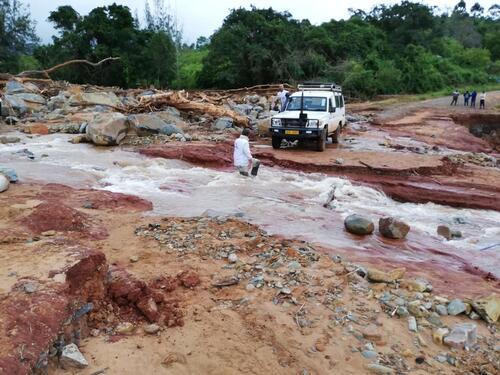
MSF logistics coordinator, Guillaume Malin makes an assessment to check if the MSF vehicle can pass through the river. MSF teams are conducting outreach programs to reach inaccessible areas in Chimanimani, eastern Chimanimani to provide medical supplies for survivors of cyclone Idai.
Cyclone Idai & Southern Africa flooding

The first six days after Cyclone Idai in Zimbabwe

Medical team leader Marthe Frieden went from working on her 'quiet' MSF project in Zimbabwe's Manicaland province, to the emergency of Cyclone Idai. Here she recounts the first six days of the response. Voices from the Field - 29 Mar 2019
 
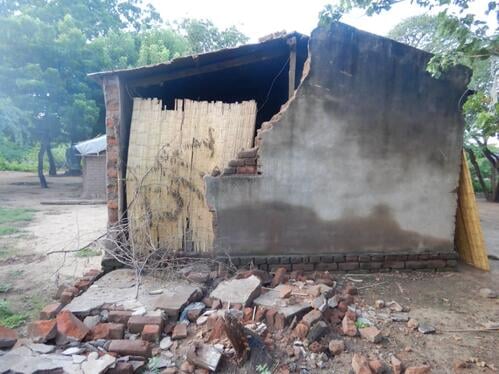
In Makhanga district, a huge number of houses have collapsed. Many thousands remain in displacement camps and makeshifts sites such as schools and churches. Big reconstruction efforts will be required in coming weeks.

Following heavy rains that affected the southern region of Malawi, an MSF team of 18 people is supporting the health ministry to cover the needs of an estimated 18,000 people in Makhanga on the eastern bank of the Shire river, with health, sanitation, NFI needs.
Cyclone Idai & Southern Africa flooding

Malawi: “This time, the flooding has destroyed houses, not lives”

Parts of Malawi have been submerged by floods from rains that later turned into Cyclone Idai. MSF logistician Labana Steven is part of the emergency response and explains the difference between these floods and those of previous years. Voices from the Field - 29 Mar 2019
Four mothers posing in a corridor of the Hospital in Bili. All four of them are staying in the hospital with their child, that's suffering from a severe case of malaria. Since the beginning of the project in 2016, the pediatric ward already treated more than 4.000 cases of complicated/severe form of malaria.
Médecins Sans Frontières (MSF)

Independent medical humanitarian assistance

We provide medical assistance to people affected by conflict, epidemics, disasters, or exclusion from healthcare. Our teams are made up of tens of thousands of health professionals, logistic and administrative staff - most of them hired locally. Our actions are guided by medical ethics and the principles of independence and impartiality. We are a non-profit, self-governed, member-based organisation.

Learn more