



Ebola disease in DRC: find out how we're responding
Learn more
8006 Results
 
Over 18 Schools have been opened up so far in Hasakeh city to provide for the steady influx of IDPs  fleeing the frontline conflict between Turkish and the Syrian Democratic Forces. Each school houses from 150 to 270 people but lack water and hygienic facilities. The Syrian Humanitarian Coordinating Office expect 30,000 refugees to come to the city in the next coming days and to be-housed in these schools. They are beginning to set up for at least a hundred schools. Most of these refugees have no documentation or identification cards due to the conflict that has been raging over the last eight years. Local humanitarian organizations have highlighted the dire need of water supply as a major need.
Syria

Northeast Syria: Turkish military operation results in displacement and hospital closure

Shelling by Turkish military has displaced many people from villages and towns along Syria's northeast border. A hospital has closed. Press Release - 11 Oct 2019
 
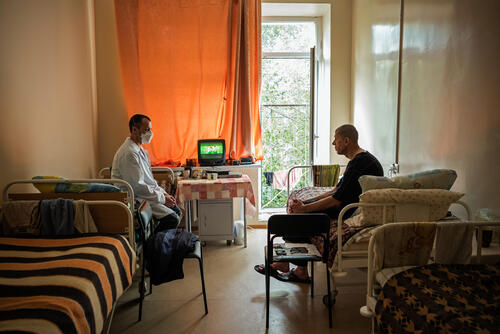
Dmitry, a patient at the TB Institute in Minsk, Belarus, visiting Andrey an MSF counsellor.  Andrey (counsellor): "During the seven months that we’ve known each other you were not an easy one. You were tough and thorny. But now it’s changed. It’s interesting with you." Andrey visits him almost every day and spends time with him, talking about different topics. 

Andrey (when Dmitry has left): “He doesn’t like it when somebody says nice things about him. They are used to living in tension, they are not used to such an attitude”. TB Institute, Minsk, Belarus, August 2018. Dmitry has been in this Institute for 7 months. Before this, he was in another hospital for 2 years.
Belarus

TB patients improve treatment adherence with psychological and social support

TB patients in Belarus have been shown to adhere - or stick to - their treatment better when they receive specialised psychological and social support. Project Update - 10 Oct 2019
 
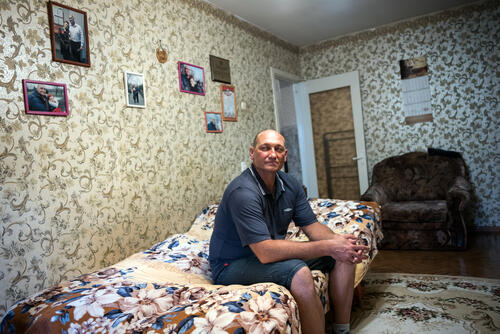
Portrait of Oleg in his living room which is also the bedroom he shares with his partner Alyona, whom he met while undergoing treatment for TB. "I was on treatment for TB, and I was not getting better. In July 2016 I was feeling worse. I would take a job but I wouldn’t be able to work for more than 2 hours. When people would give me a hand for a handshake I wouldn’t shake hands because it was painful as if my hand was breaking. 
My condition was deteriorating. In August they did an x-ray and the spot (in the lung) was growing. 
I was tired. I’d been through many things in my life – surgeries, an oncological condition, but I’d never experienced anything like it. I was told I should approach MSF, Doctors Without Borders, and that they could help. I approached them and they helped me. I felt sunshine inside me. So the decision had been approved to support my treatment. I’m very grateful to MSF because they offered me a helping hand. 
In April 2017 I was transferred to outpatient treatment here, in the TB Dispensary 2. On new treatment, with the new drugs I felt more or less ok in a month. I had an appetite again. MSF staff would call me and visit me, we would talk, joke together and I felt better. All this support has a very good impact. So I was transferred here, I was taking these drugs, and I started gaining weight. 
My mother was supporting me during the treatment. I was single then." Oleg says, in Minsk, Belarus, in August 2018.
Tuberculosis

TB drug delamanid must be more affordable and made available in more countries

Drug manufacturer Mylan will introduce a lower price for newer TB drug delamanid in South Africa - but it is still too expensive for those who need it and must be made available at a lower price in other countries Statement - 10 Oct 2019
 
Palestine: The invisible mental health crisis plaguing the West Bank
Palestine

The invisible mental health crisis plaguing the West Bank

Much-needed mental health consultations are among the services Médecins Sans Frontières (MSF) offers civilians in Hebron, in the occupied West Bank of Palestine since 1996. Project Update - 10 Oct 2019
 
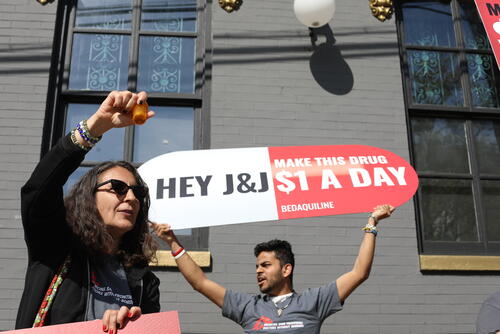
 MSF's Access Campaign and MSF-USA held a demonstration across form the J&J shareholders' meeting on April 25, 2019, in New Brunswick, New Jersey. The message was for J7J to bring down the price of newer TB drug bedaquiline to $1 per day.
Access to medicines

MSF demands Johnson & Johnson reduce price of lifesaving TB drug

Despite benefiting from contributions, including tax payer funds, to develop tuberculosis drug bedaquiline, Johnson and Johnson are making huge profits - while people die. We demand that J&J halve the price of bedaquiline. Press Release - 10 Oct 2019
 
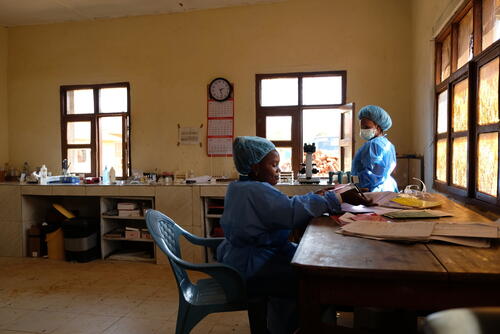
The laboratory at the Malabako General Hospital, where MSF helped refurbish the infrastructure. The hospital is suffering from a severe staff shortage
Democratic Republic of Congo

Ebola response overshadows already fragile health system

The Ebola response in the Democratic Republic of Congo is draining medical staff and resources from the regular - and already fragile - health system. Project Update - 9 Oct 2019
 
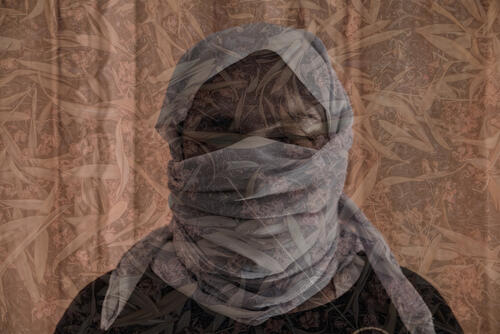
A Yezidi woman aged 60 poses in her house in Sinuni on September 2nd, 2019. 
« We are from Khanasor village but we’ve been living in Sinuni since March 2019, when we came back from the IDP camps. After the 2014 genocide, I started to have mental health problems. I feel nervous, scared, uncomfortable and angry. I have a constant headache. I have pain in my eyes because I cry a lot. I am always thinking about the memories from the genocide, those who died, those who emigrated. Some of my sons live abroad now, and it’s difficult to be apart ». 
(Merged image: top view of the burned ground in a ghost town north of Mount Sinjar, on which dead flowers have fallen)
©Emilienne Malfatto
Mental health

The Yazidi - a community without hope

The genocide of the Yazidi people - a religious minority based in northern Iraq, near the border with Syria - by Islamic State group in 2014 traumatised the remaining community. Today MSF teams are providing medical care, but especially mental healthcare, to help people heal. msf.exposure.co - 9 Oct 2019
 
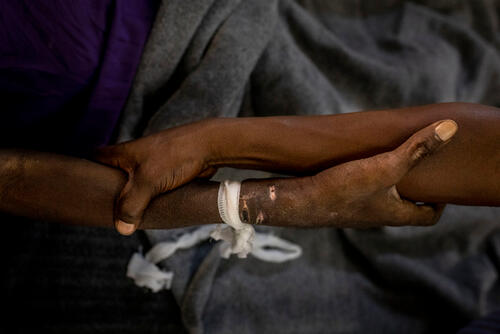
John * and Jean * hold each other’s arms in the CHK. Jean was diagnosed with HIV in 2010. He was hospitalized in June 2019 for the first time. A few weeks after his release, he had to return urgently for a new hospitalization.
HIV/AIDS

Burden sharing or burden shifting? How the HIV/TB response is being derailed

The report <i>Burden sharing or burden shifting? How the HIV/TB response is being derailed</i> examines the HIV and TB response in nine countries where MSF runs programmes. With a focus on the financial resources available, this report highlights the current risks and gaps in HIV and TB service delivery in these countries. Report - 7 Oct 2019
 
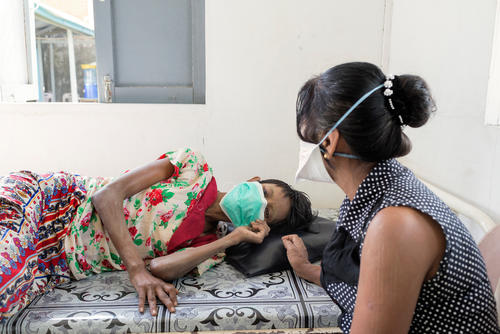
Tin Lay, 42, from Myanmar is in the preparation stage for TB treatment at MSF's Insein clinic, Yangon, Myanmar, Feb. 22, 2018.
HIV/AIDS

Urgent boost and reality check needed for HIV and TB funding

An MSF report looking at the funding shortfall for HIV and TB and resulting affects on patients in nine countries highlights the dangers for a potential reversal in the HIV and TB response if donor countries don't increase funding. Press Release - 6 Oct 2019
 
A Yezidi man aged 24 poses in his tent on Mount Sinjar on September 3rd, 2019. 
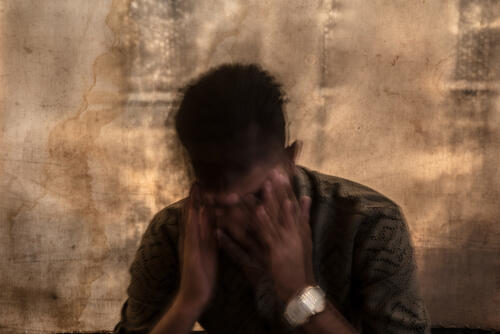
« We are from the South of the mountain, close to Sinjar City. After the genocide, we stayed for one year in an IDP camp in Kurdistan, then we came here, to the mountain. I live in this tent with my family, my parents, my wife, my brother, my nephews… It is very, very difficult to live here. The living conditions are very hard. It’s either too hot or too cold. The latrines are shared and disgusting. There is no work here. I work with an armed group and make 300 USD a month. 
I am never happy. I am always upset. I cannot hang out with my friends because I can’t pretend to be happy. Depression is very hard. I feel like I am melting - and indeed I have lost a lot of weight. I affects my whole body. I also forget a lot of things. 
I keep thinking about things I saw, or heard, about the genocide. Children who died. Children who were killed by ISIS and then ISIS cooked them and gave the ‘meat’ to their mothers. 
I tried to kill myself three times: by drowning, with a gun, and with a knife. Each time, I was stopped. Since then, my family is worried about me, and I feel guilty because of that. It just makes things worse. 
I don’t want to take medication because it has too much side effects. I would like a magic pill to make all of what happened disappear, and make things good again. 
In those living conditions, it’s not easy to get better. Every single night I cry myself to sleep. Nothing makes me happy in life. There is no happiness in this life. If I am alive or dead, it’s the same thing. »
©Emilienne Malfatto
Iraq

MSF warns of mental health crisis among Yazidis in Iraq

A mental health crisis, including multiple suicides, is occurring in Iraq among the Yazidi community in Sinjar. IS atrocities took place here in 2014. Press Release - 4 Oct 2019
Four mothers posing in a corridor of the Hospital in Bili. All four of them are staying in the hospital with their child, that's suffering from a severe case of malaria. Since the beginning of the project in 2016, the pediatric ward already treated more than 4.000 cases of complicated/severe form of malaria.
Médecins Sans Frontières (MSF)

Independent medical humanitarian assistance

We provide medical assistance to people affected by conflict, epidemics, disasters, or exclusion from healthcare. Our teams are made up of tens of thousands of health professionals, logistic and administrative staff - most of them hired locally. Our actions are guided by medical ethics and the principles of independence and impartiality. We are a non-profit, self-governed, member-based organisation.

Learn more