


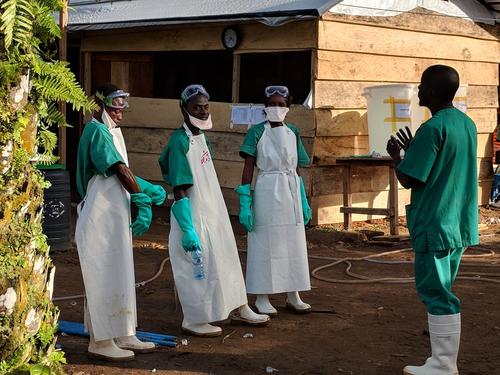

Ebola disease in DRC: find out how we're responding
Learn more
4633 Results
 
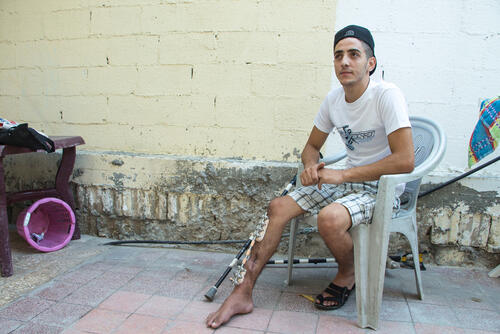
Twenty-two year-old Eyad was shot in the leg during the ‘Great March of Return’ demonstrations in Gaza on the 14th May – one of the deadliest days witnessed by MSF teams in the six months of protests. He needs a bone graft and limb reconstructive surgery which is not currently possible inside the Gaza strip.  Eyad’s case has been accepted for treatment at the MSF’s specialist surgical hospital in Amman, Jordan – but for people living in Gaza, requesting the authorisation to leave from the Israeli authorities is a lengthy, difficult process which often ends with a refusal.

“I still remember vividly the day I was shot: the bullet entered my leg like an injection and then I felt a hot sensation on my other leg. I looked down and saw lots of blood, and I realised I had been wounded. I was in so much pain.

After the bullet entered my leg I started to shake, and it felt like I had electricity coursing through my body.  At first, I was stunned by what I saw. I thought I was going to lose my leg and become an amputee. 

I was shot on the 14 May 2018. Like a lot of Palestinians I was shot in the leg. It just goes to show how barbaric the Israeli army was towards us that day. 

I went to the demonstrations because I love my country and I am trying to defend it. I wanted to show everyone that we have the right to our lands and the right to have our homes back. The demonstration was peaceful. Then the Israeli army started shooting. I knew it was going to be dangerous, so I went alone. I didn’t want to see any of my friends injured or killed. I wanted to free our land, our home, our sacred places. Israel can take all they want; I just want them to give us back our land. 
My mother tried to convince me not to go and begged me to stay at home. She called my grandparents to try and persuade me. But they could not stop me. I had made up my mind. 
Ever since I was shot I’ve had trouble sleeping. When I sleep, it feels like knives are moving inside my leg and electricity is coursing through my body. I don’t move around a lot, I don’t go out; only if I have to. I prefer not to move around a lot because it is just so painful.

My parents and siblings are caring for me – they take good care of me. They bring me whatever I need.

“All I hope is to be able to walk normally again”
 
I go to MSF’s clinic in Gaza three times a week for dressing changes and to have physiotherapy. My condition started to improve after the first debridement operation, which cleaned the gunshot wound and took out the infected blood. I have had about six operations, including the debridement of the wound, attaching the external fixator to stabilise the bone, and a skin graft where they took skin from my thigh to cover the gunshot wound.

The next stages of my treatment must be done in Jordan, at the MSF reconstructive surgical hospital in Amman. They plan to use a bone graft to fix the shattered bone, and a plastic surgeon will then reconstruct my damaged leg. When I heard they wanted to send me to Jordan I was full of fear because I thought the Israeli army wouldn’t let me leave Gaza. I thought I’d have to have an amputation. But once I heard that the Amman hospital had accepted me, I started to feel hopeful again. I started to see that things might be ok. Now I am just waiting to see if I am permitted to leave Gaza.

“I have lost everything”
 
I left school at high school and I don’t have a job. Actually, this is one of the main reasons I went to the border to demonstrate, because I don’t have job and I don’t have anything to do. I wish I could work. 

But there is no work in Gaza. I am a musician, it’s not a profitable job, but I love to play instruments like the flute and drums.

Have I returned to the protests? That is an embarrassing question... no, I haven’t. After experiencing this amount of pain and losing so much of my life from what happened, I don’t want to go back.

I have lost friends, I have lost the ability to go out or move around as I wish. I find it difficult to play my instruments. I have lost everything.
My only hope is to return to how I used to be.
But I know that won’t happen... I can’t swim or play football anymore. I was a really good footballer. I’m not able to run the way I used to. I just hope that, with further surgery, I will be able to walk normally again, without any pain. That’s all I hope.

“It is overwhelming to see your friends die.” 
 
My friends still go to the demonstrations; some of them have also been wounded. One of my friends also got shot and now has almost exactly the same injury as me. Another friend who helped me when I was injured has been killed. He was at a demonstration helping another wounded person when he died.
I am trying to convince other people not to go to the demonstrations. I don’t want them to experience the pain I have. The negatives of protesting outweigh the positives. Going there is so dangerous: people may lose their hopes and futures. They need to stay away: the Israeli army is really violent.

As Palestinians, we want these protests to be peaceful. But Israel sees this as a violation of their freedom. All we want is to return to our lands. We protest to show everyone that we are Arab, that we are all together in this, and that we support each other. That’s why we go to the demonstrations.
Palestine

“When I sleep, it feels like knives moving through my leg”

Eyad, 22, describes how he was shot in the leg during the ‘Great March of Return’ demonstrations in Gaza on 14 May, his treatment since and his hopes for the future. Voices from the Field - 2 Oct 2018
 
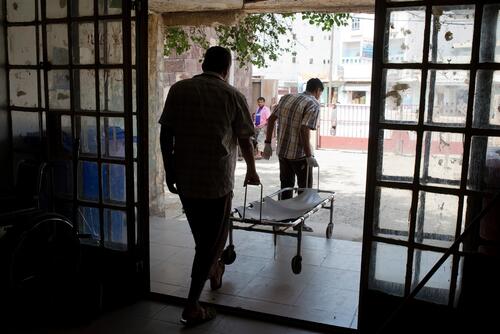
Two Yemeni men carry a stretcher out of Al Salam Hospital to go pick up a patient on July 22, 2015 in Qataba, Yemen.
Yemen

MSF suspends activities after attack in Ad Dhale

MSF strongly condemns attacks against its staff and asks for protection for humanitarian workers and patients. Statement - 2 Oct 2018
 
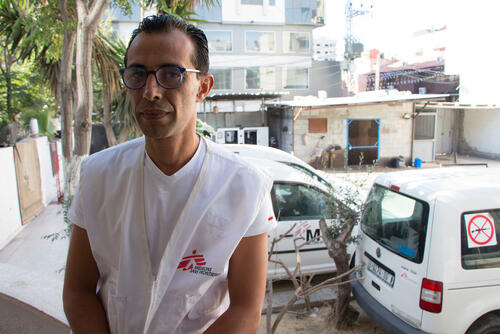
Dr Mohammed Abu Mughaiseeb, MSF medical referent in Gaza
Palestine

“Nothing can prepare you for this”

Dr Mohammed Abu Mughaiseeb, MSF medical referent in Gaza, describes the shocking volume of wounded arriving from the fence over the last six months and their bleak long-term prospects. Voices from the Field - 2 Oct 2018
 
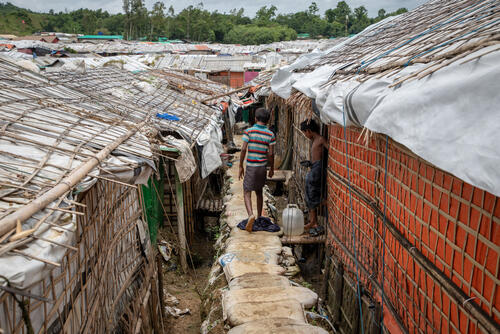
A child walks on an elevated foot path reinforced by sandbags in the Unchiprang camp in Cox’s Bazar, Bangladesh.
Rohingya refugee crisis

Crisis update – September 2018

September 2018 update on activities in Cox's Bazar district, Bangladesh, providing care for Rohingya refugees who have fled Myanmar. Crisis Update - 1 Oct 2018
 
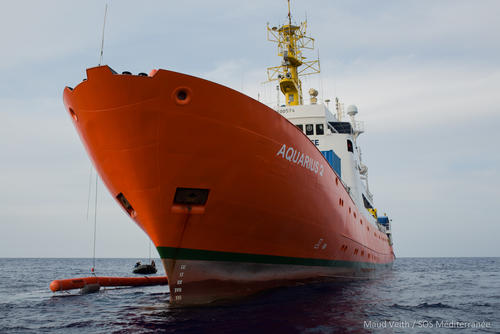
Central Mediterranean – 23 September, 2018 – Over the past 72 hours, Aquarius assisted two boats in distress and now has more than 60 survivors on board, several of whom are psychologically distressed and fatigued from their journeys at sea and experiences in Libya. 
SOS Mediterrannee and MSF are reeling from the announcement by the Panama Maritime Authority it has been forced to revoke the registration of the Aquarius under blatant economic and political pressure from the Italian government.
“Five years after the Lampedusa tragedy, when European leaders said ‘never again’ and Italy launched its first large scale search and rescue operation, people are still risking their lives to escape from Libya . News from the Panama Maritime Authority arrived to the Aquarius while its teams were engaged in an active search and rescue operation in the Central Mediterranean.
Mediterranean migration

Italian government pressures Panama to stop Aquarius rescues on world's deadliest maritime route

SOS MEDITERRANEE and MSF demand that European governments allow the Aquarius to continue its rescue mission. Press Release - 23 Sep 2018
 
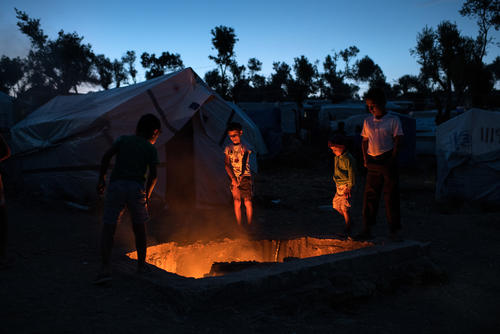
Thousands of people seeking safety after fleeing countries such as Syria, Afghanistan, Iraq, Sudan, and Congo continue to risk their lives to reach Europe. Those who try to arrive via Turkey and the Aegean Sea have been trapped for an indefinite period of time on islands in Greece as part of the EU/Turkey deal and its deterrence and containment approach. 
In Moria refugee camp, on Lesbos island, there are currently more than 7,500 people in a camp made for a maximum of 2,500. With the camp so full, refugees are now staying in an informal extension of the camp known as Olive Grove. The awful conditions at Moria camp/Olive Grove and arbitrary administrative situations have had a dramatic impact on their health and in particular their mental health. 
Médecins Sans Frontières teams provide medical and mental health support outside Moria camp and run a clinic for severe mental health cases in Mytilene, the capital of the island.
Greece

“It is difficult to believe this is Europe”

http://blogs.msf.org - 21 Sep 2018
 
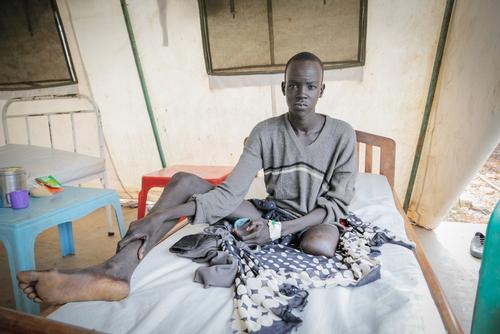
Banywich Bone, 18 ans, was reffered to Agok From Mayom, where MSF runs a primary health center. He was bitten by a snake three years ago, while he was sleeping at home. When he arrived in the hospital, he presented an infected wound for which doctors blame the snake bite. His left leg had necrotic tissus and pain, the wound was infected and MSF surgeon had to amputate the leg above the knee.
Snakebite

Time to strike back at snakebite and end the antivenom access crisis

Every year, an estimated 2.7 million people are bitten by venomous snakes, resulting in death for more than 100,000 people. Although effective treatment exists for snakebite envenoming, the vast majority of people aren’t able to access it. Report - 19 Sep 2018
 
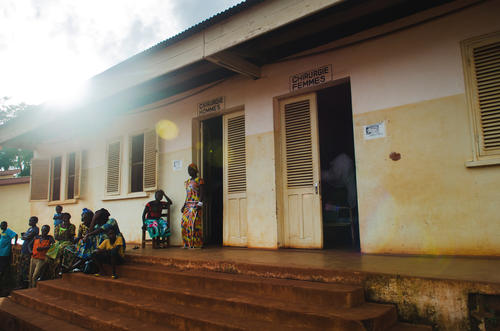
Bangassou – 8.8.2017

Surgery ward of Bangassou hospital.
Central African Republic

“We simply can’t let these people down. But we remain vigilant”: MSF returns to Bangassou

In 2017 a series of security incidents forced MSF to evacuate our team from Bangassou, CAR, and suspend activities in the area. In April 2018, our team returned to the city. Interview - 18 Sep 2018
 
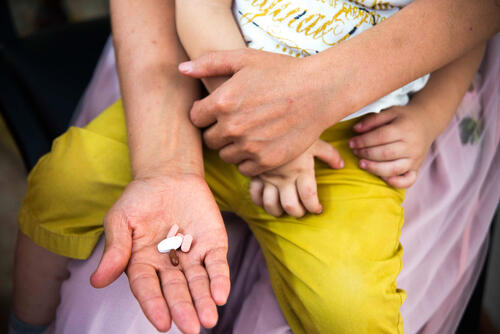
Chechnya, Russian Federation. T., 31, a mother of two, is an XDR TB patient. She doesn’t tolerate the treatment well, but is committed to complete it for the sake of her 5 year old daughter and 2 year old son. ‘When I heard the treatment was two years - I thought then: two years, no, I cannot stand it. And now just seven months left, time passes. I just know that I have to take the medicines, so I do it. I do not tolerate them well. When I was hospitalised my boy was three months old. Then I found out how many people are ill with TB, and I learned how good these people in the hospital were. At first it was difficult, then my strength started to come back. We all had a common misfortune there, and everyone understood each other well’.
Tuberculosis

Open Letter to J&J: Calling for affordable access to critical TB drug bedaquiline

MSF sent an open letter to Johnson & Johnson urging the pharmaceutical corporation to take action so that countries can access an affordable and sustainable supply of the critical drug bedaquiline, used to treat multidrug-resistant tuberculosis (MDR-TB). msfaccess.org - 17 Sep 2018
 
Formation des hygienistes.
DRC Ebola outbreaks

With a new Ebola outbreak, we knew we had to act fast

An experienced nurse, Patient Muhindo Kamavu was one of four MSF nurses who were the first on the ground, alongside the Ministry of Health, to respond to the Ebola outbreak declared on 1 August in Mangina, North Kivu, Democratic Republic of Congo. Voices from the Field - 13 Sep 2018
Four mothers posing in a corridor of the Hospital in Bili. All four of them are staying in the hospital with their child, that's suffering from a severe case of malaria. Since the beginning of the project in 2016, the pediatric ward already treated more than 4.000 cases of complicated/severe form of malaria.
Médecins Sans Frontières (MSF)

Independent medical humanitarian assistance

We provide medical assistance to people affected by conflict, epidemics, disasters, or exclusion from healthcare. Our teams are made up of tens of thousands of health professionals, logistic and administrative staff - most of them hired locally. Our actions are guided by medical ethics and the principles of independence and impartiality. We are a non-profit, self-governed, member-based organisation.

Learn more