


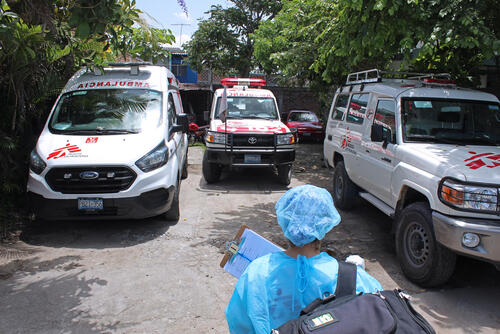
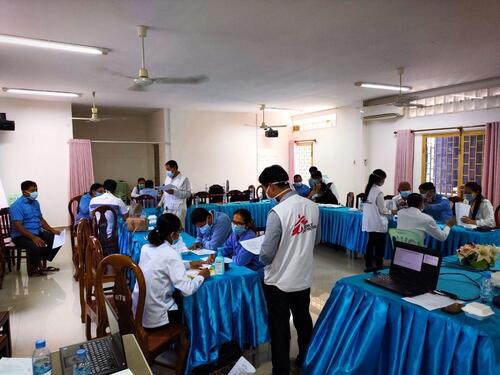

Ebola disease in DRC: find out how we're responding
Learn more
214 Results
 
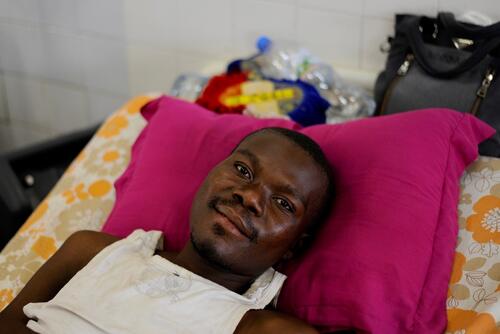
(EN) Benjamin was admitted to the advanced HIV unit of the Centre Hospitalier Universitaire Communautaire (CHUC) in Bangui. He just received a visit from the doctors who are responsible for his care. He has been admitted to the hospital following complications linked to an opportunist infection.

(FR) Benjamin, patient admis à l'unité VIH avancé du Centre Hospitalier Universitaire Communautaire (CHUC) de Bangui, vient d’avoir la visite des médecins qui assurent le suivi de sa prise en charge. Il a été admis suite à des complications liées à une maladie opportuniste.
HIV/AIDS

HIV is in a state of silent crisis in Central African Republic

While CAR has the highest HIV prevalence in West and Central Africa, access to information, early detection, treatment and care remains extremely scarce for people. Project Update - 30 Nov 2020
 
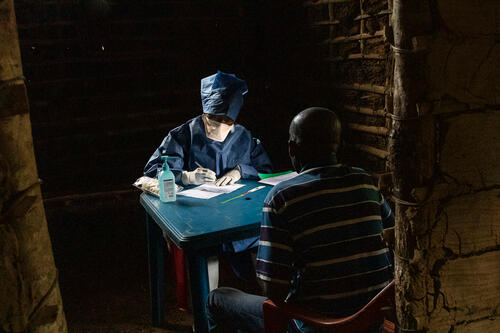
Dr Tathy, an MSF doctor, sees patients considered as non-Ebola suspects in consultation, as part of the mobile intervention clinic and training of local medical staff in the Ebola context, in the village of Bobua. This decentralization-based device aims to detect and isolate, if necessary, any person presenting symptoms close to Ebola (fevers, diarrhea, headaches, bleeding, etc.). But at the same time to treat other pathologies which are rife in the area, such as malaria or severe acute malnutrition. This is in order to increase the acceptance of MSF by the population in the area, and to avoid the stigmatization that affects Ebola patients, by getting as close as possible to the patients, and taking care of them where they live. Bobua.

***

Dr Tathy, médecin MSF, reçoit en consultation des patients considérés comme non suspects Ebola, dans le cadre des activités de clinique d'intervention mobile et de formation du personnel médical local en contexte Ebola, dans le village de Bobua. Ce dispositif axé sur la décentralisation, a pour but de déceler, et isoler le cas échéant, toute personne présentant des symptômes proches d'Ebola (fièvres, diarhhées, céphalées, saignements...). Mais de soigner en même temps d'autres pathologies qui sévissent dans la zone, telles que le paludisme ou la malnutrition aïgue sévère. Ceci afin d'augmenter l'acceptance de MSF par la population dans la zone, et d'éviter la stigmatisation qui affecte les patients Ebola, en se rapprochant au plus près des patients, et en les prenant en charge sur leur lieu de vie. Bobua.
DRC Ebola outbreaks

Improved medical response sees the end of DRC’s eleventh Ebola outbreak

Almost six months since the eleventh outbreak of Ebola was declared in DRC, new tools and an improved medical response have seen the epidemic come to an end. Project Update - 19 Nov 2020
 
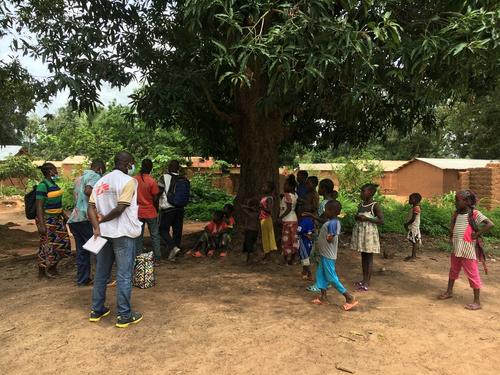
An MSF team informs the population of Batangafo about the upcoming mass drug administration (MDA) to prevent malaria.
Central African Republic

In times of COVID-19, malaria remains the number one killer of children in CAR

While COVID-19 makes the headlines, malaria remains one of the biggest causes of death in the Central African Republic; it is the biggest killer of children under five. MSF teams are providing preventive medication to people in Batangafo, in the country's northwest. Project Update - 15 Sep 2020
 
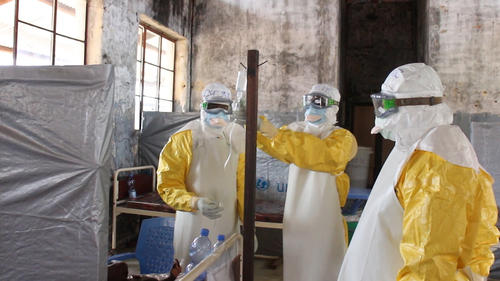
Medical staff inside the MSF-supported Bolomba Ebola treatment center.
DRC Ebola outbreaks

Responding to new Ebola outbreak in Équateur province

Since the declaration of a new outbreak of Ebola in DRC, the country's eleventh, in Equateur province, MSF teams are responding in the most remote, affected health areas. Project Update - 4 Sep 2020
 
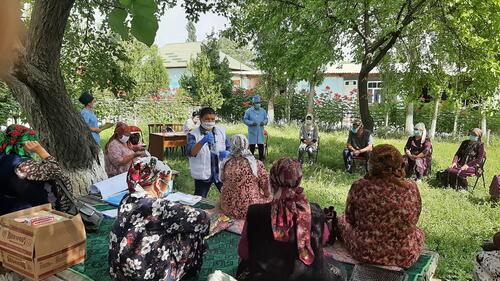
MSF staff organise a COVID-19 health information session in Aydarken
Kyrgyzstan

In remote Kyrgyzstan, COVID-19 puts a strain on the health system

MSF teams in Kyrgyzstan are bracing for further cases of COVID-19, especially in remote areas of the country, where resources and staff were already stretched. Project Update - 22 Jul 2020
 
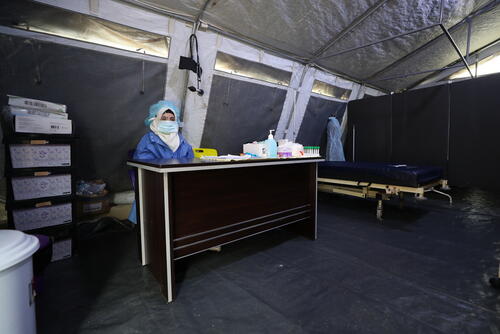
A medic waits for patients in a dedicated space set-up to identify potential COVID-19 symptomatic patients, to place them in observation if needed and call an ambulance for them to be tested, at a hospital supported by MSF in Northwest Syria.
Syria

COVID-19 provokes fears over further health system decline in northwestern Syria

With the first people diagnosed with the new coronavirus in northwestern Syria in early July, MSF is concerned over the impact the COVID-19 pandemic will have on the already-depleted healthcare system in the region. Project Update - 21 Jul 2020
 
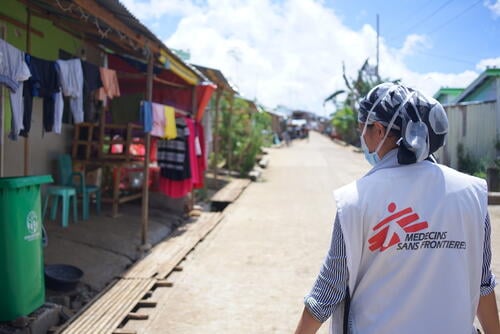
COVID-19 response in Marawi
Philippines

Displaced communities in Marawi living with COVID-19 and ongoing uncertainty

Around 120,000 people in Marawi, in the south of the Philippines, are still displaced following a siege by IS-related groups in 2017. The community lockdown in the Philippines caused by COVID-19 has complicated lives further. Project Update - 17 Jul 2020
 
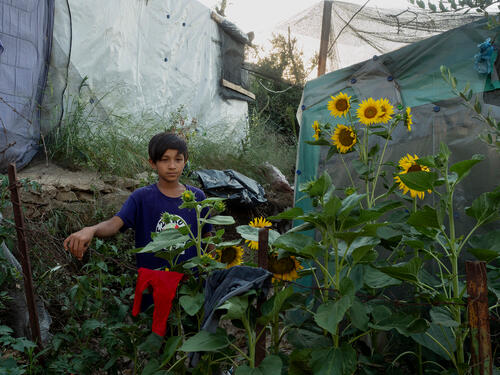
Yasin is a 9-year-old boy from Afghanistan, who visits the MSF pediatric clinic once a week with his father Mohtar, to consult with a child psychologist.
He suffers from nightmares and is constantly afraid that something bad will happen to him in Moria. When he grows up, he wants “to help children like his psychologist” in the MSF pediatric clinic that is located right across from Moria. Yasin lives in a makeshift shelter in the olive grove, with his 3-year-old brother and their parents.
Greece

Greek government must end lockdown for locked up people on Greek islands

The Greek government is using the coronavirus pandemic as a weak, discriminatory excuse to keep asylum seekers and migrants trapped on the islands in an extended lockdown. Project Update - 16 Jul 2020
 
"Emergency care has collapsed. We are witnessing hospitals can no longer receive patients who deserve emergency care” – Luis Romero, Field coordinator of MSF El Salvador.
El Salvador

People are dying at home amid collapsing health system in El Salvador

With the health system in El Salvador overwhelmed and close to collapse due to the coronavirus pandemic, MSF teams are seeing increased numbers of people dying at home, often of non-COVID-19 illnesses, or while waiting for ambulances to transport them to care. Project Update - 9 Jul 2020
 
Nurses of the Ministry of Health receive training in Sangker operational district, ahead of the relaunch of the hepatitis C nursing activity pilot, where nurses will lead the care of hepatitis C patients.
In addition to skills related to hepatitis C, new measures around infection prevention control regarding COVID-19 are taught.

Until the end of June 2020, just 141 cases were confirmed in Cambodia, and a quarter of them originates from a European tourist group in March. The authorities were quick to implement thorough contact tracing and asked our teams to help with this. We’ve also contributed to the new IPC and clinical guidelines for Cambodia and developed training units. Subsequently, about 300 staff members of hospitals run by the Ministry of health received training. Given the difficulty of importing medical equipment, the team is now trying innovative approaches to develop oxygen ventilation systems by using commercially available diving masks and 3D-printing the necessary connectors in the country in anticipation of an outbreak of COVID-19 in Cambodia.
Cambodia

Innovation needed to respond to COVID-19 in Cambodia

So far, 141 cases of COVID-19 have been confirmed in Cambodia. With the outbreak of the new coronavirus, MSF teams had to quickly halt regular hepatitis C activities to prevent patients from being infected with the virus during visits to the clinic. Project Update - 7 Jul 2020
Four mothers posing in a corridor of the Hospital in Bili. All four of them are staying in the hospital with their child, that's suffering from a severe case of malaria. Since the beginning of the project in 2016, the pediatric ward already treated more than 4.000 cases of complicated/severe form of malaria.
Médecins Sans Frontières (MSF)

Independent medical humanitarian assistance

We provide medical assistance to people affected by conflict, epidemics, disasters, or exclusion from healthcare. Our teams are made up of tens of thousands of health professionals, logistic and administrative staff - most of them hired locally. Our actions are guided by medical ethics and the principles of independence and impartiality. We are a non-profit, self-governed, member-based organisation.

Learn more