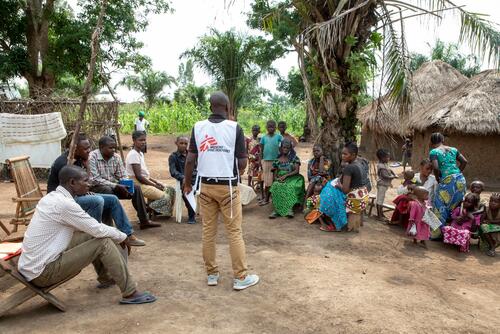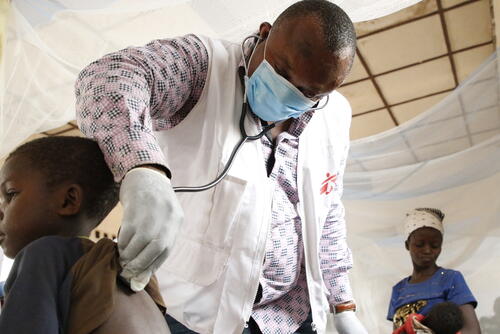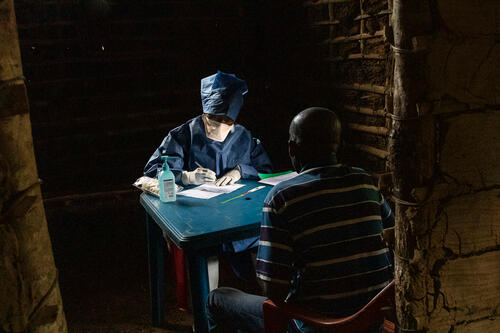
Dr Tathy, an MSF doctor, sees patients considered as non-Ebola suspects in consultation, as part of the mobile intervention clinic and training of local medical staff in the Ebola context, in the village of Bobua. This decentralization-based device aims to detect and isolate, if necessary, any person presenting symptoms close to Ebola (fevers, diarrhea, headaches, bleeding, etc.). But at the same time to treat other pathologies which are rife in the area, such as malaria or severe acute malnutrition. This is in order to increase the acceptance of MSF by the population in the area, and to avoid the stigmatization that affects Ebola patients, by getting as close as possible to the patients, and taking care of them where they live. Bobua.

***

Dr Tathy, médecin MSF, reçoit en consultation des patients considérés comme non suspects Ebola, dans le cadre des activités de clinique d'intervention mobile et de formation du personnel médical local en contexte Ebola, dans le village de Bobua. Ce dispositif axé sur la décentralisation, a pour but de déceler, et isoler le cas échéant, toute personne présentant des symptômes proches d'Ebola (fièvres, diarhhées, céphalées, saignements...). Mais de soigner en même temps d'autres pathologies qui sévissent dans la zone, telles que le paludisme ou la malnutrition aïgue sévère. Ceci afin d'augmenter l'acceptance de MSF par la population dans la zone, et d'éviter la stigmatisation qui affecte les patients Ebola, en se rapprochant au plus près des patients, et en les prenant en charge sur leur lieu de vie. Bobua.
MSF’s Dr Tathy consults a patient, who is not suspected of having Ebola, at a mobile clinic in the village of Bobua, Équateur province. Democratic Republic of Congo, October 2020.
© Caroline Thirion/MSF

Improved medical response sees the end of DRC’s eleventh Ebola outbreak

MSF’s Dr Tathy consults a patient, who is not suspected of having Ebola, at a mobile clinic in the village of Bobua, Équateur province. Democratic Republic of Congo, October 2020.
© Caroline Thirion/MSF
Ebola disease in DRC: find out how we're responding
Learn more

The Ebola outbreak in Équateur province, northwestern Democratic Republic of Congo (DRC), has come to an end almost six months after it started thanks to an improved approach to patient care, said Médecins Sans Frontières (MSF).

The outbreak, the eleventh recorded in the country’s recent history, spread relatively slowly after it was declared on 1 June 2020, despite the fact that as many as 13 out of 17 health districts in Équateur province reported confirmed Ebola cases. According to the Ministry of Health, 130 patients were reported as having been infected, of which 55 people died. The 42.3 per cent mortality rate was significantly lower than the 66 per cent observed during the previous outbreak, which occurred in northeast DRC between August 2018 and June 2020 and claimed the lives of 2,287 people.

The introduction of the latest medical tools, including vaccines and treatments, the strengthening of community-based surveillance and a decentralised model of patient care all contributed to the rolling out of an effective intervention in areas that are often difficult to reach.
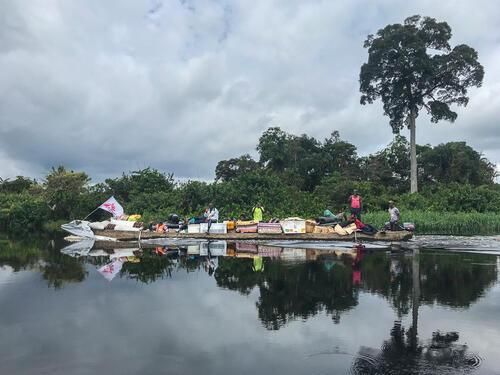
Departure by pirogue of the MSF teams from Lotumbe and Ingende, after several months of MSF presence in these remote health areas which had Ebola positive cases at the beginning of the epidemic. For several weeks, MSF deployed
multidisciplinary mobile teams there, who carried out interventions in different targeted villages in the area (reinforcement of PCI and construction of isolation structures, epidemiological surveillance, closer contact and health promotion with the communities, training of local medical staff, free medical consultations, etc.). MSF is withdrawing from the area, following the handover to the Congolese Ministry of Health and the probable announcement of the imminent end of this 11th epidemic. Lotumbe. 

***

Départ par pirogue des équipes MSF de Lotumbe et Ingende, après plusieurs mois de présence MSF dans ces zones de santé reculées qui ont connu des cas positifs Ebola au début de l’épidémie. MSF y a déployé pendant plusieurs semaines des équipes mobiles pluridisciplinaires, qui ont mené des interventions au sein de différents villages ciblés de la zone (renforcement PCI et construction de structures d’isolement, surveillance épidémiologique, rapprochement et promotion de la santé avec les communautés, formation du personnel médical local, consultations médicales gratuites...). MSF se désengage de la zone, suite à la passation au Ministère congolais de la Santé, et à l’annonce probable de fin prochaine de cette 11e épidémie. Lotumbe.
MSF teams leave the villages of Lotumbe and Ingende by pirogue (a type of canoe), after several months working in remote health areas affected by Ebola. Equateur province, DRC, October 2020.
© Caroline Thirion/MSF

“We took advantage of lessons learned during the previous outbreak,” says Dr Guyguy Manangama, MSF emergency manager. “These allowed for a better management of the situation in Équateur, though the two contexts are different.”

“During the tenth outbreak, our intervention sometimes faced challenges in terms of its acceptance by people because it was too centralised,” says Dr Manangama. “This time, we favoured a decentralised approach and kept people informed at all times about the intervention and the surveillance mechanism, to improve access to healthcare in the region.”

MSF had responded to the emergency since the beginning of June in the areas affected by the outbreak. Our teams supported the local healthcare system and offered treatment for other diseases such as malaria and acute malnutrition. We adopted innovative strategies, including providing care through fixed sites and mobile clinics in our response.

More than 1,450 consultations were carried out across 28 health centres in five different health districts, among those that reported Ebola cases or had unexplained deaths in the community. Local medical staff were trained on the treating the disease and donations were made to support local health centres.

New medical tools, including vaccines and curative drugs, to prevent and treat the disease also contributed to improve the quality of response. These tools, as well as the adaptation of the medical response to the specific conditions on the ground, are the results of experience accumulated during previous outbreaks. Their ultimate purpose is to produce a better, more integrated and accessible Ebola response in future outbreaks.