



Ebola disease in DRC: find out how we're responding
Learn more
115 Results
 
Amina Story 7/7

Amina is 15 years old, she looks like she has the weight of the world on her shoulders. Her small frame shrinks further in size as she talks about what she has experienced.

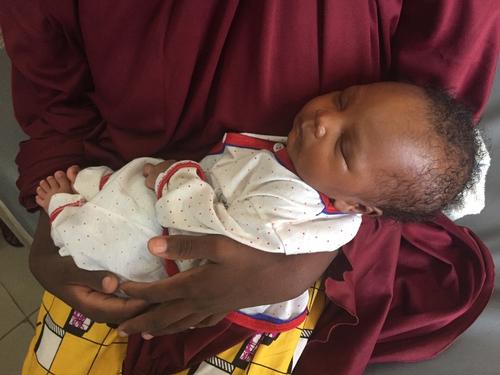
Sleeping on the hospital bed besides her is her son Yaqub, who she gave birth to a few days ago in MSF‘s health facility in Maimusari, 15 kilometres from the centre of Maiduguri, the capital of Borno State, north east Nigeria.

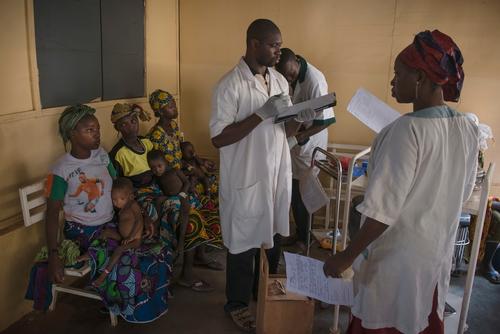
The MSF health centre in Maimusari is heaving with women and children, everwhere you look women are huddled holding their babies or seated on benches waiting to be seen by health workers.

I say women, but many of the faces in the crowd are teenager girls similar in age to Amina. Some of these girls have given birth to their second or third child. 

More than five hundred women and babies are being treated in this MSF health facility daily and more than seventy babies are delivered every week. 

MSF runs an In Patient and Out Patient Department,  maternity and ante natal services and an Ambulatory Theraputic Feeding Centre – ATFC. This is where malnourished  children and babies are provided with threaputic treatment. 

Amina says she is her husbands second wife, he has five children from his first wife, Amina says she has no idea where he is and he has yet to meet their newborn son. 

Amina is from Bama, a town in north east Nigeria. 
Bama is one of the frontlines in the ongoing conflict between the Nigerian army and Boko Haram that has left more than one million displaced and facing a growing nutrition crisis. 

Amina was evacuated from Bama and refered to MSF‘s health facility in Maimusari. The journey by road takes two and a half hours, the road is in poor condition and dangerous because it is part dotted with military checkpoints and is close to the Sambisa Forest in Gwozah, where Boko Haram are said to have a base. 

“I don‘t remember the journey from Bama to Maiduguri because I was in so much pain I had passed out. My youngest sister, Noor, aged five acompanied me on the journey. Was I scared ? I have spent my whole life being scared and so this was no different“ says Amina.

“It is very hard to be a girl here. Many bad things happen to girls, unspeakable things happen and they start happening to little girls as young as ten“ Amina twists the fabric of her dress as she talks and looks away frequentky trying to avoid eye contact with the nurse in the room. 

“What can I tell you ? It is impossible for me to talk about these things. “

I ask her how she feels about being a mother?

She shrugs her shoulders and then leans back and looks in to the distance.

In the same room as Amina there are two women on each bed with their newborns. 

The older looking mothers handle their children with more experience and attachment, holding their babies close as they breastfeed them. 

In one bed there are twins nestling into the blankets they’re laid out on. Many of the new mothers have expresionless faces. They look utterly exhusted.

Fatima,  35, has given birth to her sixth child, she says her baby was deliverd safely by MSF and she is thankful that she had somewhere to turn to in her time of need. 

“I felt safe here and knew that I would get good care and my baby would be healthy. I do not know what tomorrow will bring and all I can do is hope for the best for my child and all the children.“

MSF midwife Etsuko Nakamura is doing the rounds in the health centre. 

In the delivery room a woman has just given birth and has a retained placenta which can be life threatening as it can cause infection. Nurses masage her uterus to try and encourage the placenta to discharge. 

Another woman is in labour and the staff are preparing for her delivery.

“Our women patients are mostly in poor general health and for most it is very difficult for them to get to see a doctor because they don’t have the money or their family members do not see it as a priority,“ says  MSF midwife Etsuko.

“We deliever up to fifteen babies daily, many of the women have had repeat pregnancies and deliveries in a short space of time – their bodies are weak and exhausted. 

As always with our work  we see the dailly impact of conflict and poverty. We see how women and children’s lives are made harder by violence and instability. 

It is the women and children who are the most vulnerable and suffer the most,“ says Etsuko.
Nigeria

Amina, a 15-year-old mother in Maiduguri

“Our women patients are mostly in poor general health, and for most it is very difficult for them to get to see a doctor because they don’t have the money or their family members do not see it as a priority,” explains Etsuko Nakamura. Voices from the Field - 18 Aug 2016
 
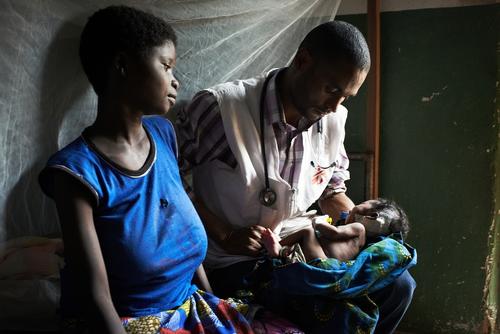
Muenge Kifeta sits with her 1 month old daughter who is checked up by MSF doctor Alexander Akili in the maternity ward at the government hospital in the village of Shamwana, Katanga, Democratic Republic of Congo on September 21, 2013. The baby has a serious neo-natal infection but will recover after ongoing observation at the hospital. She traveled 35km from a nearby village in an MSF mobile unit.
Democratic Republic of Congo

After ten years, Shamwana project is closed

Press Release - 16 Aug 2016
 
msf-placeholder
South Sudan

Activity Update, May 2016

Project Update - 15 Jul 2016
 
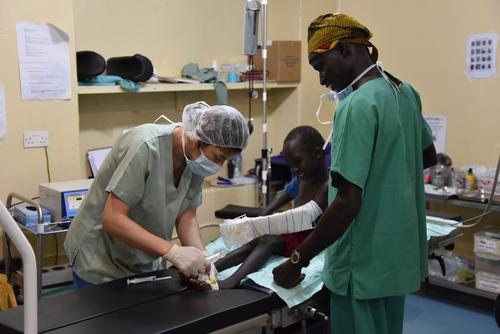
The operating theatre is an essential part of emergency health services for women and children in Aweil. Young Wol Wol is deceptively tall at only 5 years old. He was climbing mango trees with his friend when he fell. And because it is the end of the season mangos only remain higher up in the trees, so he had to climb higher to reach the very last fruit and then fell.
The boy sustained a head injury, open elbow fracture and displaced wrist fracture (in a displaced wrist fracture the bones are misaligned and won’t heal correctly unless they are realigned). Armelle will put the child to sleep under general anaesthetic, and the MSF medical team will do the debridement (removing damaged tissue) and washing of the wound, then the Ministry of Health surgeon will do the reduction of the wrist fracture. After surgery, Wol Wol’s arm had to be put in a plaster cast. 
The operating theatre team undertakes surgery for an average of more than 200 children like Wol Wol per month. The team manages many dressings for burns, orthopaedic cases like fractures, and drainage of abscesses. “For maternity patients we also do emergency obstetrics surgery. We complete around 20 to 15 caesarean sections every month”, explains Armelle Vanderhaghen, anaesthetist nurse.
South Sudan

Paediatric care and treating malnutrition in Aweil

Project Update - 9 Jun 2016
 
MSF Emergency Team performed an intervention in Bambouti, south-east of Central African Republic, to assist thousands of South Sudanese refugees and local population in an extremely remote ands isolated area of the country
Central African Republic

Thousands of South Sudanese refugees living in deplorable conditions

Project Update - 11 May 2016
 
The entrance of the MSF-supported health centre in Boguila, where MSF has been working since 2007. Nineteen people, including three Central African MSF staff members, were killed during an armed robbery in the grounds of MSF’s hospital in Boguila, Central African Republic, on 26 April 2014. Immediately after the tragedy, MSF made the decision to reduce its activities, and the hospital now functions as a health centre, where an MSF team continues to answer people’s medical needs in an area where no other healthcare is available.
Central African Republic

Humanitarians need to go where no one else wants to

Midwife Carlen Mezendy Ndakala is the delivery room supervisor at the MSF maternity clinic in Bangui, the capital of the Central African Republic. She shares some of her experiences providing humanitarian care in a highly unstable environment. Voices from the Field - 11 May 2016
 
In southern Mali, children struggle with endemic malnutrition, the heavy toll of seasonal malaria, and other preventable diseases such as diarrhoea and lower respiratory tract infections. Since 2009, Medecins Sans Frontieres is partnering with the Ministry of Health to link prevention and treatment across community and hospital levels of care for the best outcomes for children under 5, in Koutiala. 
Koutiala is MSF’s most comprehensive paediatrics project, committed to strengthening prevention, early detection and diagnosis, as well as improving the quality and scope of care to treat the sickest children. It builds on the community-level “paediatric package”, addressing nutrition, vaccination, hygiene and health education via outreach and community health centres (CSCOM; currently 5) with the MSF-run paediatrics department within the Ministry of Health regional general referral hospital, Centre de Sante de Reference de Koutiala, or CSREF. In 2014 the hospital expanded to 200 beds.
Child health

A day in one of our largest paediatric programmes

Paediatrics advisor Dr David Green has recently arrived in Koutiala, southern Mali, on an extended visit to one of the largest paediatric programmes run by Médecins Sans Frontières (MSF). He describes a recent Monday working with national staff doctors, who share their wealth of experience in the six-year-old project. Voices from the Field - 11 May 2016
 
Elise, 12, is HIV positive and following a tough experience with ARV drugs she is suffering greatly.
HIV/AIDS

HIV in children is a symptom of the failures of the AIDS response

“The upcoming UN high level meeting on HIV/AIDS is a unique, and perhaps the last, opportunity to close the treatment gap, not only for children but also for all people living with HIV. Governments of countries left behind the HIV/AIDS response, particularly in West and Central Africa, should seize this chance to ask loud and clear an increased commitment from the international community to intensify the HIV response for people facing a deadly treatment gap”, says Dr Mit Philips, MSF’s health policy advisor. Report - 10 May 2016
 
Khadija, 42, is a mother of four from Syria who is now detained on Samos island, Greece, along with her children. She spoke to MSF from behind two metal fences. 
“What is going to happen next? Will they kill us here in Europe? My husband was killed and our house was destroyed by a barrel bomb in 2013. Since then we have been moving from village to village looking for safety, until I lost hope and I brought my children to Turkey. I worked many jobs but it was so hard for me to manage with four children so I decided to come here to be safe. Yet here we are behind barbed wire like criminals, this is extremely unjust.
For more details see: https://lc.cx/4BCC
Greece

Will they kill us here in Europe?

Voices from the Field - 13 Apr 2016
Four mothers posing in a corridor of the Hospital in Bili. All four of them are staying in the hospital with their child, that's suffering from a severe case of malaria. Since the beginning of the project in 2016, the pediatric ward already treated more than 4.000 cases of complicated/severe form of malaria.
Médecins Sans Frontières (MSF)

Independent medical humanitarian assistance

We provide medical assistance to people affected by conflict, epidemics, disasters, or exclusion from healthcare. Our teams are made up of tens of thousands of health professionals, logistic and administrative staff - most of them hired locally. Our actions are guided by medical ethics and the principles of independence and impartiality. We are a non-profit, self-governed, member-based organisation.

Learn more