



Ebola disease in DRC: find out how we're responding
Learn more
431 Results
 
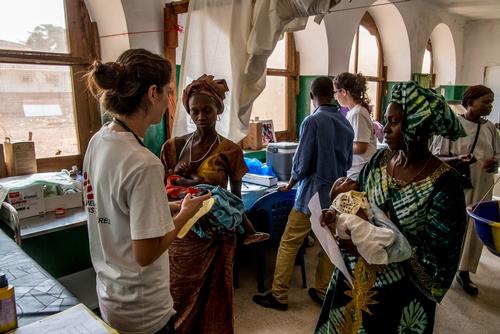
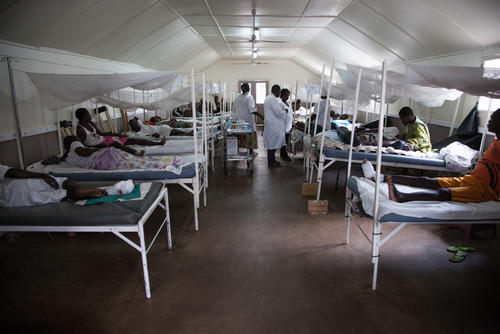
Women are waiting at the MSF supported hospital in Masisi, North Kivu, DRC. The MSF teams support the full extent of primary and secondary health care services (surgery, internal medicine, gynecology, maternity, pediatric, neonatology as well as a « village d’accueil » for women in their third trimester of a risky pregnancy who can stay there to ensure they have access to medicalized support to give birth) and undertake mobile clinics with a focus on malaria (curative/preventative) in remote health posts; watsan & health promotion.
Democratic Republic of Congo

48 hours on the frontline of maternity care

blogs.msf.org - 24 Sep 2018
 
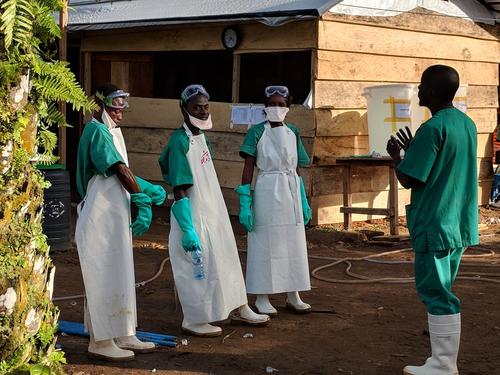
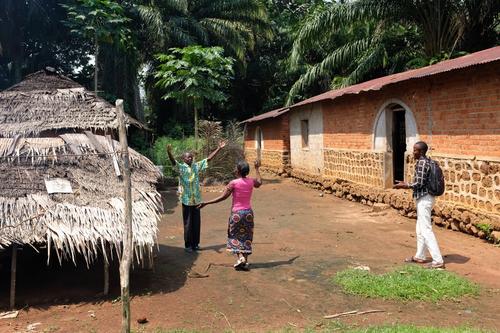
Formation des hygienistes.
DRC Ebola outbreaks

With a new Ebola outbreak, we knew we had to act fast

An experienced nurse, Patient Muhindo Kamavu was one of four MSF nurses who were the first on the ground, alongside the Ministry of Health, to respond to the Ebola outbreak declared on 1 August in Mangina, North Kivu, Democratic Republic of Congo. Voices from the Field - 13 Sep 2018
 
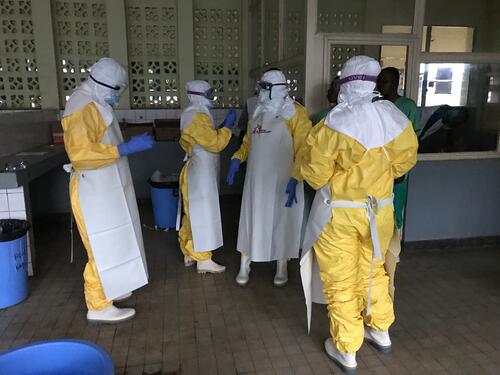
Mbandaka hospital in Equateur province, DRC. 

MSF staff Teams treating patients in the isolation areas in  Mbandaka hospital.

MSF teams are currently in the Mbandaka and Bikoro areas and are putting in place two Ebola Treatment Centres of 20 beds each
 

 More information in update from Field Communication Manager DRC.
DRC Ebola outbreaks

“Congolese health workers have shown an amazing commitment to fighting Ebola”

Miriam Alía explains how MSF took part in the ring vaccination against the disease and tells of her personal experience working with Congolese health workers. Voices from the Field - 11 Jul 2018
 
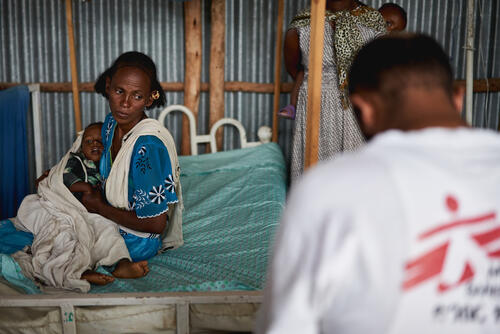
A mother holds her baby –affected by malaria - while an MSF medical team member attends to them. Between May and September, malaria is one of the main morbidities for refugees and the host community in the Tigray Region of Ethiopia.
Ethiopia

Fighting stigma and providing mental health to Eritrean refugees

Every month, around 5,000 Eritreans flee their country. Half of them arrive in refugee camps in the Tigray and Afar regions of Ethiopia. Since 2015, MSF has provided health services in the area, with a focus on mental health and psychiatric care, to the population of Hitsats and Shimelba refugee camps, as well as to the host community. Voices from the Field - 10 Jul 2018
 
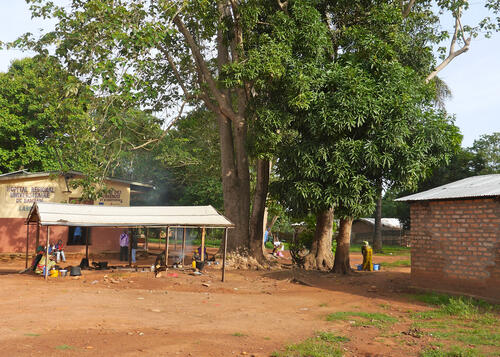
Improvised kitchen in Bambari general hospital. In Bambari, MSF supports the paediatric and maternity wards and supports the surgery national team. In February, the UN stabilisation mission, MINUSCA, declared Bambari a “city without armed groups”, strengthening the perception of it as a safe area for those fleeing violence elsewhere in the country. Currently, 50 percent of Bambari’s residents (113.800 people in total) have been displaced from their homes in other parts of Central African Republic. Of the 55,869 displaced people, 10,300 have arrived in Bambari since mid-March. Most are living in nine camps which ring the city but several moved in the hospital compound, where they feel safer.
Central African Republic

Ongoing fears of outbursts of violence in Bambari hamper access to healthcare

Interview with former head of mission Paul Brockman about recent outbursts of violence in Bambari, CAR, and their impact on the local population. Voices from the Field - 26 Jun 2018
 
Marie-Vincent’s husband welcoming her home with a prayer. He lost his son and grandsons to Ebola but his wife has returned home a survivor.

“I WILL START TODAY FROM ZERO” – MARIE-VINCENT’S STORY

“At first, we didn’t believe in Ebola,” says Marie-Vincent, a woman recently discharged from MSF’s Ebola treatment centre (ETC) in Bikoro, Democratic Republic of Congo (DRC). She has just recovered from the virus, after her entire family fell sick.

Marie-Vincent doesn’t know how old she is, but she looks to be perhaps 60, and has certainly seen a lot in her life. Her family’s story of Ebola started with her son, Charles. 

One of 11 children, Charles was a nurse who ran a remote health centre in Itipo, tiny town some 170 kilometres from Mbandaka, the capital of Equator Province in Democratic Republic of Congo, over dirt roads and broken bridges. Itipo is the so-called epicentre of the recent Ebola outbreak. 

Charles spent years caring for patients with diseases like malaria, diarrhoea and malnutrition, as well as assisting women with antenatal care and complicated deliveries. He died from a case of probable Ebola on 9 May, the day after the epidemic was officially declared. His body was never tested for the virus, but was treated with care and respect, washed and carried back to the village of his birth for a traditional burial. 

In the days that followed, the full force of the virus would be released on his family and the colleagues who cared for him when he was sick.

“We became suspicious about why Charles was ill when the other nurses told us to distance ourselves from him,” says Marie-Vincent, “But I still looked after him, because a mother cares for her son when he is sick.” 

The body of a person who has died from Ebola is extremely contagious. In the days after Charles was buried, Marie-Vincent and several members of her family began to fall sick. 

“As soon as he was in the ground, we began to feel ill. We had fevers, vomiting and diarrhoea. We began to believe it really was a sickness and not a curse. I’d heard about Ebola and the mysterious deaths in some local villages. But at the time, we just didn’t know.” 

Soon, Marie Vincent was extremely sick with the virus and was taken to be tested. Her oldest son and his wife, then another son and another male relative, all fell ill one after the other. Next, Charles’ pregnant wife began to run a fever, as did two of his son’s and his son’s young fiancée. The whole family was brought to MSF’s Ebola transit centre in Itipo and referred onto the ETC in Bikoro, a town a few hours away, after their tests came back positive for the virus. 

The next weeks were spent inside the treatment centre, battling the symptoms and the fear, together.

“The staff were very warm and did everything they could to help us survive,” says Marie Vincent. “They encouraged us and made us believe we would recover even when we felt like giving up.”

Sadly, however Marie-Vincent’s grandsons (Charles’ sons) as well as the young fiancée all died from Ebola. Although Charles’ wife would later recover, her unborn child, a little boy, would not survive. The Ebola virus crosses the placenta where the mother’s immune system cannot go and has no hope of protecting it.

“I’ve recovered, but there is nothing left for me at home. Everything I own has been burned. I’m old, but I will have to start my life again from scratch. I will start today from zero.”
DRC Ebola outbreaks

“I will start today from zero”

The story of Marie-Vincent, a woman recently discharged from MSF’s Ebola treatment centre (ETC) in Bikoro, DRC, who lost her son and other family members to the virus. Voices from the Field - 19 Jun 2018
 
With the aim of improving medical care to help reduce the mortality rate among children under five years old, MSF launched a paediatric project in the region of Bafata in central Guinea- Bissau in November 2014. MSF is working in the paediatric department of the Bafata regional hospital, the referral centre for the entire region, where more than 180,000 people live, and in several health centres in the area.
Guinea-Bissau

Medical knowledge that outlasts MSF project

Erling Larsson, a Swedish doctor who has recently returned from Guinea-Bissau, describes the main outcomes of MSF's work in the region. Voices from the Field - 18 Jun 2018
 
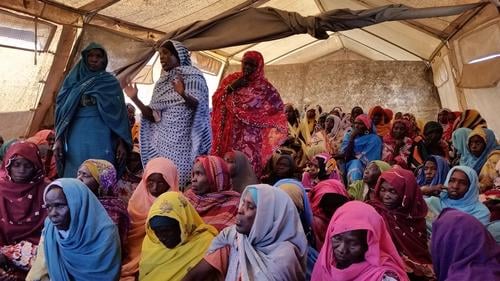
Traditional birth attendants in discussion with MSF Doctors. These trusted community representatives, are usually present during births in the home. By creating a dialogue, MSF is able to ensure that they refer women before and after birth for check ups and if there is a complication.
Sudan

Dreams of returning home remain distant for displaced in Darfur camp

Two years ago, fighting erupted in Jebel Marra, southwestern Sudan, forcing nearly 160,000 people to look for protection. Over 23,000 settled around the small village of Sortoni and clustered together to form a camp for displaced people. But many are still reluctant to return home despite the difficulties of life in the displaced people’s camps. Voices from the Field - 18 May 2018
 
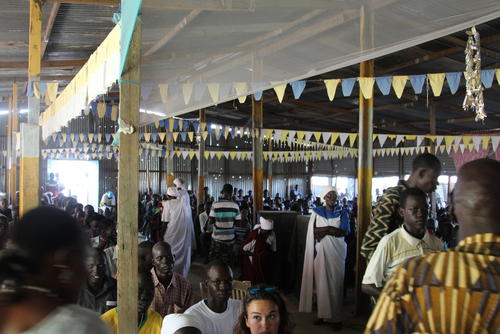
Churches and religious service are an important opportunity for the community to come together and share in their experiences. People can better come together with their issues when they do so in a collective manner.
South Sudan

The mounting mental health toll in Upper Nile State

The Malakal Protection of Civilian site (PoC) was created at the beginning of 2014 to offer temporary protection to the population of the area who were caught up in fighting in South Sudan's Upper Nile region. But four years on, the difficult living conditions, the loss of hope, feelings of enclosure, as well as limited livelihood opportunities have had an effect on the mental health of those who are trapped inside. Voices from the Field - 17 Apr 2018
 
On the evening of April 10th, patients flocked to the MSF Sica hospital in Bangui following the resumption in the afternoon of the operation of MINUSCA and Central African security forces in PK5 district in Bangui on the 10th. April against local armed groups, which gave rise to fighting.

Le 10 avril en soirée, les patients ont afflué  à l'hôpital MSF Sica de Bangui suite à la reprise dans l'après-midi de l'opération de la MINUSCA et des forces de sécurité centrafricaine dans le quartier de PK5 à Bangui le 10 avril contre des groupes armés locaux, qui a donné lieu à des combats.
Central African Republic

Four things to know about the conflict in the Central African Republic

Ongoing war has resulted in a protracted humanitarian crisis in the Central African Republic (CAR), creating severe health needs among the population. Voices from the Field - 10 Apr 2018
Four mothers posing in a corridor of the Hospital in Bili. All four of them are staying in the hospital with their child, that's suffering from a severe case of malaria. Since the beginning of the project in 2016, the pediatric ward already treated more than 4.000 cases of complicated/severe form of malaria.
Médecins Sans Frontières (MSF)

Independent medical humanitarian assistance

We provide medical assistance to people affected by conflict, epidemics, disasters, or exclusion from healthcare. Our teams are made up of tens of thousands of health professionals, logistic and administrative staff - most of them hired locally. Our actions are guided by medical ethics and the principles of independence and impartiality. We are a non-profit, self-governed, member-based organisation.

Learn more