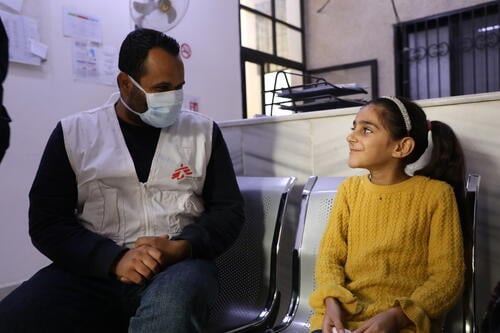
- People in northeast Syria continue to struggle to access healthcare, water, and food, according to an assessment conducted by MSF earlier this year in Hassakeh governorate.
- Water scarcity disproportionately affects women, leaving them susceptible to physical exhaustion, harassment, and exploitation.
- MSF calls on donors, humanitarian agencies, and authorities to scale up funding and coordination, to prevent the further deterioration of services.
Amsterdam/Hassakeh - People in northeast Syria continue to struggle to access healthcare, water, and food, according to an assessment conducted earlier this year in Hassakeh governorate by Médecins Sans Frontières (MSF). MSF staff spoke with over 150 families from both local communities and internally displaced people.
Our assessment in June found that people face severe barriers to accessing basic services. Among respondents, 90 per cent reported postponing or avoiding seeking healthcare due to high costs for consultations and medication, the lack of nearby or functioning facilities, and the burden of transportation.
“We were unable to secure medication for my father’s chronic disease for over four months,” says Khoula*, a resident of Hassakeh. “His condition worsened and became complicated, eventually requiring urgent surgical intervention. We did everything we could to secure the money for the operation, but we were too late. My father passed away.”
Eighty-five per cent of households reported that they or someone in their family lives with at least one non-communicable disease (NCD).
To address these challenges, MSF is working in collaboration with the local health authority to support clinics dedicated to treating NCDs in Hassakeh and Raqqa governorates.
The crisis in northeast Syria is not only about conflict; it’s about the daily erosion of people’s ability to survive with dignity.Barbara Hessel, MSF head of programmes in northeast Syria
Water scarcity
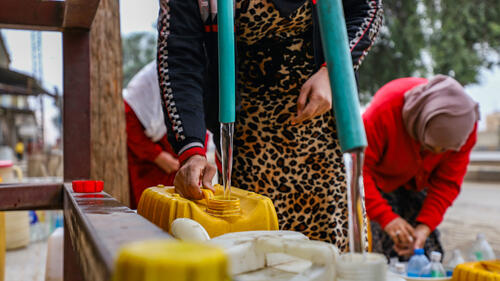
In northeast Syria, widespread water scarcity, driven by climate change, the weaponisation of water resources, prolonged droughts, and excessive groundwater extraction have been made worse by frequent damage to water infrastructure, specifically in Allouk and Tishreen water stations.
Since 2019, repeated interruptions to Alouk station, the main source of safe water for nearly one million people, have forced families to rely on unsafe and unregulated water sources. Survey results indicated only 37 per cent of households can consistently access sufficient water to meet basic hygiene and domestic needs.
“We bathe once every five days now,“ says Khalid*, who has been displaced to Hassakeh during the years of the conflict. “We have to choose between being clean and being hydrated.“
The assessment also highlights how water insecurity disproportionately affects women, who are primarily responsible for securing water for their household. They often walk long distances, facing physical exhaustion, harassment, and exploitation.
“I was collecting our household’s water allocation from the communal water tank,“ says Fatima*, a young woman from Hassakeh. “The man managing the distribution insisted I step inside so he could help me. leaned in, he touched me inappropriately. I was so shaken that I left without taking the water, since then, I’ve never gone back alone.“
Women also reported that some private vendors have offered water in exchange for sex, which is unacceptable and highlights the intersection of vulnerability, gender, and survival.
We bathe once every five days now. We have to choose between being clean and being hydrated.Khalid*, a displaced man in Hassakeh
In Hassakeh, MSF teams recently rehabilitated 12 boreholes and supported the rehabilitation of two water stations (Al-Aziziah and Al-Hamma) to prepare for any potential startup of Alouk station and ensure access to safe water for local communities.
Economic vulnerability, food insecurity
Economic vulnerability is widespread, with median household incomes reported at US$150 per month, ranging from as low as $15 to $200. Food has become increasingly out of reach for lower-income families, with 77 per cent of households surveyed reported food shortages multiple times per month.
“The crisis in northeast Syria is not only about conflict; it’s about the daily erosion of people’s ability to survive with dignity,“ says Barbara Hessel, MSF head of programmes in northeast Syria. “These figures underscore a deteriorating humanitarian situation.“
Khadija*, a mother of four, shared her struggles:
“As a mother, my children are the most important part of my life; I often skip meals so they can have enough to eat,” says Khadija. “Still, we struggle to provide them with the proper nutrition they need. It breaks me to see them asking for food I cannot always give. I feel hopeless.”
While most families depend on local markets for their food, their purchasing power is insufficient to meet even the most basic dietary needs.
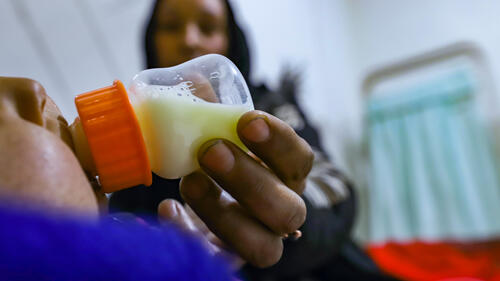
In Raqqa, MSF teams run inpatient and outpatient feeding units to provide care for children suffering from malnutrition.
Barriers to return
Topping these challenges, many displaced people we interviewed in Hassakeh reported being unable to return to where they’re from due to the ongoing security and safety concerns, lack of shelter, and the absence of humanitarian support for returnees.
“Even if we’re willing to return, there’s nothing to return to – no aid, no shelter, no support,” says Al’aa*, a displaced woman from Ras-Alain/Serekaniye. “Without help going back isn’t just hard, it’s impossible.”
MSF calls for action
Donors, humanitarian agencies, and authorities must scale up funding and coordination to prevent further deterioration of essential services. All parties to the ongoing conflict must protect civilian infrastructure, including water stations, in accordance with international humanitarian law.
“People are being forced to make impossible choices, between buying food, medicine, or water,” says Hessel. “Without immediate investment and political will, thousands will continue to face preventable suffering.”
*Names have been changed to protect their privacy.
MSF has operated in northeast Syria for over a decade, delivering healthcare, nutrition, and water programs across Al-Hasakah, Raqqa, and Al-Hol camp.
Syria
Syria: MSF concludes three years of support to Darat Izza healthcare centre
Project Update
6 May 2026
Syria
After years of detention former Al Hol residents face uncertain future
Press Release
27 Feb 2026