


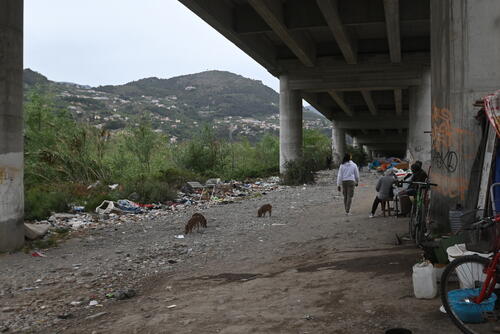
- Médecins Sans Frontières (MSF) has witnessed extremely vulnerable people being pushed back indiscriminately by French police.
- MSF urges Italy, France, and other European countries to put an end to systematic and indiscriminate pushbacks.
- We call for the end of arbitrary detention of people on the move and the use of violence at borders.
Ventimiglia - People have been systematically pushed back at the Italian-French border by French police – often with violence, inhumane treatment as well as arbitrary detention – and left without adequate shelter and with limited access to healthcare in Italy.
MSF calls on Italy, France, and other European countries to implement all necessary measures to prevent further harm to vulnerable people in transit, and to put an end to systematic and indiscriminate pushbacks.
In a new report Denied Passage - The continuous struggle of people on the move pushed-back and stranded at the Italian-French border, MSF documents the conditions reported by hundreds of people transiting in the city of Ventimiglia, in Northwest Italy, and attempting to cross the border towards European countries.
Between February and June 2023, our teams, who run a mobile clinic in Ventimiglia to assist individuals in transit, provided medical treatment or orientation to services to 320 patients. Among them, 215 patients reported acute conditions, including skin, respiratory and gastrointestinal diseases, as well as musculoskeletal complaints and injuries, while 14 had chronic illnesses such as diabetes and cardiovascular diseases. We also offered health promotion as well as socio-medical group sessions to 684 people.
We spent the night in the cold and this morning we were pushed back and taken to Italy, but we have no news of my wife.Jean*, an asylum seeker from Ivory Coast
“Our team has witnessed extremely vulnerable people being pushed back indiscriminately by French police, regardless of their individual circumstances and without appropriate assessment,” says Sergio Di Dato, MSF project coordinator in Ventimiglia.
Many of the people encountered by our teams reported procedural violations during the notification of the refusal of entry by French authorities, such as inaccurate transcription of personal data, lack of information or absence of intercultural mediators.
Vulnerable people such as minors, pregnant women and new mothers, elderly people or severely ill persons are not exempted from this practice. More than a third among the 48 unaccompanied minors assisted by our teams reported to have been pushed back to Italy, while several individuals reported being arbitrarily detained in containers during the night, without any specific protection for women and children.
People have also stated that food and water are not provided systematically, medical care is often denied, sanitary facilities are inadequate, and people are forced to sleep on the floor in situations of overcrowding.
Maïté*, 20-year-old woman from Guinea Conakry, hope to study in France
“On the journey from Mali to Algeria, [smugglers] kept me in an abandoned building in the desert for two weeks. They threatened me, beat me and left me without food. Eventually they released me, but soon I ended up in another prison for a week.”
![Maïté*, 20-year-old woman from Guinea Conakry
“I left Guinea Conakry four years ago. After both my parents died, I was living with my aunt. When I was 15 years old, she told me it was time for me to get married and she chose a husband for me. My husband used to beat me every day. He was violent and I ended up in hospital many times. Four years have passed and I still have the scars on my body.
I could not live that way, so I decided to escape from that life. I left when I was 16 years old, alone. I went through Mali and then Algeria. It took me at least two months to cross the desert. Most of the time we didn't have enough food or water.
On the journey from Mali to Algeria, [the smugglers] kept me in an abandoned building in the desert for two weeks. They wanted me to pay more money, but I had no one to call to ask for money. They threatened me, beat me and left me without food. Eventually they released me, but soon I ended up in another prison for at least a week.
When I finally managed to enter Algeria, [armed forces] sent me back towards Niger. After that, I managed to reach Algeria, but life was not at all easy and I decided to cross the desert from Algeria to Tunisia. You cross the desert to avoid the police. If they find you in Algeria they send you back to Niger, and if you are in Tunisia they send you back to Algeria, and you have to start walking again. I walked through the desert for almost a week, with five other people. We walked through the night and looked for a place to shelter in the early morning. We only had water and some biscuits with us. That's how I got to Tunisia.
I spent three years in Tunisia, working in restaurants, cleaning and trying to earn money to come to Europe by crossing the Mediterranean Sea.
The sea crossing was hard. There were 45 of us on an eight-metre-long boat. We spent two days at sea without food before a ship rescued us. They took us to Lampedusa. From Sicily I decided to continue the journey to France.
I travelled by train to Ventimiglia. I want to get to France and start studying. Without education you get nowhere and I want to do something good with my life.”](https://img.msf.org/AssetLink/f0la6v3o82fot315cwdcq325ef0m6qmg.jpg "Maïté*, 20-year-old woman from Guinea Conakry")
Moreover, during the reporting period alone, our staff in Ventimiglia identified at least four cases of family separation occurring during pushbacks, with some instances causing trauma for the victims, including children.
“We were stopped yesterday in Nice by the police,” says Jean*, a man from Ivory Coast. “My wife is pregnant. She was taken to the hospital because she fainted while they were handcuffing her.
“My two-year-old son and I were taken to the border police station in Menton. We spent the night in the cold and this morning we were pushed back and taken to Italy, but we have no news of my wife.”
Access to adequate shelter, healthcare, clean water, or sanitary facilities is extremely limited for people transiting in Ventimiglia. Despite the recent opening of two new ‘first-assistance centres’ in the city (Punto Assistenza Diffusa – PAD), where extremely vulnerable migrants who have been pushed back from France can find refuge for a few nights, dozens of transiting people are still forced to sleep on the streets or in makeshift shelters.
Two out of four promised PADs are still not functioning and fundamental services such as accommodation, healthcare and legal support are provided by local associations and civil society. Skin diseases, gastrointestinal, urinary, and upper-respiratory tract infections are just some of the ailments registered by our teams, often a direct consequence of the poor living conditions.
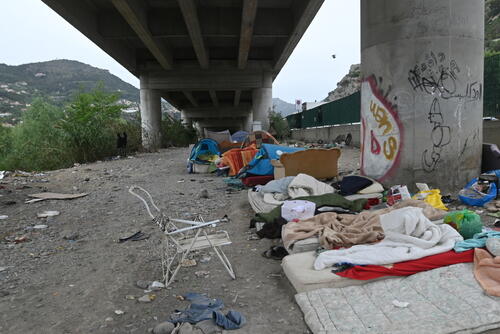
“It is crucial that people in transit, regardless of their legal status, are granted the right to receive comprehensive protection and services that address their needs,” says Di Dato.
“The bottleneck created in Ventimiglia is not an isolated case but rather reflects the larger trend of European migration policies that prioritise containment and securitisation over fundamental rights and international protection.”
Drawing from the testimonies and medical data collected by our team in Ventimiglia and at the Italian-French border, MSF urges Italy, France, and other European countries to implement all necessary measures to prevent further harm to these vulnerable people, and specifically calls on them to:
- Put an end to systematic and indiscriminate pushbacks, and to degrading and inhumane treatment both at European Union internal and external borders;
- End the practice of arbitrary detention of people on the move and the use of violence at borders;
- Ensure humane and dignified treatment as well as access to healthcare and decent living conditions for people transiting in Ventimiglia, across Italy and throughout Europe;
- Guarantee and increase safe and legal passages for people seeking assistance and protection in Europe;
- Guarantee the right of all foreign children to seek asylum on French and European territory.
Read the full report Denied Passage - The continuous struggle of people on the move pushed-back and stranded at the Italian-French border here.
*Names changed to protect identity.
MSF has been working in Italy since 1999, assisting migrants and refugees arriving by sea, in reception centres and informal settlements, providing them with medical, humanitarian, psychological and socio-healthcare assistance, in partnership with Italian authorities.
Mediterranean migration
EU member states must reverse deadly inaction on Central Mediterranean migration
Press Release
22 Nov 2023
Mediterranean migration
“No one came to our rescue”: The human costs of European migration policies in the Central Mediterranean
Report
22 Nov 2023
![Maïté*, 20-year-old woman from Guinea Conakry
“I left Guinea Conakry four years ago. After both my parents died, I was living with my aunt. When I was 15 years old, she told me it was time for me to get married and she chose a husband for me. My husband used to beat me every day. He was violent and I ended up in hospital many times. Four years have passed and I still have the scars on my body.
I could not live that way, so I decided to escape from that life. I left when I was 16 years old, alone. I went through Mali and then Algeria. It took me at least two months to cross the desert. Most of the time we didn't have enough food or water.
On the journey from Mali to Algeria, [the smugglers] kept me in an abandoned building in the desert for two weeks. They wanted me to pay more money, but I had no one to call to ask for money. They threatened me, beat me and left me without food. Eventually they released me, but soon I ended up in another prison for at least a week.
When I finally managed to enter Algeria, [armed forces] sent me back towards Niger. After that, I managed to reach Algeria, but life was not at all easy and I decided to cross the desert from Algeria to Tunisia. You cross the desert to avoid the police. If they find you in Algeria they send you back to Niger, and if you are in Tunisia they send you back to Algeria, and you have to start walking again. I walked through the desert for almost a week, with five other people. We walked through the night and looked for a place to shelter in the early morning. We only had water and some biscuits with us. That's how I got to Tunisia.
I spent three years in Tunisia, working in restaurants, cleaning and trying to earn money to come to Europe by crossing the Mediterranean Sea.
The sea crossing was hard. There were 45 of us on an eight-metre-long boat. We spent two days at sea without food before a ship rescued us. They took us to Lampedusa. From Sicily I decided to continue the journey to France.
I travelled by train to Ventimiglia. I want to get to France and start studying. Without education you get nowhere and I want to do something good with my life.”](https://img.msf.org/AssetLink/o1twmgg772862kkfvfv13b0y7d7r152v.jpg "Maïté*, 20-year-old woman from Guinea Conakry")
Italy
Denied Passage: The struggle of people stranded at the Italian-French border
Report
4 Aug 2023