


![Maïté*, 20-year-old woman from Guinea Conakry
“I left Guinea Conakry four years ago. After both my parents died, I was living with my aunt. When I was 15 years old, she told me it was time for me to get married and she chose a husband for me. My husband used to beat me every day. He was violent and I ended up in hospital many times. Four years have passed and I still have the scars on my body.
I could not live that way, so I decided to escape from that life. I left when I was 16 years old, alone. I went through Mali and then Algeria. It took me at least two months to cross the desert. Most of the time we didn't have enough food or water.
On the journey from Mali to Algeria, [the smugglers] kept me in an abandoned building in the desert for two weeks. They wanted me to pay more money, but I had no one to call to ask for money. They threatened me, beat me and left me without food. Eventually they released me, but soon I ended up in another prison for at least a week.
When I finally managed to enter Algeria, [armed forces] sent me back towards Niger. After that, I managed to reach Algeria, but life was not at all easy and I decided to cross the desert from Algeria to Tunisia. You cross the desert to avoid the police. If they find you in Algeria they send you back to Niger, and if you are in Tunisia they send you back to Algeria, and you have to start walking again. I walked through the desert for almost a week, with five other people. We walked through the night and looked for a place to shelter in the early morning. We only had water and some biscuits with us. That's how I got to Tunisia.
I spent three years in Tunisia, working in restaurants, cleaning and trying to earn money to come to Europe by crossing the Mediterranean Sea.
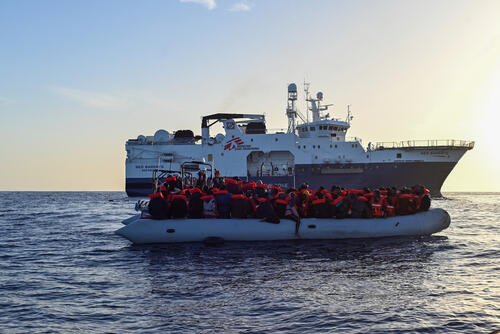
The sea crossing was hard. There were 45 of us on an eight-metre-long boat. We spent two days at sea without food before a ship rescued us. They took us to Lampedusa. From Sicily I decided to continue the journey to France.
I travelled by train to Ventimiglia. I want to get to France and start studying. Without education you get nowhere and I want to do something good with my life.”](https://img.msf.org/AssetLink/o1twmgg772862kkfvfv13b0y7d7r152v.jpg "Maïté*, 20-year-old woman from Guinea Conakry")
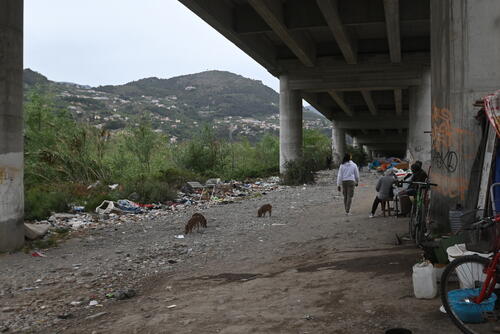
Findings from our operations in Ventimiglia, Italy, between February and June 2023, indicate that people on the move crossing the French-Italian border are systematically and indiscriminately returned to Italy, without consideration of individual circumstances or vulnerabilities.
Most of our patients in Ventimiglia have gone through extremely dangerous journeys to reach Europe. Many have survived highly traumatic experiences in their countries of origin or during their migration journey.
The following report documents the significant dangers migrants face throughout their journeys to and within Europe. It also provides valuable insight into people’s living conditions and access to healthcare once they reach Europe.
Furthermore, it emphasises European countries' failure to safeguard individuals' well-being effectively. The ‘bottleneck’ created in Ventimiglia is causing unnecessary suffering among migrants attempting to continue their journeys. Ensuring comprehensive protection and services that address the specific needs of individuals in transit, irrespective of their legal status, is of the utmost importance.
Read the full report below:
Denied Passage: The continuous struggle of people on the move pushed-back and stranded at the Italian-French border
pdf — 3.09 MB
Download
Mediterranean migration
EU member states must reverse deadly inaction on Central Mediterranean migration
Press Release
22 Nov 2023
Mediterranean migration
“No one came to our rescue”: The human costs of European migration policies in the Central Mediterranean
Report
22 Nov 2023
Italy
People on the move face violence and pushbacks at Italian-French border
Press Release
4 Aug 2023