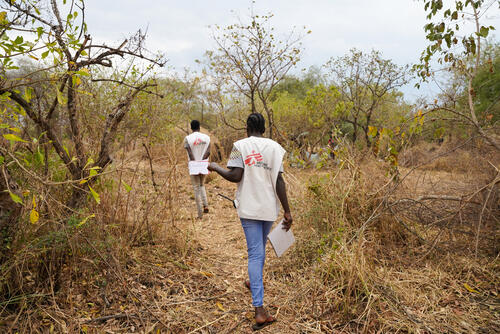
MSF outreach activities in Boma, GPAA
Content Portal

Latest

Daniel Kuju, health promotion supervisor, and Beatrice Johnson, community health educator, visit semi-nomadic communities in Labarab, Greater Pibor administrative area to conduct health awareness sessions. South Sudan, February 2024.
© Manon Massiat/MSF

Discover all our latest news, stories and publications. Use the filter to get to the content you're looking for.
Work with MSF

In 2024, 67,000 people worked with Médecins Sans Frontières and contributed to giving lifesaving medical assistance to people who would otherwise be denied access to healthcare, clean water and shelter.

A large majority of MSF staff, about 90 per cent, are locally hired in their country of residence, working for MSF assistance programmes in proximity with the people and communities we support, or in MSF offices around the world.  

About 10 per cent of people working for MSF are internationally mobile staff, specialists or senior managers hired on fixed-term contracts to carry out assignments in countries of intervention.  

MSF doesn’t employ only doctors and nurses. To fulfill our social mission, we recruit employees from a large range of professions in the medical, finance, logistics, IT, administration, human resources, and communications fields, and in other areas.  

If you would like to work with MSF, you will find information about our behaviour commitments, minimum requirements, our recruitment processes and our current international job vacancies.  

To know more about MSF’s remuneration policies, you can also visit msf.org/rewards.

MSF has section offices in 24 countries and 18 MSF branch offices. View the worldwide map of MSF offices.

Our behavioural commitments

The integrity of our organisation is upheld by the good conduct of each individual staff member, in any location, with full respect for the communities we serve.

When you join us, we expect you to commit to our social mission and Charter; helping to deliver medical assistance to populations in distress and to people affected by natural or man-made disasters. 

For us, this means not tolerating any behaviour from our staff that exploits the vulnerability of others, or of employees taking advantage of their position for personal gain. 

We do not tolerate any physical or psychological abuse against individuals, sexual harassment, sexual relations with minors, or any behaviour that does not respect human dignity. 

MSF promotes a working environment free of harassment and abuse. Our leadership has unequivocally committed to fight abuse and to reinforce mechanisms and procedures to prevent and address it. 

 
MSF Clinic: inpatient department and surgical capacity, Gogrial, Warrap State. South Sudan
About MSF

The MSF Charter

MSF.ORG 12 Dec 2022
Mamadou M'Baiki health center in the PK5 district in Bangui
Video

Welcome to Médecins Sans Frontières/Doctors Without Borders

Who we need in our assistance programmes

 
Libya

Trapped in transit: the neglected victims of the war in Libya

Press Release 30 Jun 2011
 
Yemen

MSF continues its emergency operations

Voices from the Field 11 Aug 2011
 
In Memoriam

Francine Matthys

Project Update 28 Sep 2011
 
Haiti

Cholera cases are increasing in Port-au-Prince

Project Update 10 Oct 2011
Anchor Links
Hero Image
Integrated Community Case Management - Abyei
Hero Pathing Form
Work With Us (Field)
Headline
Work with us
Background
Image
Hero Alignment
top
Schedule content for publication
Off
Description
We rely on a strong network of professionals to deliver lifesaving medical aid. Discover what it means to work for MSF, including our social mission, Association and behavioural commitments.
Select caption
Short caption
Use a custom breadcrumb
No

Donate

Your donation matters

Your gift will help us bring lifesaving medical care to people in need.

Emergencies come in many forms: armed conflicts, disease epidemics, natural hazards, malnutrition crises, and more. Your gift ensures that when an emergency happens, our teams are there to relieve suffering and save lives.

Rounded figures taken from 2024 International Financial Report

Your donations at work
SF supported Darayya health facility
An MSF health promoter talks to Rawan Jamaluddin after a blood test at the Daraya healthcare centre in Rural Damascus. Syria, November 2025.
© Zahra Shoukat/MSF
01 / 10
Syria

Helping care reach people in Daraya after years of war

In the aftermath of the Syrian war, MSF collaborated with local health authorities to restore a healthcare centre in Daraya. Returning families can finally find reliable health services close to home.

Read More

FAQs

We pride ourselves on the incredible support of our donors. Our funding structure relies on lots of donations from millions of individuals around the world. It is our donors, who fuel MSF’s work.

In 2024, 98 per cent of our income came from some 7.1 million private donors. It is thanks to the generosity of these private supporters – mainly individuals like you, but also companies and private foundations – that we are able to operate independently and provide humanitarian assistance in some of the world’s most insecure environments and forgotten crises.

The remaining two per cent of our income came from public institutions, other sales and financial transactions.

For more details, see the International Financial Report

In 2024, we raised a total of €2.36 billion euro: 98 per cent of that came from private donations.

For more details, see the International Financial Report.

Your donations pay for millions of consultations, surgeries, treatments and vaccinations every year.

We are a non-profit organisation and 79% of our financial resources are allocated to fulfilling our social mission: 63% to our humanitarian programmes, 12% to support our projects and programmes, and 3% to our bearing witness (témoignage) activities. The rest is spent on general management and fundraising costs. We also maintain reserves that allow us to respond immediately to a crisis without having to wait for an appeal. The use of MSF funds is tightly controlled and the audited financial reports are publicly available.

The overwhelming majority of our programmes are implemented directly by our teams. In other cases, we provide support to local medical networks who can directly access those in need. This is notably notably the case in Syria where some areas of the country are not directly accessible to our teams.

For a more detailed breakdown of our sources of income, by activity and by geographic area, see the International Financial Report.

Where is the money spent? > In 2024, 59% of programme expenditure was spent in Africa, 30% was spent in Asia, and the rest in Europe, the Americas, Oceania and for transversal activities, such as search and rescue.

We spent the most in the Democratic Republic of Congo, Yemen, South Sudan, Nigeria, Sudan, Central African Republic, Chad, Afghanistan, Haiti, Palestine and Syria.

The International Financial Report gives more details of the geographic distribution of expenditure. It also provides breakdowns of expenses and funding for all the countries where MSF has significant programme activities in a given year.

We don't accept contributions from companies and industries whose core activities may be in direct conflict with, or limit our ability to provide, medical humanitarian work. Hence, we don't accept money from pharmaceutical and biotechnology companies, extraction industries (such as oil, natural gas, gold, or diamonds), tobacco companies and arms manufacturers.

Additional limitations may exist in the national giving acceptance policies of the countries where MSF is fundraising.

MSF does not accept in-kind donations of medical products or health technology. Only under exceptional circumstances, and on a case-by-case basis, MSF may consider accepting such donations according to the criteria and conditions set forth in MSF’s Policy for In-Kind Donations of Medical Products and Health Technology (PDF).

We appreciate that some of our supporters may have a particular interest in a country or programme in which we work. While in some circumstances it is possible to have your gift directed toward a specific programme or country, we ask that you contribute with unrestricted funding.

Unrestricted general donations give us the ability to direct funds where the needs are greatest, including under-reported and neglected crises.

MSF would not be able to swiftly respond to emergencies in Central African Republic, South Sudan or Yemen, nor provide lifesaving care to hundreds of thousands of people living with HIV, if not for the general support from our donors worldwide.

Further details on where our money comes from, how much we raise, and how we spend it, can be found in our International Financial Report.

The International Financial Report also gives details on where we spend your money, showing the geographic distribution of our expenditure, and providing breakdowns of expenses and funding for all the countries where MSF has significant programme activities in a given year.

Warning

Please be aware there have been cases of individuals posing as Médecins Sans Frontières (MSF) staff in order to scam people out of money.

MSF has received reports of third parties attempting to fraudulently obtain money on our behalf via email, social networking websites or apps, or in person at public locations.

The following is a list of scams and hoaxes that have been brought to our attention (please note this list is not exhaustive):

  • An individual or individuals carrying out what appears to be fraudulent collections of money in public locations, while pretending to represent MSF.
     
  • People posing as MSF staff in emails asking for reimbursements for donations, sometimes naming actual MSF staff or senior management in their appeals in order to bring a sense of credibility.
     
  • People posing as MSF staff requesting money to pay for individual medical procedures for fictitious patients.
     
  • People posing as MSF staff who have been detained on their way home and asking for money to be transferred in order to secure their release from detention. 
     
  • People posing as MSF staff, or acting on behalf of MSF staff, on social networking websites or apps in order to lure unsuspecting members of the public to send funds to cover the travel costs of the alleged MSF staff member to return from a field mission.
     
  • ​People posing as MSF staff who have been detained on their way home and asking for money to be transferred in order to secure their release from detention. 
     
  • People posing as MSF human resources or recruitment staff asking people applying for a job with MSF for money or to pay a fee.

All MSF staff are instructed to call their home MSF office if they find themselves in an unfortunate situation like losing their passport or if they have trouble with a visa. We then provide all the support they need to get home.

MSF staff in the field will also have access to funds in an emergency situation and so have no need to request financial support from anyone, for either themselves or their patients.

MSF does not charge a fee at any stage of the recruitment process (application, interview meeting, processing, training or any other fees).

Unfortunately there is nothing we can do to stop scams such as these and others from happening. If you are unsure if you are the subject of a scam or fraud involving a supposed MSF staff member, please get in contact with your local or nearest MSF office. You can also get in touch with your country’s local consumer commission or fraud reporting office.

Anchor Links
Hero Image
Safe Birth in Aweil
Hero Pathing Form
Donate
Headline
Donate to MSF
Background
Image
Hero Alignment
center
Schedule content for publication
Off
Description
Your donations pay for millions of consultations, surgeries, treatments and vaccinations every year. Learn more about your donations at work and have your questions answered in our FAQ section.
Select caption
Short caption
Use a custom breadcrumb
No
 
Victims of airstrike in Sanaa
Yemen

MSF-supported hospitals treat mass casualties caused by airstrikes in Sana'a

Press Release 8 May 2018
 
Access to medicines

Access Campaign Year in Review 2017

msfaccess.org 7 May 2018
 
West Aleppo, Syria: MSF helps vaccinate tens of thousands of displaced Syrian children
Syria

Thousands of displaced kids in Aleppo catch up on vaccinations

Project Update 7 May 2018
 
Zwara, Libya
Libya

Time running out for 800 migrants and refugees in Zuwara detention centre

Statement 4 May 2018
 
Listening spaces in Diffa
Niger

In Diffa, listening spaces have been set up for and by women from the community

msf.lu 4 May 2018
 
Mobile Clinic - Moria Camp
Greece

Overcrowded, dangerous and insufficient access to healthcare in Moria

Statement 4 May 2018
 
Ngala, Nigeria: Emergency aid to victims of violence and displacement

Intensifier la réponse à la crise humanitaire au Nigéria

3 May 2018
 
Year in review IAR 2016

Bilan de l'année

3 May 2018
 
Boost Hospital, Lashkar Gah, Helmand, Afghanistan

Afghanistan

3 May 2018
 
Boost Hospital, Lashkar Gah, Helmand, Afghanistan

أفغانستان

3 May 2018
 
Year in review IAR 2016
International Activity Report 2016

A year in review

3 May 2018
 
Harandi, Tehran, Iran
International Activity Report 2016

Voices from the field

3 May 2018
 
MSF Measles Vaccination in DRC
International Activity Report 2016

2016 in figures

3 May 2018
 
Uganda overwhelmed as tens of thousands flee violence in South Sudan
اللاجئون والنازحون

عشرات الآلاف من الفارين من العنف الدائر في جنوب السودان يتدفقون إلى أوغندا بما يفوق طاقة البلد

آخر تطورات أزمة إنسانيّة 2 May 2018
 
Aquarius SAR: Winter conditions and high seas
International Activity Report 2016

Mediterranean Sea

2 May 2018
 
International Activity Report 2016

Mauritania

2 May 2018
 
International Activity Report 2016

Philippines

2 May 2018
 
MSF Projects in Mozambique
International Activity Report 2016

Mozambique

2 May 2018
 
Malnutrition project in Madagascar
International Activity Report 2016

Madagascar

2 May 2018
 
International Activity Report 2016

Libya

2 May 2018
 
Georgia: DR-TB patients find hope in new treatments
International Activity Report 2016

Georgia

2 May 2018
MSF Logistique - Bordeaux
How we work

How we deliver medical humanitarian assistance

Everywhere we work, the circumstances are unique. Nonetheless, our programmes generally follow a common set of practices designed to make sure our resources and expertise are used to maximum effect.


Learn more