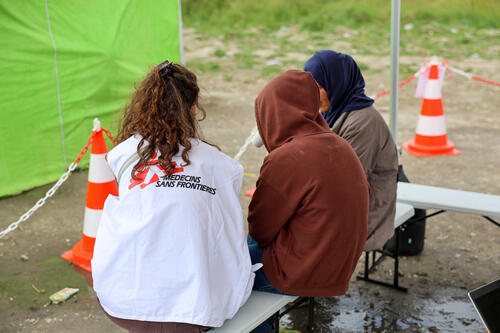
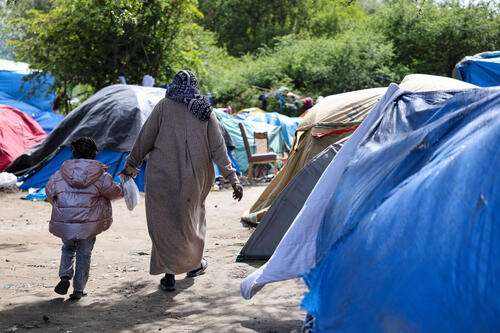
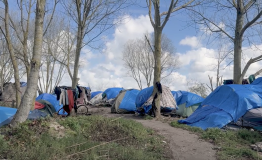
In northern France, near Dunkirk, more than a thousand displaced people are living in makeshift camps with limited access to healthcare. Among them are an increasing number of women, who are oftentimes isolated in remote areas of the camps and are victims and survivors of violence. Every week for the past few months, Médecins Sans Frontières (MSF) has been providing women in the area with much needed gynaecological care and psychological support through our mobile clinic. Victorine Sagot-Priez, a psychologist, and Charlotte Thivoyon, a midwife, explain how they work with women experiencing the profound physical and psychological consequences of violence and displacement.
What are the reasons your patients come to see you?
Charlotte: Patients often come to see me for antenatal care as their pregnancies haven’t been regularly monitored or monitored at all. Some women need safe abortion care. In such cases, I liaise with the hospital’s family planning department and support them throughout the process. Others talk to me about possible sexually transmitted infections, particularly after having suffered sexual violence. In addition, many women suffer from severe period pain, often linked to female genital mutilation they underwent in their country of origin.
Yet, regardless of their medical issue, the priority for these women is to find somewhere safe to sleep, somewhere to wash, something to eat, food for their children, or to obtain medication. Whilst they are concerned about their pregnancy and health, these women’s overriding concern is, above all, to survive. In this context of extreme precarity, where basic needs are not guaranteed, it is impossible for them to receive regular medical care.
Victorine: The women I meet mainly suffer from anxiety, which they are seeking to alleviate. They also often report repetitive thoughts, insomnia, flashbacks, hypervigilance and physical symptoms including difficulty breathing and racing heartbeat. Many of our patients find themselves in a state of psychological ambivalence, torn between the impossibility of giving up on crossing the Channel to reach the UK and the fear of dying.
This ambivalence is compounded by the traumatic events experienced on their migration journey and the living conditions in the camps, which seek to discourage them from staying in France. “They don’t want us to stay, but they puncture our boats when we try to set sail and tear down our tents, time and time again,” one patient told me.
The conditions for survival here in northern France intensify pre-existing trauma and add new layers to it, thus exacerbating the symptoms. When a patient mentions her insomnia – as she must remain on alert all night because her tent’s zip offers little protection – the shadows of a person or gunshots in the camp can trigger a traumatic memory from the past.
I sometimes meet women who are mentally exhausted and who describe their daily struggles, particularly intrusive memories of rape they have suffered — experiences they have not yet been able to speak about. Care that includes a gynaecological component, combined with a psychological approach, is therefore particularly valuable, as it also enables healing through the body.
How do you approach your work?
Victorine: I treat every consultation with a patient as a one-off encounter; I may never see her again. Speaking about their experiences can be a first step to healing. However, it’s a delicate balancing act carried out in partnership with our patients, as these women are still exposed to violence in an unsafe environment that can trigger memories of past trauma.
Many women experience shame and guilt about the violence they have suffered. I have met women who had never spoken to anyone about what they had been through, convinced that they were partly to blame.
Many women experience shame and guilt about the violence they have suffered. I have met women who had never spoken to anyone about what they had been through, convinced that they were partly to blame.Victorine Sagot-Priez, MSF psychologist
Charlotte: Here, we’re reaching people who are completely excluded from the healthcare system, which is not adapted to their situation anyway. I only see patients in a highly vulnerable state, whom nobody cares about apart from the associations providing basic humanitarian assistance in the area. We don’t know if the person will cross over to the UK the same evening we have met her, or the next day; we don’t know if we’ll see them again, or if they will attend their follow up session.
Are you able to build a rapport with your patients, despite the circumstances?
Charlotte: Building a connection is tricky because, as I said, we may only see our patients once. The women we work with can cross the Channel at any time, and once they reach the UK, medical care we were providing ends.
So, knowing this, I try to plan ahead as much as possible. For instance, for our pregnant patients, I know that during the birth, care at the hospital will be complicated, as there will have been no prior monitoring of the mother or baby. No one will know, for example, whether my patient can give birth vaginally. The medical teams, even in A&E [emergency department], won’t have the information needed to assess her condition.
I make sure I always clearly explain to the patient the signs of an emergency or serious condition that would require her to go to hospital urgently. I make sure the patient is fully aware of the 112-emergency number and that she knows what to do if she has contractions or is bleeding. This also means working with the women to prepare them for various eventualities, such as the consequences of female genital mutilation on childbirth, and informing them about the option of requesting an epidural. If they have never given birth in Europe, they may not necessarily be aware of this.
Victorine: It is very important to build a connection with these women who are seeking safety; it is the first step towards providing care. These women have had to leave their home countries to escape forced marriage or female genital mutilation, because they were unable to live freely or were exposed to violence or armed conflict.
The consultation allows them space to build the trust necessary to break free from those patterns of control in which they often find themselves trapped. Establishing a relationship of trust is a key therapeutic tool to help them continue to rebuild their self-confidence and rebuild their lives.
France
Unaccompanied minors in Marseille need continued support as MSF teams shift focus
Project Update
27 Aug 2026
Refugees, IDPs and people on the move
One in one out: Lives at risk between France and the UK
Documentary
22 May 2026