


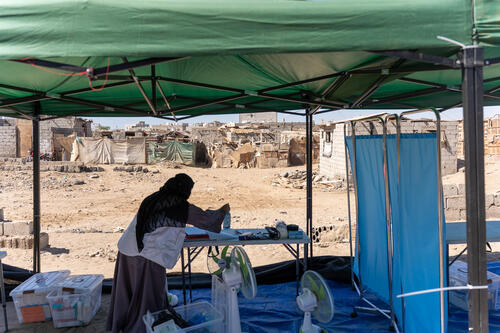
In the south of Yemen, a recent escalation of fighting is displacing many families. Médecins Sans Frontières (MSF) teams are responding by supporting health facilities and reaching people through mobile clinics. Here are five things to know about the current situation in the south of Yemen.
1. What is currently happening in Yemen and on its western coast?
In September 2026, the Ansar Allah forces launched a rapid military operation down the western coast of Yemen, seizing strategic areas like the city of Mocha and Bab Al-Mandab Strait. The incursion reached the vicinity of the third largest city in Yemen, Taiz, with roads and access to the south being blocked. In return, the internationally recognised government in Aden, backed by Saudi Arabia, announced a counter-offensive on 5 October, and fronts are reported to be progressing towards Bab Al-Mandab and Dhubab. Today [8 October], territorial control remains unclear.
This escalation has led to a significant influx of displaced people fleeing the captured areas across the west coast. It further increases the needs of people who are already grappling with years of conflict and humanitarian crisis, as well as extremely high levels of acute malnutrition, cholera and acute watery diarrhoea, measles, and other communicable diseases.
2. What is the humanitarian situation?
Across Yemen, more than 22 million people are in urgent need of humanitarian support and around 5.2 million people are displaced, according to UNHCR.1
This latest escalation is taking place against the backdrop of an already severe and chronically underfunded humanitarian crisis in the country. More than 200,000 people have been displaced due to the insecurity in the past month, according to the UN.2 As MSF teams have observed in recent mobile clinics, displaced people have had to undertake very long journeys to reach safer areas, often on foot, across desertic lands, with high temperatures and limited access to food and shelter.
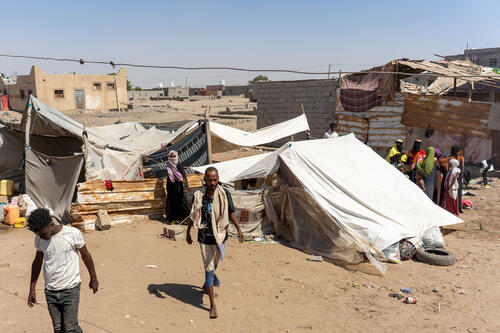
Many have settled around Lahj governorate, and in the outskirts of Aden. They are in critical need of medical and humanitarian support, including water and sanitation services in the informal places where they settle, such as schools and mosques. The risk of waterborne diseases, like cholera, is increasing rapidly in the current conditions.
The ongoing escalation is adding new pressure to an already overstretched medical system. The availability of health facilities, which was already affected by the humanitarian crisis, is now affected by the resumption of hostilities, as facilities have less capacity to respond to people’s ever-increasing needs.
3. What are the most pressing medical needs that MSF teams are seeing?
Food insecurity and loss of livelihoods is leading to an increase of malnutrition cases, cholera is on the rise, and access to health services and referrals are compromised.
In the many camps across Lahj and Aden governorates, 70 per cent of the patients treated by MSF mobile clinics are women and children. People present with skin infections, fever, diarrhoea, and communicable diseases. The long walks have caused foot injuries and ear and eye infections. Displaced people who cannot find shelter in host communities, and formal or informal camps have been seen by our teams on the road or sleeping under the shade of trees.
4. How is MSF responding?
MSF is focusing on continuity of care, while supporting the health authorities to respond to increased medical and humanitarian needs. Medical needs were already very high in Mocha, a port city, before the escalation, with many of the women arriving for labour at Mocha General hospital being malnourished.

We continue to support the paediatrics and maternity services at Mocha General hospital, where we received 567 patients between the 10 September and 6 October at the emergency department, and assisted in 45 deliveries.
In the general healthcare centre supported by MSF in Khokha, north of Mocha, the medical teams are providing an average of 130 to 160 consultations per day, with 2,122 patients seen at the triage during the same period. The cholera treatment unit has also been reactivated in the healthcare centre of Khokha.
In early September, we pre-positioned emergency medical kits in the two general healthcare centres in Khokha and Mafraq Al-Mocha, as well as in Dhubab's general healthcare centre. Up until now, our teams have not treated trauma injuries directly.
In response to the needs of displaced people, we sent mobile clinics across Aden and Lahj governorates, with 775 total consultations since 15 September. Twenty children were diagnosed with severe acute malnutrition. Assessments across south Yemen are being carried out to identify camps and improvised settlements where people have limited access to healthcare.
To support the health authorities in their response to the emergency, we are carrying out capacity building activities in Ibn Khaldoun hospital in Lahj, and four trauma kits were sent to Taiz hospitals. MSF is also providing support to trauma services and donations at the emergency department of Al-Jumhouria hospital in Aden.
We continue to further assess ways of adapting our operations to respond to people’s emerging needs.
5. What more can be done?
An urgent and rapid scale-up of the humanitarian response is needed to address acute and growing needs. Displaced people who are living in dire conditions urgently need food, water and sanitation services, shelter, and essential items.
Humanitarian organisations and the authorities must ensure and expand access to healthcare for the people affected by the crisis. Displacement, insecurity, and overstretched services are leaving many unable to reach urgently needed care.
In this context of heightened insecurity, civilians and healthcare must be protected at all times.
Yemen
Yemen: Renewed fighting puts pressure on the health system and increases people's humanitarian needs
Project Update
15 Sep 2026

Yemen
As conflict engulfs Mocha, health workers keep hospital open
Voices from the Field
11 Sep 2026
DRC Ebola outbreaks
Ebola disease outbreak spreads like a megafire in North Kivu as new hotspots multiply
Project Update
5 Oct 2026