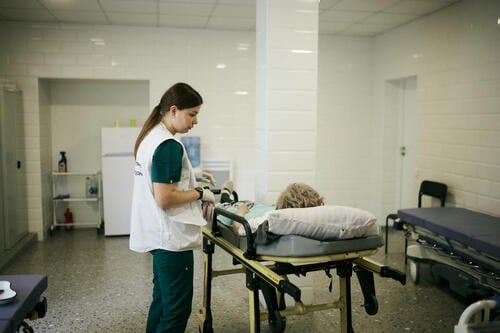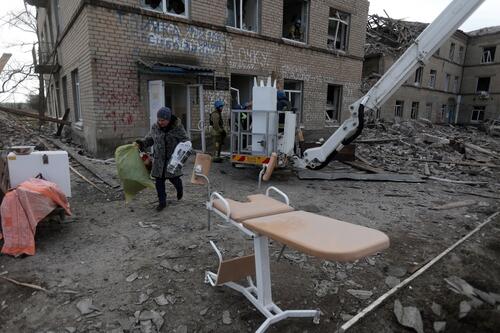
- MSF’s latest report indicates that attacks on healthcare in Ukraine are too consistent to be a random consequence of war.
- Attacks on healthcare are impacting people’s ability to reach care, as well as medical staff’s ability to provide it.
- All parties must uphold their obligations under international humanitarian law, and states with influence over Russia must demand an end to attacks on healthcare.
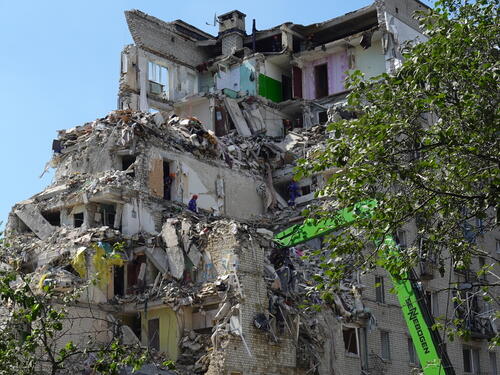
Médecins Sans Frontières’ (MSF’s) latest report, No Safe Place to Heal, was released today. The report documents relentless attacks on healthcare and medical personnel in Ukraine, which appear to constitute a deliberate strategy to destroy the medical system and collectively punish people — rather than being an incidental product of Russia's invasion.
Between April 2022 and December 2025, MSF documented more than 20 attacks on medical facilities associated with our activities. Four hospitals where MSF worked have been completely destroyed. Seven ambulance bases had to be abandoned. We have lost access to over 80 villages that we supported with mobile clinics across six regions.
The World Health Organization documented 2,811 attacks on healthcare from February 2022 to the end of 2025, and Ukraine’s Ministry of Health reports that Russian forces have damaged or destroyed over 2,500 medical facilities in the same period. This includes 327 that have been completely destroyed.
“These attacks are too consistent, too frequent, and too precise to be incidental; when hospitals are struck repeatedly, when ambulances are targeted with precision drones, when medical workers are killed en-route to delivering medicines in clearly marked vehicles – this is not coincidence,” says Robin Meldrum, MSF country coordinator for Ukraine. “This is a pattern; patterns have intent behind them.”
This is a pattern; patterns have intent behind them.Robin Meldrum, MSF country coordinator for Ukraine
Strikes on medical infrastructure and the crippling fear of attacks on civilians have created a crisis in access to healthcare for people in need of non-emergency medical treatment or treatment for chronic conditions.
An MSF survey of 187 civilians in near-frontline regions found that those who ‘always’ or ‘most of the time’ had access to healthcare diminished from 72% before the war’s escalation to just 35% since. Those accessing care ‘rarely’ or ‘never’ rose from 7% to 35%. This translates directly into suffering and even death from manageable conditions, such as cardiovascular disease, diabetes, and epilepsy. These have become life-threatening due to interrupted treatment and delayed access.
Healthcare facilities that remain operational are cruelly understaffed: in one MSF-supported hospital in Kherson, the number of doctors has fallen by 66 per cent since 2022.
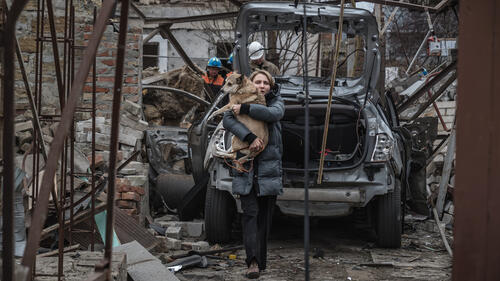
MSF teams in eastern and southern Ukraine work under the constant threat of first-person view (FPV) drone attacks — weapons that allow soldiers to identify and strike targets with precision in real time. On 29 September 2025, a nurse and a director from an MSF-supported health centre, who were delivering medicines in a clearly marked vehicle in Lyman, Donetsk, were struck by a Russian FPV drone. The director lost a leg in the attack. Under international humanitarian law, deliberately attacking clearly marked medical personnel or vehicles may amount to a war crime.
MSF medical workers near the frontline, and in an early rehabilitation treatment centre in Cherkasy, are witnessing how drone warfare is fast outstripping the medical response. Where injuries were once predominantly caused by artillery, drone strikes now account for a growing share of trauma cases — producing multiple victims with multiple simultaneous wounds, higher infection rates, and rising rates of sepsis.
An MSF surgeon described a patient who arrived with an amputated right leg, an open fracture of the left leg, an open fracture of the right arm, shrapnel in the left arm, and multiple wounds to the chest, abdomen and head. Five surgeons operated on the patient simultaneously for around six hours.
“The first battle is against bleeding,” says the surgeon. “If the patient survives that, the second battle is against infection. And many lose that second fight.”
The first battle is against bleeding. If the patient survives that, the second battle is against infection. And many lose that second fight.MSF surgeon in Ukraine
This year marks ten years since the adoption of United Nations Security Council (UNSC) Resolution 2286, which unequivocally reiterates the protection of humanitarian and medical personnel, patients, and healthcare infrastructure in armed conflict.
MSF calls on all parties to uphold their obligations under international humanitarian law; on states with influence over Russia to use it to demand an end to attacks on healthcare; and on the UNSC to properly investigate and make public denunciations about attacks on healthcare as a way of showing commitment to Resolution 2286.
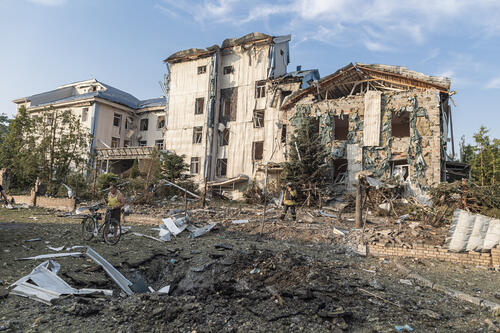
Ukraine
Russian attacks in Kyiv damage Ukrainian ambulance station and injure medical personnel
Statement
2 Jul 2026