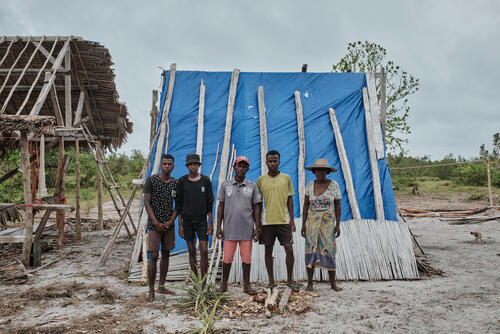
Andriamanantena Tsiva Aurélien with his family in front of their house, partially destroyed by the cyclone.

Andrianantenaina Tsiva Aurélien, 48 years old, 3 children, lives in Fokontany Antanambao V, Commune Nosy Varika.
He is the president of the fishermen's association of Nosy Varika district.

Batsirai has had serious consequences for fishing. After Batsirai, fish are increasingly scarce, which heavily affects the daily income of fishermen. If before Batsirai they had an income of 30,000 to 40,000 Ariary (about 9 euros) per day, now they barely have an income of 4,000 to 5,000 Ariary (about 1 euro).

Despite the warnings, Tsiva Aurélien still decided to stay in his house on the day Batsirai hit the island. It was only when he saw the walls of his house flying away that he decided to leave, but he was injured in the arm and the material losses were considerable.
After Batsirai, they could no longer return home and were forced to stay in the disaster shelters. For the time being, they are living on the few provisions they have left.

Aware of the ephemeral nature of humanitarian aid, Tsiva Aurélien wants to embrace a more permanent solution. And as president of the fishermen, he is thinking of having a cold room to be able to extend the supply of maritime products to other localities than Nosy Varika, in order to increase their daily income.

Faced with climate change, the president of the fishermen is planning on fish breeding techniques. As the weather has become uncertain, fishermen are perishing at sea because of the bad forecasts. Lacking meteorological equipment, they cannot rely on their experience. Traditionally, they rely on nature to predict the weather. That's what they've always done: observe the colour of the sky, the direction of the wind, the shape of the clouds... The decision to go fishing or not depends on these observations.
He hopes to play the safety card by turning to fish farming. 
The acquisition of "lifeboats" would also make it possible to respond to the risks of accidents at sea. Indeed, from the age of 14, children leave school to join the ranks of the fishermen, and already at a very young age come up against the dangers of the sea and the vagaries of bad weather. 

The total number of fishermen in the district of Nosy Varika is about 700 people, of which 360 are members of the fishermen's association.
Andriamanantena Tsiva Aurélien (centre) with his family in front of their house, which was partially destroyed by Cyclone Batsirai. Nosy Varika district, Madagascar, March 2023.
© iAko M. Randrianarivelo/Mira Photo

At COP28, more failure on climate change is not an option for vulnerable communities

Andriamanantena Tsiva Aurélien (centre) with his family in front of their house, which was partially destroyed by Cyclone Batsirai. Nosy Varika district, Madagascar, March 2023.
© iAko M. Randrianarivelo/Mira Photo
Ebola disease in DRC: find out how we're responding
Learn more

Geneva – Too little is being done to protect the most vulnerable people against the negative impacts of climate change, warns Médecins Sans Frontières (MSF). World leaders gathering in Dubai for the COP28 conference on climate change must take urgent measures to protect the health of the most affected communities.

“The world’s most vulnerable people are paying with their health and their lives for a problem they did not create,” says Dr Christos Christou, MSF International President. “It is both absurd and tragic that those who are the least responsible for the emissions that generate the climate emergency are left to suffer the consequences. This shows that we are not just in a crisis of climate, but also in a crisis of humanity and solidarity.”

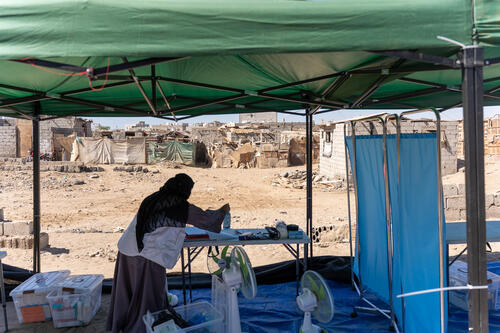
The climate emergency is a health and humanitarian emergency. Severe health impacts of climate change are already affecting people across the globe and are projected to increase over time as the planet heats up. MSF works in many of the world’s most climate-vulnerable settings and treats patients experiencing the health impacts of climate change first-hand.

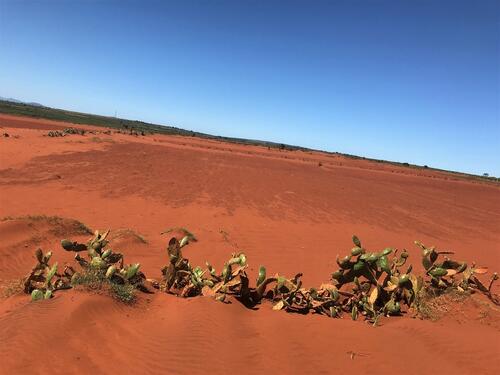
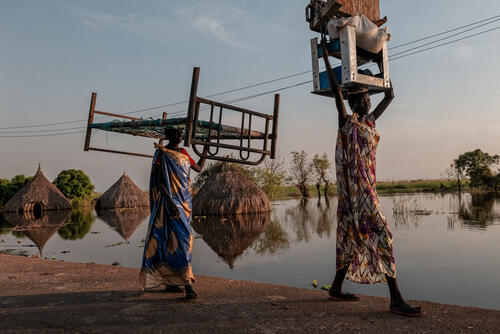
In 2023, we have continued to witness and respond to the consequences of such events, including widespread flooding in South Sudan, severe cyclones in Myanmar, Madagascar and Mozambique, and relentless heat and extended droughts that have driven millions to the edge of starvation throughout the Horn of Africa. We have also responded to multiple concurrent cholera outbreaks in several countries and alarmingly high rates of dengue across the Americas. The deadly mix of malaria and malnutrition has kept our paediatric wards full across the Sahel, including in eastern Chad, where people fled to from gruesome conflict in Sudan.

Dr Christos Christou, MSF International President “This is not a future problem; it is happening now. We see it in our waiting rooms. And it is happening because global political leadership has failed to deliver on commitments to curb emissions and deliver on their promises to support countries.”
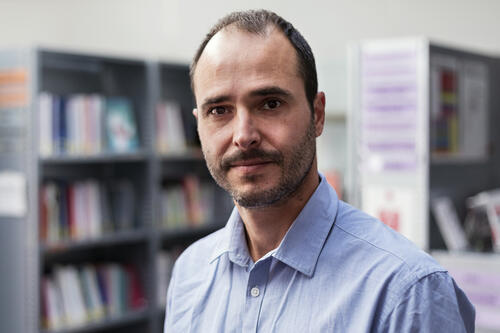
Dr Christos Christou commenced his role as International President of Médecins Sans Frontières in the first week of September 2019. Before this, he held a number of roles in the field with MSF and with the Association in MSF Greece. Dr Christou joined MSF in 2002, where his first assignment was in Greece as a field doctor, working with migrants and refugees, before working as a doctor in an HIV/AIDS project in Zambia in 2004 and 2005. After a break from field missions for a number of years while he trained as a surgeon, from 2013 he joined MSF missions in a number of conflict zones and insecure contexts, including South Sudan, Iraq and, most recently, Cameroon, as an emergency and trauma surgeon.
Portrait of Dr Christos Christou, MSF International President. Geneva, Switzerland, September 2019.
© MSF/Pierre-Yves Bernard

“This is not a future problem; it is happening now. We see it in our waiting rooms,” says Dr Christou. “And it is happening because global political leadership has failed to deliver on commitments to curb emissions and deliver on their promises to support the most affected countries to adapt.”  

As the Parties to the Conference take stock of the progress to meet climate goals, it is already clear that lack of climate action has put people’s health at great risk. Failing to cap global heating at 1.5 degrees Celsius is an existential threat for many people in the humanitarian contexts where MSF works.

The most affected communities and countries have repeatedly asked for, but are not receiving, the support they need to deal with the consequences of climate change. They need real commitment to reduce greenhouse gas emissions and they need concrete financial and technical support. These communities need to see climate action that equals the scale of the climate emergency. The world cannot continue to look on as humanitarian crises become more severe, and the world’s most vulnerable people continue to bear the consequences.

“We cannot afford another failure,” says Dr Christou. “How many more years will go by, how many more COPs, and how many more lives will be affected – or lost – before concrete measures are decided and acted upon?”