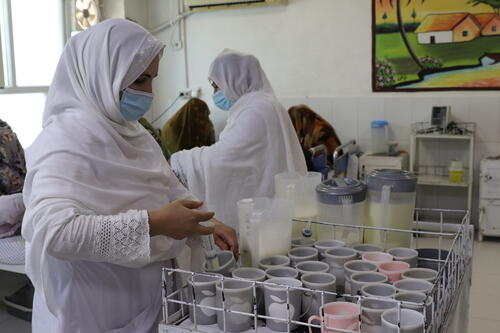
- An alarming number of children with severe malnutrition are being admitted to inpatient therapeutic feeding centres which MSF supports or runs in southern Afghanistan.
- Recurrent droughts and border closures are worsening this critical situation.
- Donors, health authorities and relevant organisations must urgently prioritise and restore funding for nutrition programmes across Afghanistan.
Kabul, Afghanistan — Médecins Sans Frontières (MSF) has witnessed an alarming increase in the number of children suffering from severe acute malnutrition with medical complications who require lifesaving treatment in our therapeutic feeding centres in southern Afghanistan.
“Children are reaching us far too late in the process, and they often present in critical condition with preventable medical complications,” says Ana Lilia Banda, MSF medical coordinator in southern Afghanistan. “This reflects not only worsening food insecurity, but also the breakdown of systems designed to detect and treat malnutrition at an early stage.”
“An effective response requires different elements of care that are all working — from outpatient services that identify and treat uncomplicated cases, to inpatient care for critically-ill children,” says Banda. “Restoring this full range of malnutrition services is essential to prevent avoidable deaths.”
Children are reaching us far too late in the process, and they often present in critical condition with preventable medical complications.Ana Lilia Banda, MSF medical coordinator in southern Afghanistan
Between January and April 2026, the admission of severely malnourished children to the MSF-supported inpatient therapeutic feeding centre (ITFC) in southern Afghanistan increased by over 30 per cent on average compared to the same period over the last three years — with most children being younger than one year old.
This increase signals a deterioration in the food security situation people in Afghanistan are facing. This is placing significant strain on MSF’s capacity to respond effectively to people’s needs. We are urgently calling for the prioritisation of funding and resources for nutrition support, to prevent the nutrition situation in southern Afghanistan from worsening further.
Significant reductions in international funding since early 2025 have led to the suspension or closure of 445 health facilities, including 203 mobile health and nutrition teams, in 2025, according to data shared by the World Health Organization (WHO). These services previously played a key role in community-based screening, early detection, and the provision of care.
The situation is further compounded by recurrent droughts, which have reduced crop yields and progressively intensified food insecurity and economic hardship.1 At the same time, border closures linked to regional geopolitical tensions have disrupted the supply chain of therapeutic food into the country and increased food prices, undermining availability and worsening overall access to food for people, particularly affecting pregnant women and mothers.
“Malnutrition is not only a medical issue but also a social issue,” says Banda. “Exclusive breastfeeding during the first six months of life followed by appropriate complementary feeding is essential to meet an infant’s nutritional needs.”
Malnutrition is not only a medical issue but also a social issue.Ana Lilia Banda, MSF medical coordinator in southern Afghanistan
“But when mothers themselves do not have enough to eat, how are they expected to feed their babies?” asks Banda. “We are seeing many malnourished children less than one year of age, often accompanied by their mothers or caregivers who are also in need of care.”
Since the beginning of 2026, admissions to the MSF-supported ITFC at Boost Provincial hospital, in the southern province of Helmand, reached a monthly record-high when compared to same period over the last five years. Between January and April 2026, over 1,500 children with severe acute malnutrition with medical complications were admitted, which is more than double the number recorded during the same period in 2022.
Between January and April 2026, MSF’s ITFC in Kandahar admitted over 570 malnourished children. In addition, more than 300 patients were redirected to other health facilities. The demand for treatment is far greater than what our teams can support, even after increasing our capacity.
MSF has already scaled up our response in Helmand and Kandahar. However, with the seasonal peak in malnutrition now underway, we are deeply concerned that rising needs will continue to outpace the current humanitarian response.
MSF calls on donors, health authorities and relevant organisations to urgently prioritise and restore international and domestic funding for nutrition programmes across Afghanistan. An uninterrupted supply of specially formulated food and essential medical supplies must also be ensured. Without immediate action, the crisis risks worsening, leaving more children without access to the lifesaving care they urgently need.
MSF runs seven projects in Bamyan, Helmand, Herat, Mazar-i-Sharif, Kandahar, Khost and Kunduz, with a particular focus on delivering specialised healthcare services. Currently, MSF is providing nutritional support for children with malnutrition in Helmand, Herat and Kandahar provinces. In 2025, 9,388 children were admitted to MSF-supported inpatient therapeutic feeding centres, and 3,166 children were enrolled in outpatient therapeutic feeding centres.
Afghanistan
Afghanistan: MSF denounces the detention of staff member amid growing restrictions on women
Statement
12 Jun 2026