
On the morning of 3 November, Russian forces attacked Dnipro, Ukraine, reportedly killing at least two people and injuring 20 others. The attack damaged residential buildings, a thermal power plant, a general healthcare centre and a local hospital where almost 100 patients were receiving treatment. Damage to the hospital forced the transfer of patients to other medical facilities.
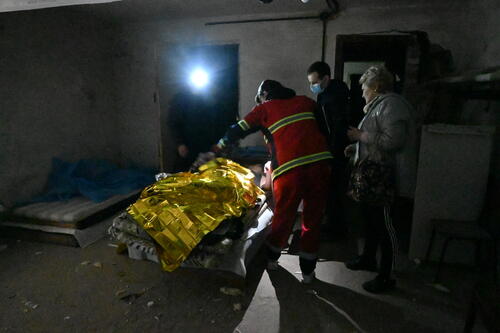
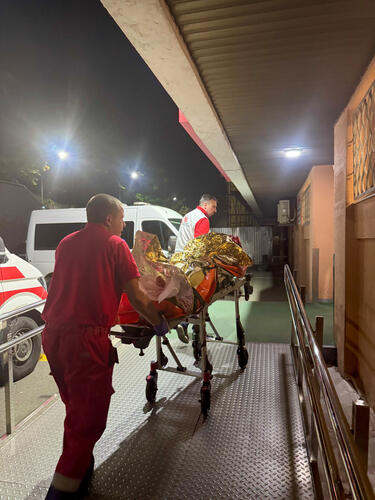
Médecins Sans Frontières (MSF) evacuated two patients from the damaged hospital by ambulance to ensure they could continue receiving medical care.
“There were people with disabilities in the hospital, as well as people wounded in previous shellings. It was clear they were terrified. There was broken glass everywhere; windows and doors had been smashed,” says Yuliia Omelchuk, an MSF paramedic, describing the situation she witnessed.
The hospital provides specialist healthcare consultations for residents of Dnipro and displaced people who have had to leave towns and villages to the East. It also offers surgical, therapeutic and palliative care. Damage to the facility has disrupted access to essential medical services for people who require ongoing treatment.
One of the patients evacuated by MSF was Roman, who had already spent a month in hospital recovering from a fractured femur. His left leg was in an external fixation device when the attack occurred.
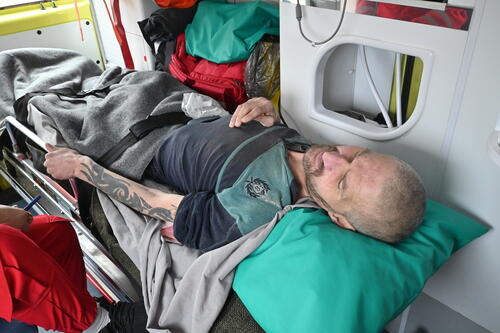
“I started hearing explosions during the night. In the morning, there were loud noises again. The second explosion blew out two windows in our ward. The door was also blown off and fell on top of me. Now I’ve broken the foot on my other leg, the one that was uninjured before,” he explains.
Roman’s ward neighbour was an elderly man living with dementia. “When the debris fell on him, he couldn’t even understand what had happened. And I couldn’t move, couldn’t escape, couldn’t even stand up. It was very frightening,” Roman says.
According to the World Health Organization (WHO), more than 3,400 attacks on healthcare in Ukraine had been verified since the beginning of the full-scale invasion up to 3 November 2026. The WHO also reported 590 attacks on healthcare since the beginning of 2026, resulting in more than 250 casualties, including 31 deaths.
Between 2022 and 2025, MSF teams have witnessed or responded to more than 20 attacks on hospitals.
“These attacks by Russian forces on the basic essentials of civilian life just keep coming,” says Robin Meldrum, MSF country director for Ukraine. "Whether targeted or indiscriminate, they surely amount to serious violations of international humanitarian law. For people who are already living under daily threats from missiles and drones, attacks on hospitals should be unthinkable, but here in Ukraine they are an ever-present risk.
"Last night’s attacks, where medical facilities were also reportedly hit in Kharkiv and Kherson cities, should make it clear to everyone that this needs to stop.”

Ukraine
Temporary ceasefire enables MSF to deliver medicines to Kherson villages near frontline
Press Release
2 Nov 2026
Ukraine
Another senseless Russian attack kills and wounds several people in Dnipropetrovsk
Crisis Update
25 Oct 2026
Haiti
Haiti: Civilians and medical facilities must be spared in surge of violence in Port-au-Prince
Press Release
28 Oct 2026