



Ebola disease in DRC: find out how we're responding
Learn more
2094 Results
 
She’s standing there with her bare feet in the mud. She’s gently carrying her last granddaughter in her arms. The little one suffers from a severe disability. Nantiek is tired but she speaks with confidence and strong words. She’s been through so much difficulty since her, and her family fled from their village next to Leer, around 120 km away.
South Sudan

Grandma Nantiek in Bentiu Protection of Civilians camp

“Our house was looted, our cattle were looted, we had to flee, and we couldn’t stay. We left everything behind,” says Nantiek, repeating the story of hundreds of families. Voices from the Field - 19 Sep 2016
 
Somali refugees in Dadaab refugee camp carry their sick and malnourished children to a new feeding center run by MSF at the outskirts of the sprawling refugee camp.
Refugees, IDPs and people on the move

Reality Check: UN High-Level Meeting on Refugees and Migrants

MSF urges world leaders not to turn a blind eye on the suffering faced by millions of refugees and migrants around the globe. Report - 19 Sep 2016
 
The MSF mobile clinic parked in one of the IDP camps of Habbaniyah Tourist City in the Amariyat al-Fallujah area around 30 kilometers away from Fallujah. At some point in the not so distant past, Habbaniyah, which nestles the big Lake Habbaniyah, was tipped to become a top tourist attraction outside Baghdad. Nowadays, the city’s 300 plus-room hotel has been used by IDP families fleeing the violence in Fallujah and Ramadi; Lake Habbaniyah that serves as the main water reservoir is also the place where all the sewage is dumped. In July 2016, MSF’s mobile clinic has conducted a total of 1921 consultations in IDP camps the Amriyat al-Fallujah area.  Morbidities include:  upper respiratory tract infections, urinary tract infections and gastric disorders.
Iraq

MSF operations in Iraq

MSF continues to expand its operations in deeply affected areas of Iraq, such as Anbar province, in order to provide essential medical care to the most vulnerable. Photo Story - 16 Sep 2016
 
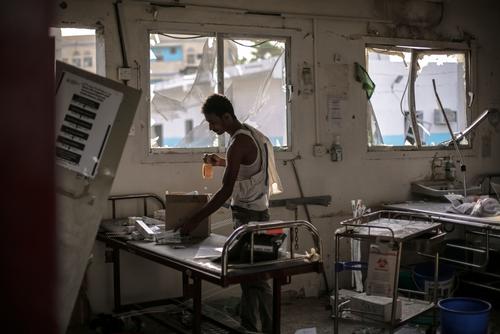
MSF Medical team leader, Crystal Vanleeuwen in front of the outpatient department in Al-Thawra hospital in the besieged area of Taiz. A siege has been imposed on the city by Houthis since late August 2015. MSF was not able to enter medical aid into the enclave area for five months. Only on January 16th, MSF got the authorization and delivered medical aid to Al-Thawra hospital inside the enclave area.
Yemen

Healthcare at breaking point

"In the public hospitals that are still functioning in Yemen, beds are full – those people who are able come from all over the country to access what medical care is available," says Crystal van Leeuwen, an MSF nurse. "For others, all that remains are private clinics that, in the current economic crisis, people can barely afford." Voices from the Field - 9 Sep 2016
 
Since the closure of the Jordan/Syria borders on 21 June, war-wounded Syrians have been systematically denied entry through Jordan’s northwestern borders to Ramtha hospital, where MSF runs an emergency trauma surgical project to treat those injured in the ongoing conflict in Syria. What was once a busy hospital has been left with very few patients, yet MSF operations continue at same speed to attend to the medical needs of war-wounded Syrians.
Jordan

You are so close, yet so very far because you are unable to reach those in need

By Hardik Vyas, otherwise known as “Tonny”, a surgeon at MSF’s Ramtha emergency surgical project Voices from the Field - 9 Sep 2016
 
Mustafa is a volunteer in one of MSF supported hospitals in the city of Aleppo
Syria

We cannot go and leave our people behind; we do not have the right to leave them alone

Mustafa Karaman volunteers as a physiotherapist in one of the only eight functional hospitals in east Aleppo, where 250,000 people are now living under siege and constant bombing, and medical staff like Mustafa are fighting a daily struggle to care for the sick and the wounded. Voices from the Field - 9 Sep 2016
 
There are an estimated 15,000 people in Bama camp – most of these people are women and children under the age of five. People are living inside a camp surrounded by the Nigerian army. Boko Haram fighters are stationed a few killometres away from Bama camp, the town is empty, and it is like a ghost town. The only people who remain in Bama are inside the camp. 

We returned to Bama on August 17th to carry out our emergency response. We reached a total number of 3,293 children under the age of five. We treated 513 malnourished children (4.2% have severe malnutrition and 10.9% have moderate malnutrition).  
Our operational aim was to reduce morbidity and mortality among children under the age of five by providing treatment and food for one month.
We took Non Food Items (mosquito nets, soap), therapeutic food for malnourished children (plumpy nut) and a food blanket ration targeting malnourished children’s household (oil, emergency food, rations and beans). 
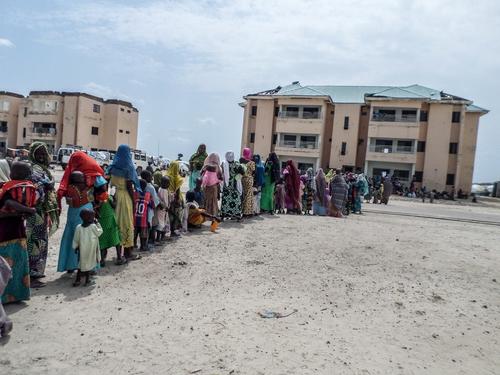
We started our distribution at 7am and there were people as far we could see. There were lines and lines of women and children. We screened the children for malnutrition as we distributed the items. 
Our operation strategy is to return to Bama every month for the next two months. 

There is an Outpatient clinic run by the Ministry of Health and UNICEF but very few patients go to the clinic because there are not enough medicines there. In addition the Nigerian Air Force opened few days ago an hospital in front of the camp’s entrance. 

Most people in the camp live in make shift corrugated iron shelters – with sheets of metal not offering much protection against the rain or elements. 
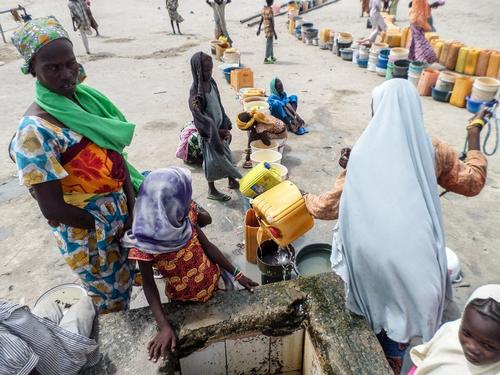
Now some people have plastic sheeting on their shelters and tents but there are no windows so it’s very hot inside these shelters and they’re not sustainable. There is also an issue around water. There isn’t enough water for the number of people in the camp. here is nine bore holes in the camp and only seven are functioning, this is not covering the needs of the 15,000 people in the camp.
Nigeria

Malnutrition is the biggest problem in Bama

Interview with MSF project coordinator Hakim Khaldi Voices from the Field - 7 Sep 2016
Four mothers posing in a corridor of the Hospital in Bili. All four of them are staying in the hospital with their child, that's suffering from a severe case of malaria. Since the beginning of the project in 2016, the pediatric ward already treated more than 4.000 cases of complicated/severe form of malaria.
Médecins Sans Frontières (MSF)

Independent medical humanitarian assistance

We provide medical assistance to people affected by conflict, epidemics, disasters, or exclusion from healthcare. Our teams are made up of tens of thousands of health professionals, logistic and administrative staff - most of them hired locally. Our actions are guided by medical ethics and the principles of independence and impartiality. We are a non-profit, self-governed, member-based organisation.

Learn more