



Ebola disease in DRC: find out how we're responding
Learn more
8016 Results
 
A young boy waits for his family member outside of the MSF sponsored Kinoni Centre de Sante in Ruhengeri province, Rwanda. 2005  In October 2002, MSF started the preparations for a reproductive health program in Ruhengeri: the maternity ward of the provincial hospital in Ruhengeri and 6 health centers in Gitare health district. .  Working closely with local community actors, this program has various areas of intervention: obstetrical emergencies, medical and psychological care for survivors of sexual violence, implementation of family planning in the health centers and, among access to the minimum package of health care to the whole population of this 6 health centers, maintenance of all general reproductive health services (staff training, sexually transmitted infection prevention, delivery and post-natal care and improving health during pregnancy). In early 2005, the program also integrated HIV/AIDS (but ending end of the year) and sexual violence constituents, with psychological support to women victims of sexual abuse.  To assure the financial access for care to the population, the project negotiates low flat fees, as well as insuring free care for the poorest section of society.
Africa

Rwanda

MSF closed its projects in Rwanda in 2007. Country
 
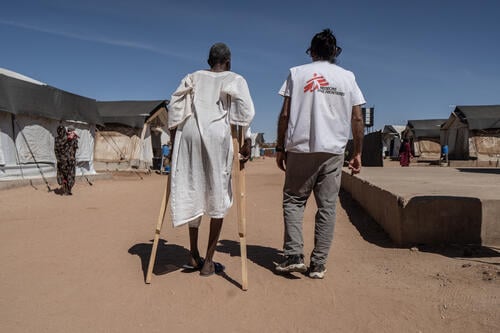
TAWILA, North Darfur, Sudan — March 2026: A man injured during fighting in El Fasher in October 2025 walks on crutches outside the MSF hospital in Tawila, escorted by Hussein, a longtime Médecins Sans Frontières (MSF) medical coordinator. Tawila has become a critical refuge for hundreds of thousands fleeing violence in and around the besieged city of El Fasher, where humanitarian organizations such as MSF provide lifesaving medical care to war-wounded civilians and severely malnourished children. (Photo by Giles Clarke/OCHA)
In Focus

Conflict in Sudan

Find out the latest information on MSF's response to the conflict in Sudan. Topic
 
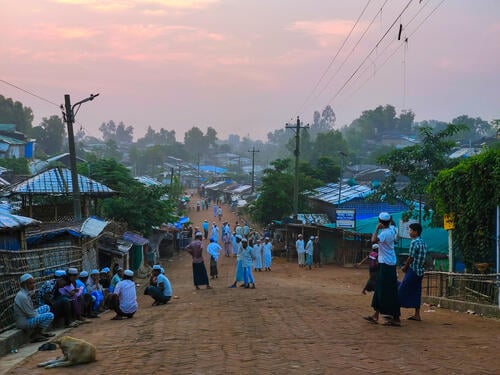
Rohingya refugees meet up and talk in the streets of the camps. Cox’s Bazar, Bangladesh, October 2023 © Ro Yassin Abdumonab

Des réfugiés rohingyas se rassemblent et discutent dans les camps de Cox’s Bazar. Cox’s Bazar, Bangladesh, octobre 2023 © Ro Yassin Abdumonab
Crisis settings

Social violence and exclusion

Many people are unable to access healthcare simply because of who they are. They may be afraid to seek help, or are excluded because they are forced to live outside of mainstream societal bounds. Topic
 
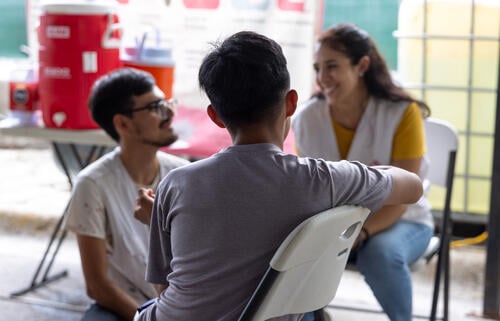
Two MSF staff chat with a child at the Pumarejo Shelter in Matamoros, a town in the northern Mexican state of Tamaulipas.
In Focus

Central American migration

The Central American migration route, from Panama to Mexico’s northern border with the United States, is punctuated by violence. Topic
 
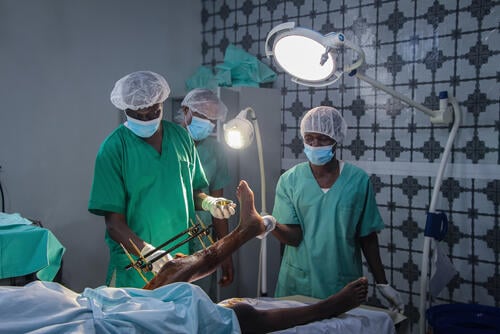
In the operating theatre of the Salama clinic in Bunia, a team of surgeons and anaesthetists from the Ministry of Health and MSF work together to treat trauma patients. In their first year of operation, the teams performed 2,050 operations at the Bunia surgery centre, Ituri, 2 June 2024.
Africa

Democratic Republic of Congo

In DRC, MSF runs some of its largest medical relief operations, working in 17 of 26 provinces, responding to diseases outbreaks, conflict and displacement, and tackling health problems such as HIV/AIDs. Country
 
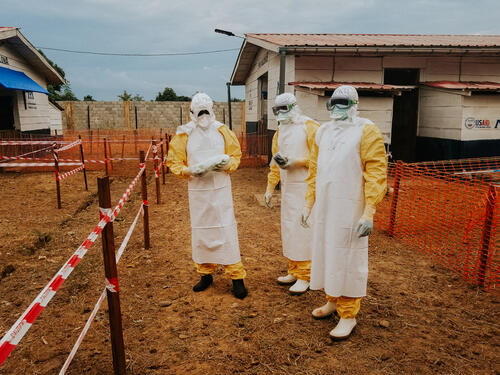
Dr Papy Dieya, MSF doctor, and two staff of the Congolese Ministry of Health at the Wangata Ebola Treatment Centre, Mbandaka, DRC.
Medical activities

Ebola and haemorrhagic fevers

Ebola and haemorrhagic fevers are rare but deadly. Outbreaks can kill up to 90 per cent of those infected, spreading fear and panic among affected communities. Topic
 
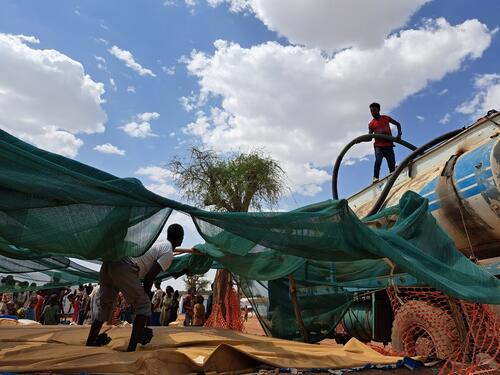
MSF provides clean water to Aby Aday IDP camp in Sheraro, Tigray. MSF re-started activities in Tigray in November 2022. Water and sanitation activities are a key priority to prevent the spreading of water borne diseases. In Sheraro, MSF team are trucking up to 1.4 million litres of water to serve six IDP camps every day.
Africa

Ethiopia

In Ethiopia, we fill gaps in healthcare and respond to emergencies such as cholera and measles outbreaks. Country
 
Amman, Jordan. 27 August, 2024.

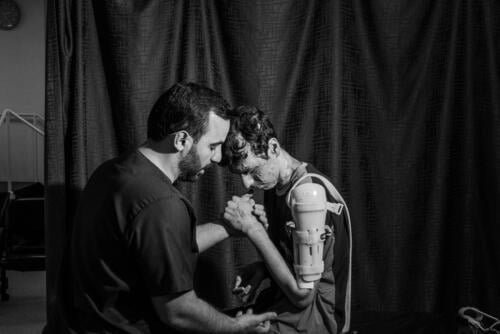
Karam, 17, from Nuseirat Camp in central Gaza, during a physiotherapy session at MSFÕs Reconstructive Surgery Hospital in Amman, Jordan. Karam nearly died after his familyÕs house was leveled by an Israeli airstrike. He suffered severe burns to his face and other areas of his body, and also suffered a serious injury to his arm. He is receiving comprehensive reconstructive surgery and physiotherapy at the MSF hospital in Amman.

International Activity Report 2025

Read the full details of MSF's activities across more than 75 countries in 2025. Annual Report - 17 Jul 2025
 
Amman, Jordan. 27 August, 2024.

Karam, 17, from Nuseirat Camp in central Gaza, during a physiotherapy session at MSFÕs Reconstructive Surgery Hospital in Amman, Jordan. Karam nearly died after his familyÕs house was leveled by an Israeli airstrike. He suffered severe burns to his face and other areas of his body, and also suffered a serious injury to his arm. He is receiving comprehensive reconstructive surgery and physiotherapy at the MSF hospital in Amman.

International Activity Report 2024

Read the full details of MSF's activities across more than 75 countries in 2024. Annual Report - 17 Jul 2025
 
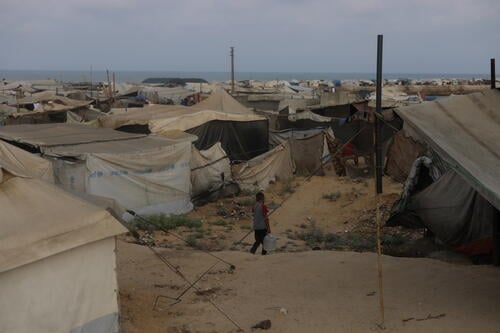
A young boy carries a water jerrycan through the Mawasi Khan Younis displacement tents, where patched and worn-out tents offer little shelter. Israel's ban on fishing and swimming increased the desperate need for fresh water for displaced Palestinians in Gaza.
In Focus

Gaza-Israel war

Learn how MSF teams are responding to the genocide in Gaza, Palestine. Topic
Four mothers posing in a corridor of the Hospital in Bili. All four of them are staying in the hospital with their child, that's suffering from a severe case of malaria. Since the beginning of the project in 2016, the pediatric ward already treated more than 4.000 cases of complicated/severe form of malaria.
Médecins Sans Frontières (MSF)

Independent medical humanitarian assistance

We provide medical assistance to people affected by conflict, epidemics, disasters, or exclusion from healthcare. Our teams are made up of tens of thousands of health professionals, logistic and administrative staff - most of them hired locally. Our actions are guided by medical ethics and the principles of independence and impartiality. We are a non-profit, self-governed, member-based organisation.

Learn more