



Ebola disease in DRC: find out how we're responding
Learn more
2094 Results
 
msf-placeholder
Central African Republic

Heavy fighting resumes in Bria despite peace agreement

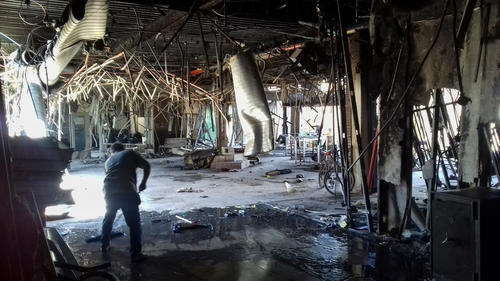
Médecins Sans Frontières (MSF) teams witnessed the resumption of fighting today in Bria, a town in the east of Central African Republic (CAR), despite the peace agreement signed yesterday between the government and different politico-military groups active in the country. Press Release - 20 Jun 2017
 
Outpatient Department in the Bidibidi MSF Health Center - paediatric consultation.

Outpatient Department dans le centre de santé MSF de Bidibidi - consultation pédiatrique.
Uganda

Despite generous policy, basic needs of refugees are not being met

“Even though we are pumping and treating record amounts of water in Palorinya, it’s only just barely enough for the population.” Press Release - 19 Jun 2017
 
Diffa town, the maternal and paediatric health centre. Kaka Wali, seen here, is 20 years old.  Kaka was discharged from the hospital two weeks ago. As part of her medical follow-up she is having a medical consultation with Dr Camara Broulaye. Last May, she was admitted to the intensive care unit due to severe complications related to hepatitis E. She suffered a miscarriage whilst in a coma. In addition to medical care, Kaka also received mental health support.
Niger

Hepatitis E outbreak in Diffa – 186 pregnant women admitted to hospital

The hepatitis E outbreak declared two months ago in southeastern Niger is particularly affecting pregnant women. Project Update - 19 Jun 2017
 
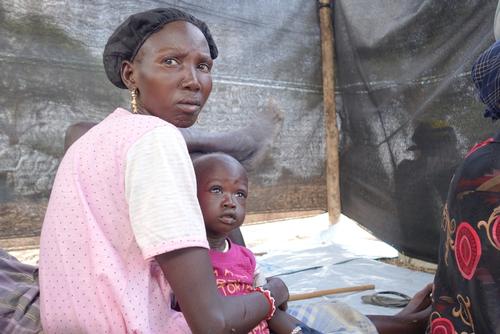
A peuhl family in the Gobolo enclave. During the November 2016 fighting in Bria, peuhl people were especially targeted. They now stay in the Gobolo neighbourhood under Minusca protection. This family just arrived in Gobolo a few days ago. Their camp has been attacked a bit more than two weeks ago, eight men, two women and a baby were killed and all their cattle stolen. Those women and children hided in the bush and slowly made their way to Gobolo for protection. They have lost everything.
Central African Republic

“I’m a civilian, not a fighter. Why did they attack me?”

The humanitarian response is slow in coming to Bria and new arrivals have yet to receive basic necessities, such as plastic sheeting and soap. Voices from the Field - 19 Jun 2017
 
In the ER section of an MSF hospital in Syria, the aftermath of an emergency case, where the patient was stabilised and then immediately rushed into surgery.
Syria

MSF to Resume its Medical Support to East Ghouta

Reports from doctors MSF supports in the area outline grave incidents on 29 and 30 April in which armed groups showed absolutely no consideration for the special protected status of patients, medical facilities and health workers. Press Release - 16 Jun 2017
 
The camps of Ameriyat al Fallujah host around 60,000 Iraqis who have fled violence in other parts of Anbar province. Many are from the city of Fallujah and arrived in June 2016 when the Iraqi forces started an offensive to retake the city from the so-called Islamic State.  Living conditions in the camps are harsh and have an adverse effect on people’s physical and psychological health, but returning home is still impossible for the majority.
Iraq

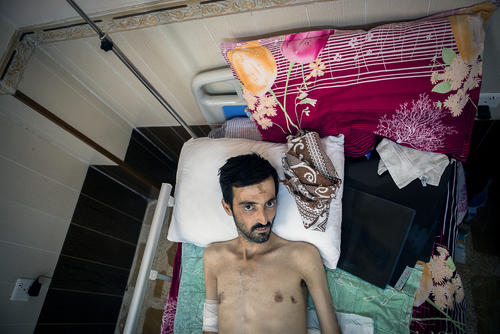
Mental health needs mount after years of war

Iraq’s recent history has been dominated by wars. Generations of Iraqis have grown up in shattered families, living in camps or among the rubble of their home towns. Each conflict has left its scars, both visible and invisible. Project Update - 15 Jun 2017
 
People are building huts on the grounds of the mission. They are afraid of going back to their neighborhoods as they fear new fighting between the autodefense groups and members of the Union pour la Paix en Centrafrique (UPC).
Central African Republic

Scores dead and thousands displaced as conflict erupts in Alindao

Conflict has erupted in recent weeks in several cities in the Central African Republic (CAR). In Alindao, in the centre of the country, more than a hundred people have been killed and thousands have been displaced. Voices from the Field - 9 Jun 2017
 
MSF teams  working in Menbij camp to provide humanitarian assistance for Syrian IDPs, north Syria.
Syria

Airstrikes or minefields – Raqqa’s residents face a deadly choice

As fighting intensifies for control of the Syrian city of Raqqa, people must decide whether to remain in the city and surrounding villages under heavy bombardment, or leave the area by crossing active frontlines and minefields, says international medical organisation Médecins Sans Frontières (MSF). Press Release - 9 Jun 2017
 
Thérèse Erede, 45, wounded by gunfire. Bambari's hospital.
Central African Republic

Will Bambari be next?

‘Will Bambari be next?’ This is the question on everyone’s lips in Central African Republic’s second city and commercial hub. Its residents worry that the violence engulfing the cities of Bangassou and Bria since early May – in the form of brutal massacres – could soon spread to Bambari, a repetition of the bloodshed of the 2013-2014 war. Project Update - 8 Jun 2017
 
William Nyuon Kuolang, 41, is a father of 5. He used to live in Yuai, a place he fled on the 15th of February 2017 following some fighting between the SPLA and opposition groups. Since then, he lives with his family in a village near Pieri.
South Sudan

“They killed the women, the girls, everybody in the town”

"I left Yuai on 15 February because of the fighting. I left running, there was no time to take anything," says William Nyuon Kuolang, 41, a father of five. Voices from the Field - 2 Jun 2017
Four mothers posing in a corridor of the Hospital in Bili. All four of them are staying in the hospital with their child, that's suffering from a severe case of malaria. Since the beginning of the project in 2016, the pediatric ward already treated more than 4.000 cases of complicated/severe form of malaria.
Médecins Sans Frontières (MSF)

Independent medical humanitarian assistance

We provide medical assistance to people affected by conflict, epidemics, disasters, or exclusion from healthcare. Our teams are made up of tens of thousands of health professionals, logistic and administrative staff - most of them hired locally. Our actions are guided by medical ethics and the principles of independence and impartiality. We are a non-profit, self-governed, member-based organisation.

Learn more