



Ebola disease in DRC: find out how we're responding
Learn more
8009 Results
 
With approximately 5.3 million people infected with HIV, South Africa has the highest number of people living with HIV/AIDS of any country. In November 2003, the South African government approved a new national HIV/AIDS plan that added life-extending antiretroviral (ARV) therapy to the existing protocol and set a goal of treating 600,000 people with ARVs by 2008.
MSF operates a rural HIV/AIDS program in Lusikisiki, in the Eastern Cape province, one of the country's poorest areas. The program has tested more than 600 people for the virus each month and has demonstrated an HIV-positive prevalence of 30 to 40 percent. MSF manages opportunistic infections in 11 rural clinics and in the district hospital and began offering ARV treatment in the clinics in November 2003.
Access to medicines

MSF puts drug patents under the spotlight

"Developing countries should not hesitate to check and challenge the validity of patents," says Ellen 't Hoen of MSF. "This is already beginning to happen in some countries, such as Kenya and Thailand." Press Release - 22 May 2003
 
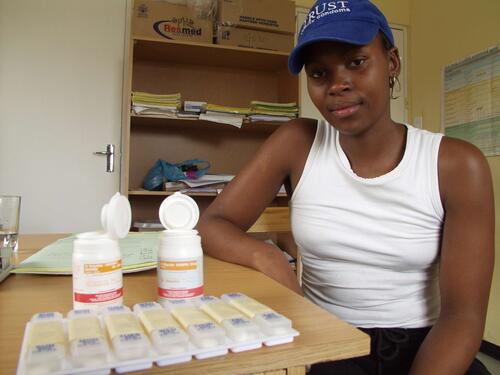
Patient following the ARV treatment in Khayelitsha, a township near Cape Town, South Africa.
Access to medicines

Drug Patents Under the Spotlight: Sharing practical knowledge about pharmaceutical patents

Patents have been one of the most hotly debated topics on access to essential medicines since the creation of the World Trade Organization (WTO) and the conclusion of the Agreement on Trade Related Aspects of Intellectual Property Rights (TRIPS) in 1994. Report - 22 May 2003
 
msf-placeholder
Democratic Republic of Congo

MSF working again in Bunia

MSF is worried about the situation in Ituri Region of the Democratic Republic of Congo and demands access to vulnerable civilians. Press Release - 21 May 2003
 
msf-placeholder
Democratic Republic of Congo

MSF opens 11 health posts near DRC cease-fire line

Previous MSF surveys in the zones have indicated that one in three children dies before the age of five. In some villages the people have to survive in the most basic conditions. We saw extremely fragile people, locally called the 'living skeletons'". Project Update - 16 May 2003
 
msf-placeholder
Democratic Republic of Congo

MSF vaccinating 80,000 children in Banalia

Because the vaccination area was spread over 100 square kms, the campaign was four times the number of people than a 'normal', large vaccination campaign in the DRC. Difficult conditions further complicated the effort. Project Update - 16 May 2003
 
msf-placeholder
Ethiopia

An estimated 3,000 to 4,000 children suffer fromacute malnutrition in Damot Gale district

250 MSF staff are responding to this emergency situation where MSF has opened two Therapeutic Feeding Centres in Boditi and Buge for children in need of treatment. MSF is intending to extend its capacities in the near future with additional programmes including high-energy rations and feeding centres. Press Release - 14 May 2003
 
msf-placeholder
War and conflict

MSF sends medical teams to help civilians wounded in Chechnya bomb blasts

The latest explosions in Znamenskoe and Gudermes region, resulting in a high number of casualties and wounded, show once again that the situaton in Chechnya is far from normal contrary to declarations made by the authorities. Press Release - 14 May 2003
 
msf-placeholder
Russia

Some 200 people call on government to do more to find and free kidnapped aid worker

In a statement May 12, MSF said that kidnapped volunteer Arjan Erkel is alive but his location remains unknown. Arjan was taken on August 12, 2002. See Russian investigators assure MSF that Arjan Erkel is alive Project Update - 13 May 2003
 
msf-placeholder
Access to medicines

MSF message for WHO member country delegations to 56th World Health Assembly

MSF, Oxfam and HAI are writing to present our concerns related to access to medicines. This issue will be discussed at the 56th World Health Assembly (WHA) on 19-28 May under the agenda items "IPRs, Innovation and Public Health" and "WHO's Medicines Strategy". Open Letter - 13 May 2003
 
msf-placeholder
Ethiopia

MSF alarmed at dramatic situation at Ethiopia resettlement site

Inadequate planning of resettlement leads to unnecessary suffering. Press Release - 12 May 2003
Four mothers posing in a corridor of the Hospital in Bili. All four of them are staying in the hospital with their child, that's suffering from a severe case of malaria. Since the beginning of the project in 2016, the pediatric ward already treated more than 4.000 cases of complicated/severe form of malaria.
Médecins Sans Frontières (MSF)

Independent medical humanitarian assistance

We provide medical assistance to people affected by conflict, epidemics, disasters, or exclusion from healthcare. Our teams are made up of tens of thousands of health professionals, logistic and administrative staff - most of them hired locally. Our actions are guided by medical ethics and the principles of independence and impartiality. We are a non-profit, self-governed, member-based organisation.

Learn more