


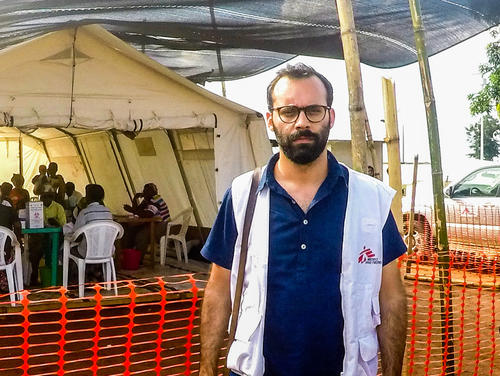

Ebola disease in DRC: find out how we're responding
Learn more
2094 Results
 
JulY 2017 - Syria - Raqqa - Eastern Quarter. The streets destroyed successively by Islamic State and by the heavy armed interventions of the Syrian Democratic Forces (SDF) and the international coalition.  

Jullet 2017 - Syrie - Raqqa - Quartier est - Les rues détruites successivement par L'Etat Islamique et par les interventions lourdement armées des Forces démocratiques syriennes (FDS) avec la coalition internationale.
Syria

Update on situation and humanitarian needs after Raqqa offensive

The battle for Raqqa ended on 17 October, and people left the city under frightening circumstances as the offensive drew closer. Project Update - 20 Oct 2017
 
msf-placeholder
Syria

Crisis update - October 2017

MSF supports more than 70 medical structures – from hospitals to small health posts – located across Syria. Crisis Update - 20 Oct 2017
 
Women wash a plastic sheet, which serves as a roof for their tented shelter, in a stream polluted by rubbish and faeces in Unchiparang makeshift settlement, in Bangladesh, where 33,000 Rohyinga refugees are sheltering after fleeing violence in Myanmar. Beside the stream, children collect water from a hand-dug well. As of mid-October 2017, there is less than one litre of clean drinking water available per person per day in the settlement, which is way below international standards for emergencies.
© Paul Andrew Jabor/MSF
Rohingya refugee crisis

Needs for clean drinking water are still extreme

I have rarely seen so many people, hundreds of thousands, living in makeshift shelters, stranded in an area the size of a small European city, and with very little access to basic services. Voices from the Field - 18 Oct 2017
 
Wounded Iraqi girl Dua Nawaf, 8, who her family was killed in an airstrike in Mosul, sits at a hospital run by Medecins Sans Frontieres in Qayyara, Iraq April 6, 2017. Picture taken April 6, 2016.
Iraq

Returnees to Mosul face booby-trapped homes and destruction

“For many people, the long-anticipated return home is turning sour as they find themselves faced with daunting levels of destruction and seemingly endless misery.” Project Update - 17 Oct 2017
 
Once a week MSF mobile medical teams serve the small settlement south of the town of Tuz Kurmato in  Salaheddin governorate where 4000 displaced people have been living for the last year and a half after their village, a few miles away, became engulfed in violent fighting. Female and male medical staff provide general health care with special focus on chronic diseases, mother and child care as well as mental health support. The community is afraid to travel around in this highly militarized area, particularly men, and are reluctant to see medical care in close by urban settlement such as Tuz Kurmato or Kirkuk.
Iraq

Hawijah offensive pushes nearly 14,000 people to neighbouring districts

“Fleeing Hawijah was so dangerous that people call it the road of death.” Project Update - 12 Oct 2017
 
Portrait of Nouri, 40 Years old from Syria
 
Nouri and his wife decided to flee Syria to save their 4 children from the war. After a few months in Turkey they took the trip 9 times to reach Greece.

“On the 22nd of July we arrived in Greece. Since I arrived in Greece, I felt as if I was born again, all the suffering I forgot, but unfortunately again, not as we expected…I don't know until this moment if we are staying, if we are going… we are like in a prison.”
Greece

EU border policies fuel mental health crisis for asylum seekers

“These people have survived bombing, extreme violence and traumatic events in their home countries or on the road to Europe.” Report - 10 Oct 2017
 
The MSF team prepares to move from one location to the other, Thaker, Leer County, South Sudan, March 21, 2017.
South Sudan

Continuing displacement is the new reality for many along northern frontier

“An older man came and dropped to the ground on his knees... he did not know what to do anymore. He just wept, in the middle of the group, like he had run out of hope.”
Project Update - 6 Oct 2017
 
A man looks at the view of Kutupalong Makeshift Settlement,  one of the main pre-existing settlements where some of the 507,000 new arrivals have sought shelter. Kutupalong and Balukhali, the largest two settlements, have effectively merged into one densely populated mega-settlement of nearly 500,000 people, making it one of the largest refugee concentrations in the world. The situation in the camps is so incredibly fragile, especially with regard to shelter, food and water, and sanitation, that one small event could lead to an outbreak that may be the tipping point between a crisis and a catastrophe, MSF says. There is an acute need for a massive humanitarian intervention focusing on food, clean water, shelter, and sanitation, and a solution is needed to reduce the size of these massive, congested camps.
Rohingya refugee crisis

“If this is the better option, the other must have been a living hell”

"I’ve heard the most horrific stories from women who have lost their husbands just trying to get here...you start to understand how harrowing this situation is." Voices from the Field - 6 Oct 2017
 
Savien Robert Zoulemati, 25, father of a week-old baby, from Yakidi village, near by Ippy. “Because me don’t have money, we went hunting. We were a group of five. After the hunt, we came back to the camp, fixed dinner and get some rest. I was lying down when heavily armed Peuhls (Fulanis) attacked us. They came by the river to not be noticed and started shooting at us. My four companions escaped and I got the bullets, one broke my arm, the second went through my hip, the third wounded my right leg. They took us by surprise, hence it was difficult to know how many they were. My companions had abandoned me and I was left with no help. I held my broken arm to my chest. It took me a lot of energy to get head back to the village, I vomited and bled, I was tired, worn out. My hunting companions had alerted the village and by the evening, my parents came to look for me and bring me back home on their bicycle. Peuhls attack us because they see us as FPRC and anti-balaka.”
Central African Republic

Crisis update - September 2017

Violence has led to over 600,000 people being internally displaced within CAR; MSF is providing medical assistance in several areas throughout the country. Crisis Update - 3 Oct 2017
 
MSF conducts drawing and play sessions with kids at five informal evacuation sites in Iligan City as part of its mental health and psychosocial support (MHPSS) program. 

According to Nur Jannah Barandia, MSF psychosocial worker, it’s important for kids to play and have a sense of normalcy especially in difficult situations.
Philippines

Helping people cope amid conflict in Mindanao

Counselling and water will only get these communities so far, and while Marawi has dropped from international news, the needs of people will last and expand. Voices from the Field - 29 Sep 2017
Four mothers posing in a corridor of the Hospital in Bili. All four of them are staying in the hospital with their child, that's suffering from a severe case of malaria. Since the beginning of the project in 2016, the pediatric ward already treated more than 4.000 cases of complicated/severe form of malaria.
Médecins Sans Frontières (MSF)

Independent medical humanitarian assistance

We provide medical assistance to people affected by conflict, epidemics, disasters, or exclusion from healthcare. Our teams are made up of tens of thousands of health professionals, logistic and administrative staff - most of them hired locally. Our actions are guided by medical ethics and the principles of independence and impartiality. We are a non-profit, self-governed, member-based organisation.

Learn more