



Ebola disease in DRC: find out how we're responding
Learn more
8007 Results
 
msf-placeholder
Angola

Access to safe and free water needs to be guaranteed

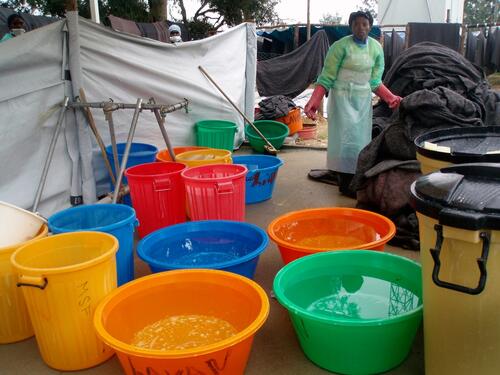
The disastrous state of the water supply and sanitation infrastructure in Luanda and other big cities is the principle reason for the rapid spread of the cholera outbreak in Angola. Press Release - 17 May 2006
 
Second cholera epidemic in Lubango in the year 2006. There were 3626 cholera cases in 3 and half months, 94 people died. MSF managed the cholera treatment centre.
An underlying epidemic of bloody diarrhea in November made the intervention particularly difficult. Within two weeks, 14 of 26 patients with bloody diarrhea died.
Cholera

Murky Waters: Why the cholera epidemic in Angola was a disaster waiting to happen

Since February 2006, Luanda is going through its worst ever cholera epidemic, with an average of 500 new cases per day. The outbreak has also rapidly spread to the provinces and to date, 11 of the 18 provinces are reporting cases. Report - 17 May 2006
 
msf-placeholder
Mental health

After four years, MSF is about to hand over mental health projects in Armenia

Inga Sahakyan from MSF distributes leaflets at the Chambarak village in the north eastern part of Armenia as part of a campaign that is attempting to address some of the population's prejudices about mental illness.
"It is sad for us to leave, but it marks a positive moment in the development of Armenia," MSF Head of Mission, Cedric Roussel.
Project Update - 16 May 2006
 
msf-placeholder
War and conflict

Violence continues in Darfur as MSF treats 46 war wounded from latest attack

Of the wounded, 30 are civilians, including two women and four elderly men. Many of them required urgent surgery. Project Update - 15 May 2006
 
msf-placeholder
Access to medicines

MSF supports opposition to Gilead's tenofovir patent application in India

Patenting tenofovir would set dangerous precendent for global access to newer essential drugs. Press Release - 10 May 2006
 
msf-placeholder
Malnutrition

In El Wak the land might find relief, but malnutrition has taken hold

The carcasses of dead cows, camels and goats are being burned and, for pastoralist people, it is like watching their life savings go up in smoke. It takes many years to rebuild animal herds, but, more immediately, this means less milk, less meat, and a weaker food supply. Malnutrition has started. Project Update - 10 May 2006
 
msf-placeholder
Vaccination

'The epidemic has started' - Responding to a meningitis outbreak in southern Sudan

Dr. Jean-Paul Delain, 53, a pulmonary specialist from Avignon, France, arrived in the village of Akuem, in southern Sudan's Bahr El Ghazal state, at the end of March to evaluate whether the area was in the midst of a meningitis outbreak. By the end of his two-week assessment of villages throughout Aweil East county, MSF had treated almost 60 patients and the epidemic threshold had been passed, prompting MSF to plan a vaccination campaign along a narrow corridor in Aweil East county's midlands section. Project Update - 2 May 2006
 
msf-placeholder
Angola

As the number of infected people reaches 20,000, response to Angola cholera epidemic remains insufficient

"Many factors have conspired to make this cholera outbreak one of the worst ever seen in Angola. But with what we know today there can be no excuse for not doing everything humanly possible to prevent the death toll from climbing much higher," says Richard Veerman, MSF Head of Mission in Angola. Press Release - 27 Apr 2006
 
msf-placeholder
Access to Healthcare

Access to health care - Colombia's cycle of violence

There are many rural medical staff that assume exceptional levels of personal risk to provide medical attention. They frequently recount stories of armed groups exerting pressure and control over their movements or work.
Download the complete MSF report in PDF format: Living in Fear: Colombia's Cycle of Violence (English)
Vivir Con Miedo (Espagnol)
Project Update - 27 Apr 2006
 
msf-placeholder
Access to medicines

World Intellectual Property Day: Governments should ignore the conclusions of WHO report on intellectual property and public health at their own risk

"The CIPIH report clearly signals that innovation is meaningless if the people who need it do not have access to it," said Ellen 't Hoen, Director of Policy and Advocacy at MSF's Campaign for Access to Essential Medicines. Press Release - 26 Apr 2006
Four mothers posing in a corridor of the Hospital in Bili. All four of them are staying in the hospital with their child, that's suffering from a severe case of malaria. Since the beginning of the project in 2016, the pediatric ward already treated more than 4.000 cases of complicated/severe form of malaria.
Médecins Sans Frontières (MSF)

Independent medical humanitarian assistance

We provide medical assistance to people affected by conflict, epidemics, disasters, or exclusion from healthcare. Our teams are made up of tens of thousands of health professionals, logistic and administrative staff - most of them hired locally. Our actions are guided by medical ethics and the principles of independence and impartiality. We are a non-profit, self-governed, member-based organisation.

Learn more