




Ebola disease in DRC: find out how we're responding
Learn more
8003 Results
 
msf-placeholder
Chad

Over 10,000 people flee violence in Chad

"The first attack was the worst, there were over a hundred of them," said a 25-year-old woman from the village of Um Ladja in Chad. "They scared everyone and rounded us up. They took everything and killed anyone who was in the way." Press Release - 16 Jun 2006
 
msf-placeholder
Somalia

Malnutrition on the rise in south-central Somalia

MSF has now admitted more than 600 patients since the beginning of 2006, ten times more than last year for the same period. Project Update - 14 Jun 2006
 
msf-placeholder
Papua New Guinea

Papua hit by simultaneous epidemics

MSF emergency teams fight disease outbreaks in two regions. Papua's health status is the lowest in Indonesia. Limited access to health facilities, lack of health education and poor sanitation leave large parts of the population vulnerable to outbreaks of disease. Project Update - 8 Jun 2006
 
msf-placeholder
Côte d'Ivoire

Another attack against civilians in Ivory Coast 'confidence zone'

"Armed men broke open our door. We all escaped through the window and tried to hide in the forest. Then my baby started to cry and the armed men began shooting in our direction. My baby was hit by a bullet and killed." Project Update - 7 Jun 2006
 
msf-placeholder
Indonesia

Focus on major surgery cases, goods distribution and mental health care as MSF teams continue at Indonesian earthquake zone

Several hundred patients are being cared for in a hospital parking lot. Project Update - 6 Jun 2006
 
msf-placeholder
Indonesia

MSF mobilises to complement Indonesian relief efforts

In the rural areas, MSF is carrying out mobile clinics to identify unmet needs, treat basic wounds and offer other basic medical care. A psychologist offers counseling to patients with psychosomatic complaints. Project Update - 1 Jun 2006
 
msf-placeholder
Indonesia

Local response has been quick but gaps still remain in the aftermath of the Indonesian earthquake

"The threat of a volcanic eruption from nearby Mount Merapi meant that national emergency services were already on stand-by in the area and were able to mobilise immediately. Nevertheless, there are still gaps in the care being offered, and some people continue to wait in the rain without shelter, food or basic survival items." Project Update - 31 May 2006
 
 *** Local Caption *** Les equipes MSF prennent en charge les enfants severement malnutris : les CRENIs accueillent les cas les plus severes ; les centres ambulatoires permettent de suivre chaque semaine les enfants severement malnutris n'ayant pas besoin d'une hospitalisation et de detecter les nouveaux cas.<br> MSF staff take care of highly malnutrished children : CRENI's are taking in most severe cases. Ambulatory feeding programmes follows each week severly malnutrished children who do not need to be hospitalized and allows to detect new cases.

International Financial Report 2005

Annual Report - 30 May 2006
 
SOMALIA, BAKOOL REGION, HUDDUR, 22.06.2004
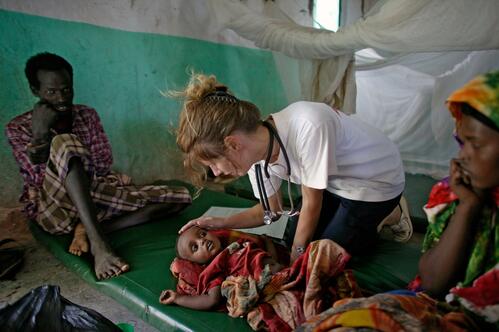
Doctor Ingrid Herder (34) examining Ali Hammad (2)  in the kala azar ward of MSF's health centre in Huddur. Ali has kala azar and is very weak and dehydrated. He is eventually given a sugar-salt solution through nasal tube.
Somalia

Médecins Sans Frontières in the forgotten crisis of Somalia

Médecins Sans Frontières (MSF) has been providing medical care in Somalia since 1986. This document provides a closer look at MSF’s efforts to alleviate the desperate medical situation Somalis continue to endure; a dramatic situation that receives little attention from the international media. Report - 30 May 2006
Four mothers posing in a corridor of the Hospital in Bili. All four of them are staying in the hospital with their child, that's suffering from a severe case of malaria. Since the beginning of the project in 2016, the pediatric ward already treated more than 4.000 cases of complicated/severe form of malaria.
Médecins Sans Frontières (MSF)

Independent medical humanitarian assistance

We provide medical assistance to people affected by conflict, epidemics, disasters, or exclusion from healthcare. Our teams are made up of tens of thousands of health professionals, logistic and administrative staff - most of them hired locally. Our actions are guided by medical ethics and the principles of independence and impartiality. We are a non-profit, self-governed, member-based organisation.

Learn more