



Ebola disease in DRC: find out how we're responding
Learn more
8003 Results
 
msf-placeholder
Cholera

A new cholera treatment centre in the north of Haiti

Click to view video highlights of MSF's activity. Project Update - 16 Nov 2010
 
msf-placeholder
Malta

Photoblog: Malta - Olmo Calvo

Malta – August 2010 Voices from the Field - 16 Nov 2010
 
msf-placeholder
Haiti

Scaling up the response to cholera epidemic

Click to view video highlights of MSF's activity. Project Update - 15 Nov 2010
 
msf-placeholder
Haiti

Cholera epidemic gains ground

Click to view video of MSF's activities. Project Update - 15 Nov 2010
 
msf-placeholder
Haiti

Haiti: MSF steps up its cholera response in Port-au-Prince

"Yesterday we recorded 216 separate cases of cholera arriving at the hospital, while the total number recorded just five days ago was 30," said Stefano Zannini, MSF head of mission in Haiti, last Thursday. "Patients are coming from everywhere, throughout the city, slums and wealthier areas." Project Update - 15 Nov 2010
 
msf-placeholder
Kenya

Urgent humanitarian assistance required for Somali refugees living outside Dagahaley camp

At least 700 Somali families who fled the war in Somalia now face unacceptable living conditions in spontaneous settlements outside the overcrowded refugee camp of Dagahaley in Kenya. The rainy season having just started, their situation has become even more precarious. MSF urgently calls upon the Kenyan authorities and aid actors to reach an agreement to ensure appropriate humanitarian assistance. Press Release - 12 Nov 2010
 
msf-placeholder
Haiti

'All of the hospitals in Port-au-Prince are overflowing with patients'

Cholera outbreak outstripping existing treatment capacity in capital. Project Update - 12 Nov 2010
 
msf-placeholder
Myanmar

MSF calls for increased response to Cyclone Giri aftermath

More than two weeks after Cyclone Giri struck the west coast of Myanmar on October 22, the emergency response is insufficient to meet people’s needs. The cyclone caused massive destruction in villages east and south of Sittwe, Rakhine State. Press Release - 10 Nov 2010
 
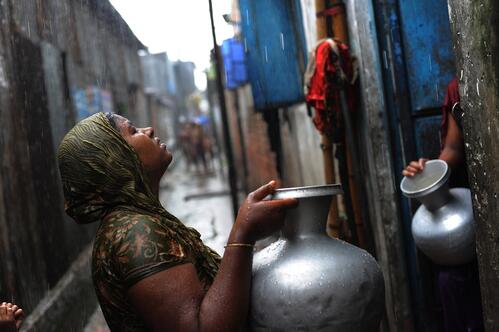
A woman tries to catch the rain water coming from the roof of a house in Muslimbag close to the embankment road in Kamrangirchar.ng women  (PLW) starts.<br />In the Kamrangirchar slum of Dhaka - on the banks of one of the most polluted rivers in the world - MSF runs a primary healthcare centre that provides care to children under five and pregnant and lactating women. Nearby, MSF also runs a therapeutic feeding centre. Through a largely home-based programme, these children are being fed with Plumpy Nut, a thick nutrient-rich peanut paste which helps children regain normal body weight. 
Kamrangirchar is one of Dhaka's many slum areas, a product of the urban mass migration that makes this capital the world's most rapidly expanding city. Development of public services and infrastructure has struggled to keep pace, and access to affordable health care is very limited. Formerly used as a dumping ground for the city's rubbish, the Kamrangirchar peninsula only started to become heavily populated over the last few decades. Covering just three square kilometres, the area is now home to 400,000 people. Through its presence, MSF hopes to bring its expertise and experience in treating malnutrition so that more children and their mothers can continue to live and grow up healthily.
Bangladesh

Photoblog: Bangladesh - Julie Rémy

Dhaka, Bangladesh – August 2010 Voices from the Field - 10 Nov 2010
 
msf-placeholder
Access to medicines

MSF open letter to European Trade Commissioner De Gucht

MSF to EU: Stop the spin, the backdoor policies and the closed-door negotiations that threaten access to affordable medicines Project Update - 8 Nov 2010
Four mothers posing in a corridor of the Hospital in Bili. All four of them are staying in the hospital with their child, that's suffering from a severe case of malaria. Since the beginning of the project in 2016, the pediatric ward already treated more than 4.000 cases of complicated/severe form of malaria.
Médecins Sans Frontières (MSF)

Independent medical humanitarian assistance

We provide medical assistance to people affected by conflict, epidemics, disasters, or exclusion from healthcare. Our teams are made up of tens of thousands of health professionals, logistic and administrative staff - most of them hired locally. Our actions are guided by medical ethics and the principles of independence and impartiality. We are a non-profit, self-governed, member-based organisation.

Learn more