




Ebola disease in DRC: find out how we're responding
Learn more
7999 Results
 
msf-placeholder
Democratic Republic of Congo

MSF emergency team responds to Ebola outbreak

An emergency team from MSF is responding to an outbreak of Ebola haemorrhagic fever in Isiro, northeastern Democratic Republic of the Congo (DRC). So far nine people have died, only one of whom has been confirmed by lab tests as having Ebola. Twelve more people are suspected to have the disease – one has been admitted to the treatment centre in Isiro. Project Update - 23 Aug 2012
 
MOHAMMED PHOTO STORY – with his brother in the Batil field hospital. On a visit to an isolated part of Batil camp, medical coordinator Helen Ottens-Patterson discovers a little boy called Muhammed. He is severely malnourished and needs to be taken to the hospital immediately.
South Sudan

'I have never seen anything like this before'

Helen Ottens-Patterson, from the United Kingdom, is a nurse MSF medical coordinator in Maban county in Upper Nile state, South Sudan. MSF is the largest provider of emergency medical care for the more than 110,000 refugees that have fled fighting in Sudan’s Blue Nile state. In Batil refugee camp, one of four camps in the county, a recent survey carried out by MSF showed that the mortality rate for children under five years old was more than double the emergency threshold. Here, Helen shares her experience in providing care for this particularly vulnerable group of people. Voices from the Field - 22 Aug 2012
 
MSF has been working on the ground in Syria for the past two months, trying to provide humanitarian assistance to people affected by the conflict. With the help of a group of Syrian doctors, in six days a team was able to transform an empty house into an emergency hospital, where wounded people could be operated on and hospitalised.
As of mid-August, MSF has admitted more than 300 patients to this facility and carried out 150 surgeries. The injuries have been largely conflict-related and caused mostly by tank shelling and bombing.
Syria

'Injured people started coming from everywhere'

Surgical specialist Anna Nowak has completed more than 20 missions with MSF. She has just returned from Syria, where she helped to set up the project. Voices from the Field - 21 Aug 2012
 
MSF has been working on the ground in Syria for the past two months, trying to provide humanitarian assistance to people affected by the conflict. With the help of a group of Syrian doctors, in six days a team was able to transform an empty house into an emergency hospital, where wounded people could be operated on and hospitalised.
As of mid-August, MSF has admitted more than 300 patients to this facility and carried out 150 surgeries. The injuries have been largely conflict-related and caused mostly by tank shelling and bombing.
Syria

Two months of operations

MSF has been working in Syria for the past two months, trying to provide humanitarian assistance to people affected by the conflict. With the help of a group of Syrian doctors, a team was able to turn an empty house into an emergency hospital in six days. As of mid-August, MSF has admitted more than 300 patients to this facility and surgeons have carried out 150 operations. Project Update - 21 Aug 2012
 
MSF has been working on the ground in Syria for the past two months, trying to provide humanitarian assistance to people affected by the conflict. With the help of a group of Syrian doctors, in six days a team was able to transform an empty house into an emergency hospital, where wounded people could be operated on and hospitalised.
As of mid-August, MSF has admitted more than 300 patients to this facility and carried out 150 surgeries. The injuries have been largely conflict-related and caused mostly by tank shelling and bombing.
Syria

'We're getting good results despite the difficulties'

Brian Moller is an anaesthetic nurse. He has been working with MSF for nine years and is today an emergency coordinator. This July, Brian managed the surgical hospital set up by MSF in Syria. Voices from the Field - 21 Aug 2012
 
Assitou  receives fluids for rehydration at Donka Cholera Treatment Center in Conakry, Guinea, Aug. 16, 2012.
Guinea is currently struggling to contain a cholera outbreak, which has affected over 3,300 people throughout the country and 2,250 in Conakry and claimed at least 80 lives in the capital, according to the Ministry of Health. MSF team works in extremely impoverished areas of the densely-populated capital, where proper systems for drainage and waste disposal are almost non-existent. Guinea is currently struggling to contain a cholera outbreak, which has affected over 3,300 people throughout the country and 2,250 in Conakry and claimed at least 80 lives in the capital, according to the Ministry of Health. MSF team works in extremely impoverished areas of the densely-populated capital, where proper systems for drainage and waste disposal are almost non-existent. Guinea is currently struggling to contain a cholera outbreak, which has affected over 3,300 people throughout the country and 2,250 in Conakry and claimed at least 80 lives in the capital, according to the Ministry of Health. MSF team works in extremely impoverished areas of the densely-populated capital, where proper systems for drainage and waste disposal are almost non-existent. As of 20 August 2012, MSF, in collaboration with the Ministry of Health, is already running cholera treatment centres and rehydration points in the city, and has treated almost 2800 patients.
Cholera

Cholera epidemic escalates

Cholera is on the rise on both sides of the border between Sierra Leone and Guinea. More than 13,000 people have been admitted to hospital in the capital cities of Freetown and Conakry since February. MSF is opening additional rehydration points and cholera treatment centres, in collaboration with local authorities, and currently has more than 800 beds available to treat cholera patients. Project Update - 20 Aug 2012
 
Yida, Refugee Camp
South Sudan

Health catastrophe continues in refugee camps

Many of the refugees from Sudan’s Blue Nile State who have fled to Maban County in South Sudan’s Upper Nile State had family members who could not complete the journey and died before they reached Batil camp. In some cases, they said their relatives died because they were “tired of walking,” which illustrates the weakened, vulnerable state in which much of this population arrived at the camp. Project Update - 18 Aug 2012
 
msf-placeholder
Democratic Republic of Congo

MSF resumes medical activities in Walikale

MSF has resumed its medical activities in Walikale, four weeks after heavy fighting in the town forced the organisation to stop working. Press Release - 17 Aug 2012
 
msf-placeholder
Central African Republic

Pressing health needs in the country

The Central African Republic (CAR) is a country largely forgotten by the world and to a large extent neglected by the international humanitarian community. Surrounded by Sudan, Chad and Congo where more high-profile crises are taking place, CAR’s dire and desperate health situation – in which few people have access to health care and many die of easily treatable diseases – has received little attention and even less assistance. Project Update - 17 Aug 2012
 
msf-placeholder
Lebanon

Syrians in need of continuous support

As the crisis in Syria intensifies, humanitarian needs are increasing. Medical assistance within Syria is limited, and aid from international organisations has been severely restricted. In neighbouring countries such as Lebanon, Jordan and Iraq, MSF has strengthened its response to the refugees who are crossing the Syrian borders. Project Update - 14 Aug 2012
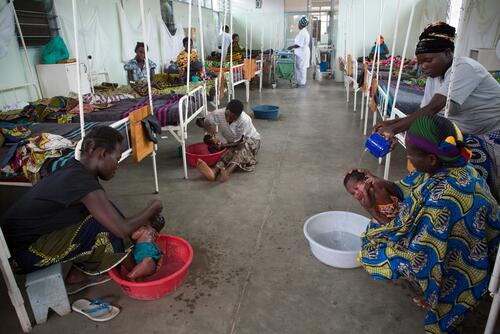
Four mothers posing in a corridor of the Hospital in Bili. All four of them are staying in the hospital with their child, that's suffering from a severe case of malaria. Since the beginning of the project in 2016, the pediatric ward already treated more than 4.000 cases of complicated/severe form of malaria.
Médecins Sans Frontières (MSF)

Independent medical humanitarian assistance

We provide medical assistance to people affected by conflict, epidemics, disasters, or exclusion from healthcare. Our teams are made up of tens of thousands of health professionals, logistic and administrative staff - most of them hired locally. Our actions are guided by medical ethics and the principles of independence and impartiality. We are a non-profit, self-governed, member-based organisation.

Learn more