



Ebola disease in DRC: find out how we're responding
Learn more
8009 Results
 
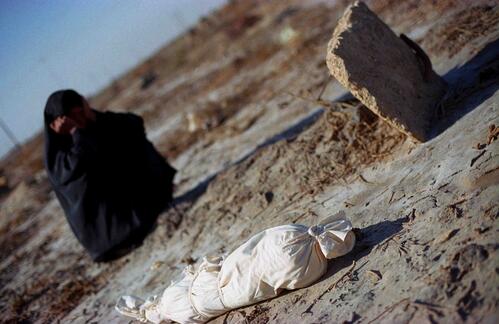
A mother grieves beside the grave of her one young son, killed in a bombing. The body of her 3 year old daughter, who died after contracting cholera awaits burial.
Iraq

A different approach to mental health

Over the past two years, Médecins Sans Frontières (MSF) has helped pioneer a different approach to mental health in Iraq. A team is working with the Ministry of Health to introduce counselling. Project Update - 12 Dec 2012
 
THIS IMAGE IS TO BE USED EXCLUSIVELY FOR THE PROMOTION OF THE URBAN SURVIVORS PROJECT. ALL PUBLICATION NEEDS TO BE ACCOMPANIED BY THE WEBDOCU ADDRESS. www.urbansurvivors.org MORE IMAGES CAN BE PURCHASED DIRECTLY FROM MEDIAS TO NOOR. www.noorimages.com PLEASE DO NOT ADD TO PHOTO GALLERIES DIRECTLY ON SOCIAL MEDIAS. IT STILL CAN BE USED AS THUMBNAIL TO LINK TO MSF PAGES or TO STORIES PUBLISHED ON ONLINE TRADITIONAL MEDIA THAT ARE RELATED TO THE URBAN SURVIVORS PROJECT. Not to be cropped or altered in any way without prior permission from NOOR.
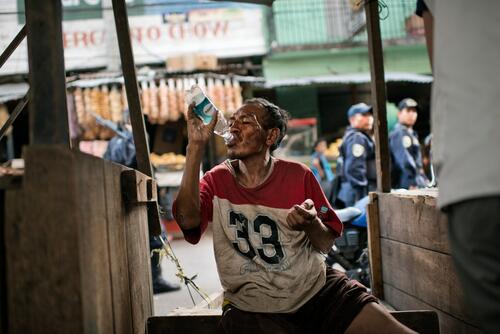
Heavily armed Hondurian police walk past a homeless man at the Mercado Las Americas.In Tegucigalpa, everyone lives with the fear of a violent death. While those who are better off can afford to barricade themselves in neighbourhoods patrolled by private armed guards, the poorest residents of the city are confined to a shrinking public space where the risk of violence and abuse – physical, sexual and psychological – is increasing.
Social violence and exclusion

The medical consequences of violence

The impact of violence in Central America and Mexico cannot be understated. Widespread violence and its dramatic medical consequences are threatening to become a humanitarian crisis, while health systems are unable to cope. The lack of adapted policies to respond to this emergency means that many survivors of violence are left without access to healthcare, support or protection. Project Update - 11 Dec 2012
 
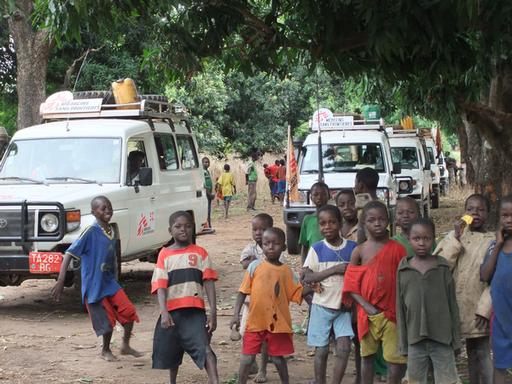
An MSF Team arrives in a village in northwest Central African Republic near Boguila to carry out interviews for a new mortality study.
In April 2012, a MSF team conducted a survey in the northwest prefecture of Ouham, in and around Boguila, where MSF manages a hospital. The team collected data on the number of people who had died in those households since the start of June 2011, and asked interviewees how the deaths occurred and where they had taken place. The data collected gives MSF a clearer picture of the health status of the population in the area, and will help the organization determine its future medical activities. The team found an "alarmingly high" number of children under the age of five are dying in parts of the Central African Republic. A lack of easily accessible health care was a principal reason, with 60 percent of those dying at home and 13 percent on the road to hospital.
Central African Republic

"As many children die here as in a war zone"

In the forests of Central African Republic, children under five are dying in numbers normally seen only in wars or natural disasters. MSF nurse Margarete Sepùlveda is doing her bit to change this.
By Nils Mork
Voices from the Field - 10 Dec 2012
 
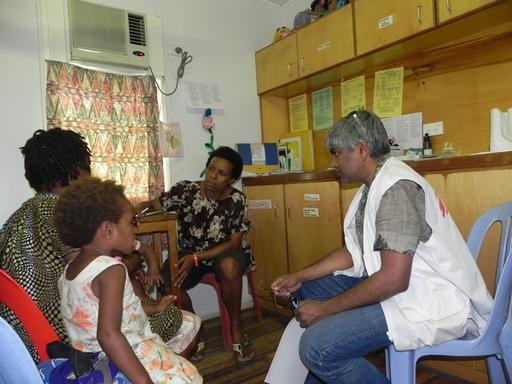
Dr. Unni Karunakara, International President of MSF, consults with a survivor of family and sexual violence at the MSF family support centre in Lae,Papua New Guinea, where women receive medical and psychological assistance for what is considered one of the most endemic problems on the island nation.  Women who come to the centre receive an essential package of care including medical and psychological first aid, the provision of post-exposure prophylaxis for HIV infection, vaccinations for Hepatitis B and tetanus and contraception to prevent unwanted pregnancies.
Papua New Guinea

Victims of sexual violence must not suffer in silence

Every day, a woman in Papua New Guinea suffers the consequences of being raped and beaten by a member of their own family. Voices from the Field - 7 Dec 2012
 
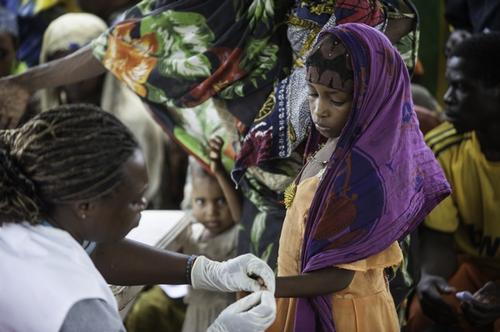
A local health worker takes a blood sample from a young girl in Mboki, in the south-east region of the Central African Republic.  A MSF team spent 13 days in the village and screened 4,548 people for sleeping sickness. Four people received treatment.
Sleeping sickness

National control activities crippled by lack of funding

Advances in the development of new diagnostic tests and treatment bode well for the fight against sleeping sickness. Two new rapid screening tests are expected next year, and one new oral treatment is in clinical trial. However, national control activities on the ground are crippled by a lack of sustainable funding, warns MSF. Press Release - 6 Dec 2012
 
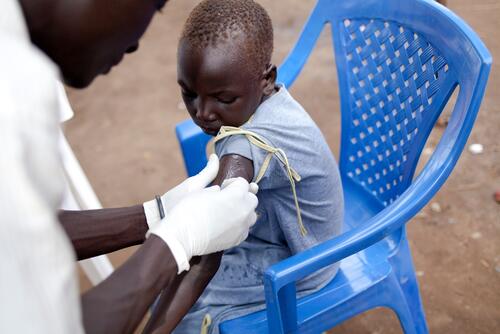
In Doro, South Sudan MSF vaccinating one of the last 10 children against Measles of a campaign reaching 22.014 children in 3 days. Measles vaccinations are a key part of MSF refugee response - measles is a real threat to anyone not vaccinated.
Vaccination

GAVI needs to offer lower vaccine prices to humanitarian actors

The GAVI Alliance should systematically extend the prices it obtains for vaccines to humanitarian actors that are often well placed to reach unvaccinated children, MSF said today at the GAVI Partners Forum meeting in Tanzania. Currently, humanitarian actors such as MSF are not able to access these prices, and are left to negotiate access to vaccines on a cumbersome case-by-case basis. Press Release - 5 Dec 2012
 
msf-placeholder
Global health

Visions for the future of healthcare and how we're going to pay for it

Speech by Dr Unni Karunakara, Médecins Sans Frontières International President, at the Global Healthcare Summit, The Economist, London, 29 November 2012 Speech - 30 Nov 2012
 
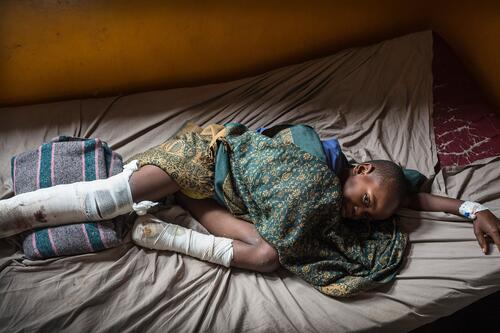
Eden, a nine-year-old boy, was seriously injured in the recent fighting between the Armed Forces of the Democratic Republic of Congo (FARDC) and the M23 rebel group in Goma, eastern Congo. He is one of 60 wounded patients currently being treated by MSF teams and local health staff in Virunga hospital. Goma, North Kivu.
Democratic Republic of Congo

Nine-year-old Eden wounded in Goma violence

Eden, a nine-year-old boy, was seriously injured in the recent fighting between the Armed Forces of the Democratic Republic of the Congo and the M23 rebel group in Goma, eastern Congo. He is one of 60 wounded patients currently being treated by MSF teams and local health staff in Virunga hospital. Voices from the Field - 30 Nov 2012
 
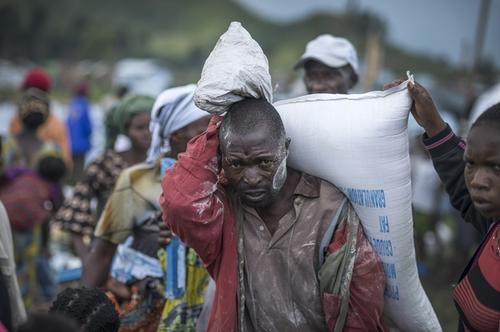
Displaced people. Mugunga 1 camp, Goma, North Kivu.
Democratic Republic of Congo

Critical humanitarian situation in east of country

An already fragile humanitarian situation in eastern Democratic Republic of the Congo has deteriorated further after the border city of Goma fell to M23 rebels last week. Teams from MSF have rapidly set up additional emergency response activities, treating victims of violence and providing assistance to newly displaced people in and around Goma. Project Update - 30 Nov 2012
 
msf-placeholder
Morocco

"In Morocco migrants are trapped in a constant cycle of violence"

Interview with David Cantero, Médecins Sans Frontières (MSF) head of mission in Morocco Voices from the Field - 29 Nov 2012
Four mothers posing in a corridor of the Hospital in Bili. All four of them are staying in the hospital with their child, that's suffering from a severe case of malaria. Since the beginning of the project in 2016, the pediatric ward already treated more than 4.000 cases of complicated/severe form of malaria.
Médecins Sans Frontières (MSF)

Independent medical humanitarian assistance

We provide medical assistance to people affected by conflict, epidemics, disasters, or exclusion from healthcare. Our teams are made up of tens of thousands of health professionals, logistic and administrative staff - most of them hired locally. Our actions are guided by medical ethics and the principles of independence and impartiality. We are a non-profit, self-governed, member-based organisation.

Learn more