



Ebola disease in DRC: find out how we're responding
Learn more
8007 Results
 
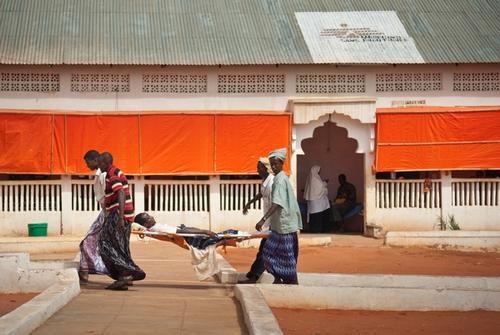
Patient on stretcher being carried to ward.
Many international staff were based here in previous years. But due to the insecurity, the hospital is now completely run by Somali staff paied and employed by MSF. It is MSF general policy to have all its structures ‘weapon free’. At the entrance of the Guri-el Hospital, all persons entering the hospital compound are checked with a metal detector. As a result of the ‘weapon free’ policy, the MSF structures are recognized as neutral places where patients feel safe in a country where weapons abound. Nearly all children arrive at the hospital with severe or moderate malnutrition. The paediatric wards are completely full. 
On top of the malnutrition, many have measles. Infectious diseases like watery and bloody diarrhea have recently become more common. The other main issues in children are lower respiratory tract infections, gastroenteritis and malaria. Because of the collapse of the healthcare system, a large proportion of the
population has not been vaccinated against measles and other diseases. The combination of acute malnutrition and measles can be deadly for children in Somalia.
Several camps for displaced people are located around the town of Guri-el. People have been fleeing violence (and more recently the iolence (and more recently the drought). They have abandoned everything and live in very basic makeshift shelters. An MSF teamcarries out medical and nutritional consultations several times a week in the camps.
Somalia’s humanitarian crisis continues to be one of the worst in the world. This year, Somalis have faced the system. Throughout 2011 Médecins Sans Frontières (MSF) ran medical projects in up to 22 different locations in south-central Somalia, the epicenter of the crisis, as well as large-scale programs in the Somali refugee camps in Ethiopia and Kenya. In the period from May to December 2011, MSF treated over 95,000 patients for malnutrition, and treated over 6,000 patients for measles and vaccinated almost 235,000 children against the disease. Within its various health care structures MSF assisted in over 5,500 deliveries and provided over 450,000 consultations. However, despite intense negotiations with armed groups, access to the most affected regions inside south-central Somalia has remained difficult. MSF first worked in Somalia in 1979 and has been present in the country with few interruptions since 1991, when a civil war erupted following the downfall of the country's dictator, Siad Barre. MSF has worked in several locations: Baidoa, Dinsor, Huddur, Jamaame, Jowhar, Kismayo, Marere, and the capital, Mogadishu, in the south; Galcayo and Guri El in the north-central area; and Belet Weyne in central Somalia. Teams have addressed a host of different crises in their many projects, focusing in particular on nutrition, emergency care for people wounded in conflict, mother and child healthcare, and treatment of infectious diseases, including cholera, measles, kala azar, and tuberculosis (TB). MSF is the only international organization providing medical and nutritional care in Guri-el town in Galgaduud region of South Central Somalia..Previously, more than 15 international staff were based here but they had to be withdrawn due to security threats. Somalis employed and trained by MSF now run the hospital, regional MSF staff from Somali origin ran the emergency projects. Access to health care is a major issue in Somalia. In a circle of 150km around Guri-el, there are no medical doctors except for those at the MSF supported hospital.
Somalia

MSF forced to close all medical programmes in Somalia

MSF today announced the closure of all its programmes in Somalia after working continuously in Somalia since 1991. Press Release - 14 Aug 2013
 
msf-placeholder
Somalia

MSF forced to withdraw from Somalia - indepth interview

An indepth interview on MSF's decision to withdraw completely from Somalia. An MSF General Director, Arjan Hehenkamp, speaks to Somali journalist Hamza Mohamed. Project Update - 14 Aug 2013
 
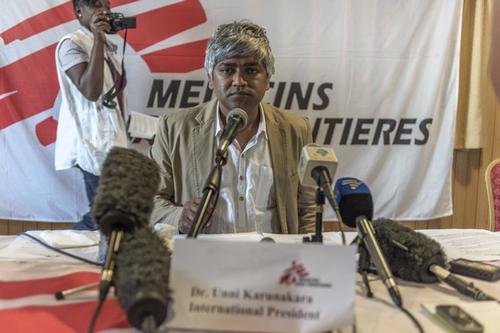
Press conference in Nairobi on 14 August 2013, in which MSF International President Dr. Unni Krishnan Karunakara, announced the closure of all MSF activities in Somalia because of attacks on patients and staff and non-respect for humanitarian action.
Somalia

Closing of MSF medical programmes in Somalia

Transcript of MSF's teleconference on the closing of MSF medical programmes in Somalia Project Update - 14 Aug 2013
 
In April 2010 MSF is started a measles vaccination campaign targeting 38,000 children under 5 this week at Argungu LGA (Local Government Area), Kebbi. During the campaign, 47,569 children aged 6 months to 5 years were vaccinated. The teams       
believe mobilisation of the community, which included the involvement of senior community and religious leaders, was very effective.
Nigeria

MSF responds to measles outbreak

Since the end of 2012, Katsina State in northern Nigeria has experienced a measles outbreak, which has just ended after lasting 28 weeks. MSF supported the authorities by providing epidemiological surveillance and case management in Katsina’s 34 local government areas. Project Update - 13 Aug 2013
 
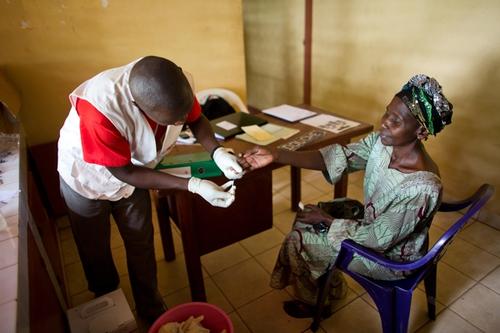
46-year old Christine Yatoungou is being tested for HIV/Aids at a hospital in Bossangoa, in northwest Central African Republic. MSF has launched an emergency re-fill of HIV drugs for the affected population after hospitals and health centres were looted during a coup d'etat in March. Christine has been infected with HIV/Aids since 2006 and due to the war her treatment was interrupted during 2 months. After being re-confirmed as having the disease, she is now receiving life saving drugs.
HIV/AIDS

As FDA approves new HIV drug dolutegravir, MSF asks when people in developing countries will have access

As the US Food and Drug Administration approved the new HIV drug dolutegravir late yesterday, MSF questioned when people in developing countries would be able to access this promising new drug. Press Release - 13 Aug 2013
 
msf-placeholder
South Sudan

MSF condemns the killing and wounding of its team members near Juba, South Sudan

On Monday, 5 August, a group of armed men attacked a car belonging to Médecins Sans Frontières (MSF) on a main road outside Juba, South Sudan. Press Release - 9 Aug 2013
 
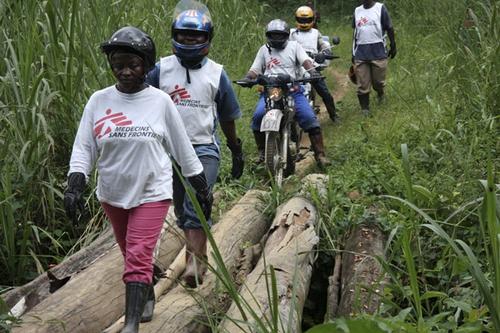
In and around Pinga, an MSF team has been reaching out to populations trapped by the conflict by running mobile clinics via motorbike and providing medical services to people who have no other hope of getting medical care. Conditions are extremely difficult; the only way to access mobile clinics is with motorcycle convoys because cars can¿t pass through the narrow jungle paths. Teams travel in a convoy of 5 or 6 bikes, each bike with two people and loaded with drugs and medical material.
Democratic Republic of Congo

MSF suspends medical activities in Pinga after threats to staff

MSF has been forced to suspend medical activities in the town of Pinga and its immediate surroundings in the east of the DRC after a targeted threat to the safety of its humanitarian staff. Statement - 9 Aug 2013
 
Sudanese refugees began streaming across the border into South Sudan in June 2011 when conflict erupted between the Khartoum government and the rebels of the Sudan People’s Liberation Movement-North (SPLM-N) in Sudan’s South Kordofan State. At the height of the crisis in Yida camp last summer, high mortality rates were reported among young children admitted to MSF’s hospital with respiratory tract infections, such as pneumonia, one of the leading causes of death. MSF determined that vaccinating with the pneumococcal conjugate vaccine (PCV) could result in a substantial mortality reduction in Yida. MSF has been working since September 2012 to procure PCV but faced significant delays due to lengthy negotiations and international legal procurement constraints. MSF was eventually able to obtain the vaccine from GSK at a reduced price, but delays have now pushed the planned vaccination into the logistically challenging rainy season.

The objective is to immunize approximately 5,000 children under the age of 2 against several pathogens, including haemophilus influenza type B and pneumococcus. This is the first time that PCV is being used in South Sudan and one of the first vaccines to be implemented in compliance with the new WHO emergency vaccination recommendations.
South Sudan

Global vaccination community turns its back on getting new vaccines to refugee children

MSF starts first use of pneumococcal vaccine in South Sudan Press Release - 8 Aug 2013
 
48-year old Linda Vilakati is one of 55 patients who have just successfully completed treatment for MDR-TB in Swaziland. Linda is a member of the first group to have completed two years of a grueling regimen for multidrug-resistant tuberculosis (MDR-TB) at MSF’s project in Mankayane, run in partnership with Swaziland’s Ministry of Health.
Eswatini

First group of MDR-TB patients celebrate end of treatment

Fifty-five Swazi patients celebrate successful cure Project Update - 7 Aug 2013
 
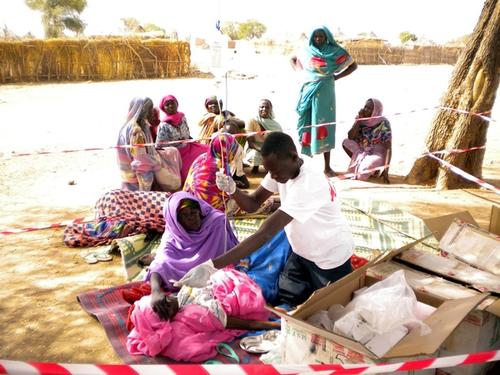
Since early 2013, violent clashes have erupted between several tribes in Darfur, leading to the displacement of thousands of people. About 70 000 persons, mainly women and children, have crossed the border to seek refuge into neighboring Chad, in Tissi, a village located accross Chadian, Sudanese and Central African borders. Deprived from any assistance for several weeks, families live under makeshift shelters or trees, without food and drinkable water. An MSF team came to assess their medical needs, conduct consultations et transfer the most serious cases to Goz Beida hospital. <br/> Depuis le début de l'année 2013, de violents combats opposent plusieurs tribus du Darfour et provoquent le déplacement de dizaines de milliers de personnes. Près de 70 000 personnes, dont une majorité de femmes et d'enfants, ont traversé la frontière pour se réfugier au Tchad voisin, dans la région de Tissi, village situé à la croisée des frontières soudanaise, tchadienne et centrafricaine. Privées d'assistance pendant plusieurs semaines, les familles vivent dans des abris de fortune ou sous des arbres, sans nourriture ni eau potable. Une équipe de Médecins Sans Frontières s'est rendue auprès d'elles pour évaluer leurs besoins médicaux, mener des consultations et transférer les cas les plus graves vers l'hôpital de Goz Beida.
Sudan

Mortality survey raises concerns over humanitarian situation in Darfu

Violence in Darfur major cause of mortality among refugees Press Release - 6 Aug 2013
Four mothers posing in a corridor of the Hospital in Bili. All four of them are staying in the hospital with their child, that's suffering from a severe case of malaria. Since the beginning of the project in 2016, the pediatric ward already treated more than 4.000 cases of complicated/severe form of malaria.
Médecins Sans Frontières (MSF)

Independent medical humanitarian assistance

We provide medical assistance to people affected by conflict, epidemics, disasters, or exclusion from healthcare. Our teams are made up of tens of thousands of health professionals, logistic and administrative staff - most of them hired locally. Our actions are guided by medical ethics and the principles of independence and impartiality. We are a non-profit, self-governed, member-based organisation.

Learn more