




Ebola disease in DRC: find out how we're responding
Learn more
4638 Results
 
msf-placeholder
Access to medicines

MSF team blocked from providing care for over five hours

The prolonged delays by Israeli forces to allow access to patients has become a constant for MSF teams and is a violation of the humanitarian right to access patients freely. Project Update - 9 Apr 2002
 
msf-placeholder
Bosnia-Herzegovina

The lesson of Srebrenica: take protection of local populations seriously

Médecins Sans Frontières (MSF) warns the Netherlands and the international community against drawing the wrong conclusions from the failure of 'Dutchbat' in Srebrenica. Press Release - 9 Apr 2002
 
msf-placeholder
Russia

Chechnya: MSF presentation to 58th Human Rights Commission

MSF presentation by Loick Barriquand before the 58th Session of the Commission of Human Rights. Geneva, April 2, 2002. Speech - 2 Apr 2002
 
msf-placeholder
Afghanistan

MSF activity at the Afghanistan earthquake

Following the earthquakes that struck the Nahrin town and region on March 25 and 26, an MSF team of six medical staff were active in the area immediately. In two days over 200 people were cared for by the organisation and, with the medical injuries treated, focus is moving towards rehabilitation. Project Update - 1 Apr 2002
 
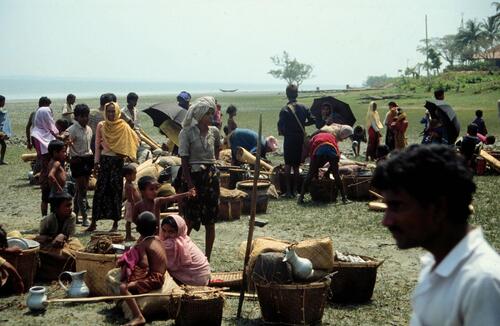
COX BAZAR, BANGLADESH, ASIA, 01.03.92. Returnees at the border with Myanmar.
Rohingya refugee crisis

Ten Years for the Rohingya Refugees: Past, present and future

The year 2002 marks the 10th anniversary of the flight of the Rohingya refugees from Rakhine State,
Myanmar to Bangladesh. Discrimination, violence and forced labour practices by the Myanmar
authorities triggered an exodus of more than 250,000 Rohingya Muslims between 1991 and 1992. Over
the years, approximately 232,000 refugees have been repatriated to Myanmar under the supervision of the
UNHCR, and 21,600 remain in two camps.
Report - 1 Apr 2002
 
msf-placeholder
Afghanistan

Most of the wounded from Afghan earthquake have been treated

Now that about 80 per cent of the area devastated by the earthquakes in Afghanistan has been assessed and fewer people are admitted in the medical structures, Medecins Sans Frontieres (MSF) is confident that the majority of injured Afghans have found treatment. Project Update - 28 Mar 2002
 
msf-placeholder
Afghanistan

MSF active at quake region within hours with tent hospitals and make-shift ambulances

A team of six MSF medical staff have been active in the Afghanistan town of Nahrin following a series of earthquakes from evening March 25 to the early hours of the 26th. Project Update - 27 Mar 2002
 
msf-placeholder
Afghanistan

MSF teams already treating wounded in Afghan quake town

The international medical aid organization Médecins Sans Frontières (MSF) is providing assistance to the Afghan population in Nahrin, the town in Baghlan Province which was most affected by the powerful earthquake that hit the country yesterday evening (March 25). Crisis Update - 26 Mar 2002
 
msf-placeholder
Afghanistan

MSF and the Refugee Council of Australia say repatriation to Afghanistan would be inhumane

It is dangerous and simplistic to imply that Afghanistan is now safe and that asylum seekers can be sent back. The war is not over, fighting between rival warlords threatens to descend into a civil war and unexploded weapons still contaminate large parts of the country. Press Release - 13 Mar 2002
 
msf-placeholder
Russia

No end in sight to the war in Chechnya

After two years of war, Chechen civilians have reached a sinister conclusion: in the fight against terrorism following the events of September 11 2001, no international power is prepared to stop the Kremlin and protect Chechens' lives or even their most fundamental human rights. Project Update - 4 Mar 2002
Four mothers posing in a corridor of the Hospital in Bili. All four of them are staying in the hospital with their child, that's suffering from a severe case of malaria. Since the beginning of the project in 2016, the pediatric ward already treated more than 4.000 cases of complicated/severe form of malaria.
Médecins Sans Frontières (MSF)

Independent medical humanitarian assistance

We provide medical assistance to people affected by conflict, epidemics, disasters, or exclusion from healthcare. Our teams are made up of tens of thousands of health professionals, logistic and administrative staff - most of them hired locally. Our actions are guided by medical ethics and the principles of independence and impartiality. We are a non-profit, self-governed, member-based organisation.

Learn more