



Ebola disease in DRC: find out how we're responding
Learn more
7999 Results
 
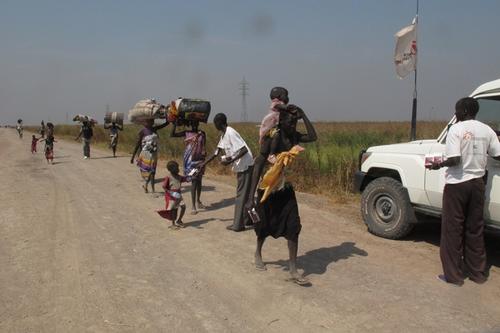
Waiting area and triage at the UNMISS camp, Juba.

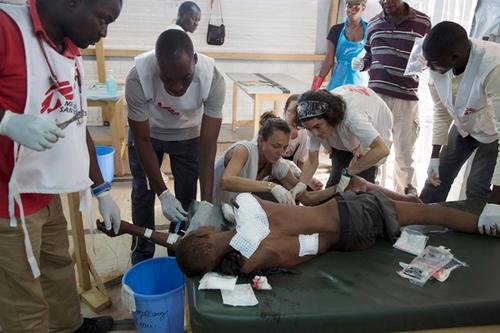
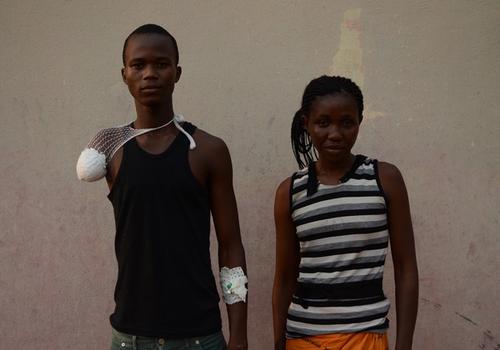
Two MSF emergency teams comprised of medics, logistics staff and water treatment specialists are running medical activities for people displaced by the recent fighting in Juba, the capital of South Sudan.  An estimated 20,000 people fled to two UN compounds and to other gathering points around the city, seeking refuge from the intense fighting that erupted in Juba. After conducting an independent assessment of the needs, two MSF teams are working to address the medical needs of the displaced.  "A few patients have direct violence wounds, such as gunshots, but the situation has calmed now in Juba and trauma medicine no longer seems to be the main need," says Forbes Sharp, MSF Emergency Coordinator in Juba. "The displaced people do not yet feel safe to return to their homes and they are unwilling to cross town to seek healthcare in regular hospitals and clinics. So we are taking healthcare to them."
South Sudan

MSF emergency teams begin mobile clinics in Juba

Project Update - 22 Dec 2013
 
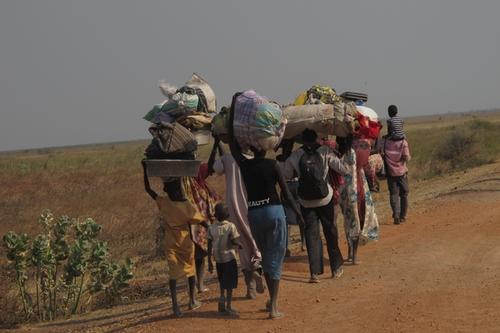
Returnees from Khartoum are camping near the Nile River in Juba, the capital of Southern Sudan, and washing their clothes and bodies. Most took a month to 6 weeks to reach Juba in order to vote the January 9th independence referendum. Also they have come to Juba since they are afraid of possible retaliation from the North, Arab majority, if they live there. *** Local Caption *** Le 9 janvier 2011, les électeurs du Sud Soudan ont voté à près de 99% pour l¿indépendance. Ce référendum - qui s¿inscrit dans le processus de paix global entre le Gouvernement de Khartoum et le Mouvement populaire de libération du Soudan (SPLM) signé en 2005 - survient au terme de plus de 20 ans de guerre civile dans le Sud. Cette guerre a fait plus de deux millions de morts et entraîné le déplacement de quelque 4,6 millions de personnes.
 9 juillet 2011 proclamation de l¿indépendance du sud.
 Aujourd¿hui, le Sud Soudan souffre d¿un manque criant d¿infrastructures et la population n¿a pas accès aux soins médicaux de base. En proie à une crise humanitaire et médicale, le pays doit régulièrement faire face à des épidémies, une malnutrition endémique ainsi qu¿à des pics de violence entraînant des déplacements de population.
 Présente dans le pays depuis plus de 20 ans, MSF travaille dans l¿hôpital civil d¿Aweil, dans l¿Etat du Nord Bahr El Ghazal depuis 2008. C¿est l¿unique hôpital de l¿Etat pour une population d¿environ 780 000 personnes. Le programme a été lancé pour réduire le taux de mortalité materno-infantile très élevé et répondre aux urgences qui surviennent régulièrement dans la région, telles que des épidémies de méningite ou de paludisme et des pics de malnutrition. Dans le service de pédiatrie et la maternité de l¿hôpital, les équipes médicales de MSF apportent des soins gratuits aux femmes enceintes et aux enfants âgés de moins de 15 ans. 
 En 2010 environ 37 000 consultations anténatales ont été menées, plus de 3 000 femmes ont accouché à l¿hôpital, 60 854 consultations pédiatriques ont été assurées. Environ 3 675 enfants ont été admis au service pédiatrique, souffrant principalement d¿infections respiratoires ou de diarrhées. Environ 2811 enfants souffrant de malnutrition aiguë sévère ont été soignés
South Sudan

MSF emergency response to intense fighting in Juba

Project Update - 20 Dec 2013
 
A family of Syrian refugees living in Istanbul. Photo for the Syrian Exodus project.
Syria

Syrian Exodus: Born in exile

This is the second chapter of the Syrian Exodus, an MSF multimedia project to follow the route of Syrians fleeing the war. See chapter one and three. Project Update - 20 Dec 2013
 
Emergency room of an MSF hospital in northern Syria (Aleppo province). The hospital has attended 601 deliveries and provided almost 15,000 consultations and 446 surgical operations up to April 2013. It is focused on obstetric care and surgery. Photo for the Syrian Exodus project.
Syria

Chapter One: “Fear is inside your body, like an illness”

Chapter One of the Syrian Exodus series Project Update - 20 Dec 2013
 
msf-placeholder
Italy

MSF calls for temporary closure and evacuation of migrants centre in Lampedusa

MSF medical teams stand ready to provide emergency medical assistance
Press Release - 20 Dec 2013
 
2008: Displaced persons fleeing the violence receive life-sustaining assistance. MSF sets up mobile clinics, distributes water, and improves the sanitary conditions in the camps in Songolo, Soke and Geti.
Several million litres of water were distributed over ten years. The construction of latrines, showers and waste deposit areas are also some of the activities carried out by MSF.
Democratic Republic of Congo

MSF's decade of medical action

In 2008, MSF provided life-sustaining assistance to displaced persons fleeing violence. MSF set up mobile clinics, distributed water, and improved the sanitary conditions in the camps in Songolo, Soke and Geti. Voices from the Field - 20 Dec 2013
 
Philippines 13 December 2013: MSF team cleaning a well in Guiuan. The city in eastern Samar is one of the areas hardest hit when typhoon Yolanda/Haiyan swept over parts of the Philippines on 8 November 2013. Apart from running a hospital on the premises of the destroyed district hospital, MSF runs mobile clinics, distributes relief goods and reconstruction material and provides clean drinking water.
Philippines

"We must still be vigilant"

Teams from MSF are distributing clean drinking water to people in areas affected by typhoon Haiyan in the Philippines. Voices from the Field - 19 Dec 2013
 
Rommy, Male, First Baby born tonight at 3AM in MSF Tacloban Hospital
Philippines

Specialised care for mothers and babies in devastated Tacloban

Voices from the Field - 19 Dec 2013
 
NFI distribution in San Miguelay, a village in the area of Santa Fe in Leyte province Philippines.
Philippines

MSF helps villagers rebuild their homes after typhoon Haiyan

MSF has been helping villagers rebuild their homes following typhoon Haiyan Project Update - 19 Dec 2013
Four mothers posing in a corridor of the Hospital in Bili. All four of them are staying in the hospital with their child, that's suffering from a severe case of malaria. Since the beginning of the project in 2016, the pediatric ward already treated more than 4.000 cases of complicated/severe form of malaria.
Médecins Sans Frontières (MSF)

Independent medical humanitarian assistance

We provide medical assistance to people affected by conflict, epidemics, disasters, or exclusion from healthcare. Our teams are made up of tens of thousands of health professionals, logistic and administrative staff - most of them hired locally. Our actions are guided by medical ethics and the principles of independence and impartiality. We are a non-profit, self-governed, member-based organisation.

Learn more