



Ebola disease in DRC: find out how we're responding
Learn more
8009 Results
 
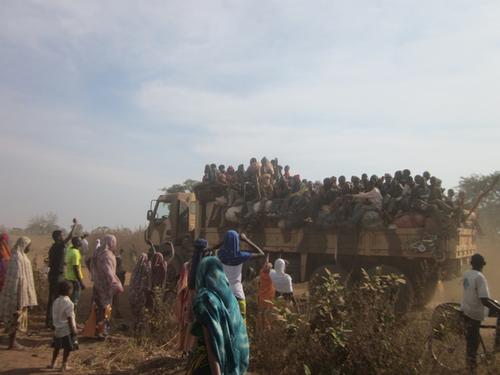
 *** Local Caption *** Plusieurs dizaines de milliers de personnes ont fui les violences ciblant les populations Peules et musulmanes dans le nord de la République Centrafricaine pour se réfugier dans le sud du Tchad. MSF intervient en urgence à Sido et Bitoye pour apporter aux réfugiés - dont la grande majorité sont des femmes - des soins médicaux d'urgence et des biens de première nécessité.<br>

Dozens of thousands of people have fled violence targeting Fulani and Muslims communities in northern Central African Republic and sought refuge into southern Chad. MSF has set up two programs in Sido and Bitoye to provide emergency medical care and basic non-food items.
Refugees, IDPs and people on the move

Refugee crisis hits Central African Republic’s neighbours as more flee violence

Around 100,000 refugees have now fled from CAR to neighbouring Cameroon, Chad, Congo Brazzaville and DRC. Project Update - 15 Feb 2014
 
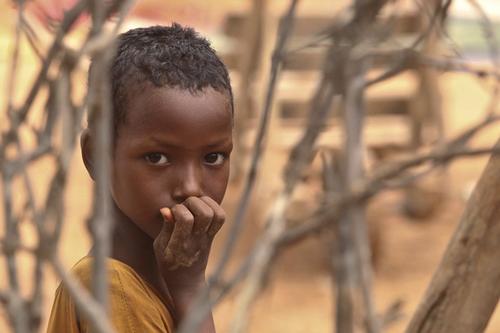
A Somali child - on the outskirts of Dagahaley refugee camp in Dadaab.

MSF is the only provider of medical care in Dagahaley, one of the five camps in the Dadaab refugee camp complex. Each month, teams carry out over 20,000 outpatient consultations and admit approximately 600 patients to the hospital
Somalia

Perspectives of refugees on returning to Somalia

MSF recently asked Somali refugees in Dadaab’s Dagahaley camp about their living conditions and their thoughts about returning to Somalia in the near future. The responses suggest that bad living conditions in the camp are not conducive to wanting to return, despite a widespread belief to the contrary. Journal article - 14 Feb 2014
 
In Hebron and East Jerusalem, MSF is running a medical and psychosocial programme for people suffering from trauma because of the conflict. MSF teams focus on people with psychological distress (acute stress, anxiety disorders, post traumatic syndromes, depression) caused by violent incidents involving Israeli settlers and Israeli Army, but also due to the intra-Palestinian conflict. In Hebron, MSF staff carried out 1726 individual mental health consultations and 945 medical consultations in 2011.
In the beginning of 2011, MSF conducted a needs assessment in East Jerusalem and decided to start providing in this part of the city mental health care to the population who suffers trauma or psychological distress due to the consequences of violence caused by the conflict and who has no access to mental health services. MSF therapies started in July in the Shufat refugee camp and Silwan area and since then MSF staff carried out 223 individual mental health consultations.
Palestine

House arrest is a 'tradition'

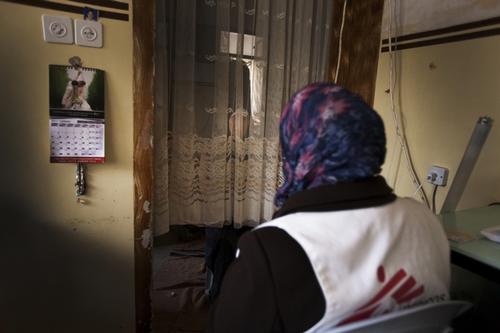
An MSF psychologist helps a young Palestinian under house arrest Project Update - 14 Feb 2014
 
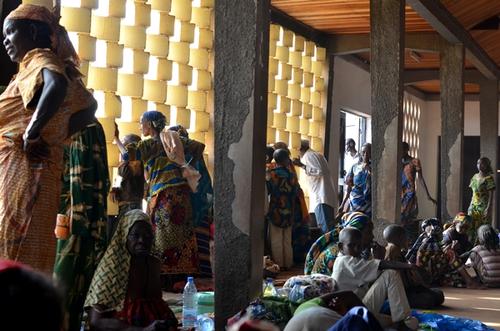
 Eglise occupée par les déplacés.<br> Church occupied by the displaced.*** Local Caption *** Since February 1st, date of the anti-Balakas takeover of the city, a thousand people (mostly Peuls/Fulani in transit on their way to Cameroon) are trapped in the city ,victims of attacks and violences. Between February 1st and February 8, 35 wounded have been taken in charge by hospital and MSF teams.
Central African Republic

Extreme violence and tensions in Carnot

Nearly 1,000 people, mostly Muslim, have been trapped in Carnot, surrounded and threatened by the self-defense militias known as anti-Balakas. Project Update - 14 Feb 2014
 
In North Kivu, MSF supports the General Referral Hospital (GRH) in Masisi where geographical and security access remains a daily challenge. MSF provides a free full package of secondary health care in the GRH and primary health care in Health Centers surrounding. Since last year, the project has also been extended to the city of Rubaya to answer to cholera epidemic in parallel with the support of the local health center. MSF also runs  mobile clinics in the area according to the evolution of needs. In 2012, MSF provided over 3000 deliveries in Masisi, including more than 1000 C-sections.
Access to medicines

Drugs for the Poor, Drugs for the Rich: Why the Current R&D Model Doesn’t Deliver

Manica Balasegaram from the Access Campaign reflects on a R&D system that is failing the world’s poorest people. Journal article - 14 Feb 2014
 
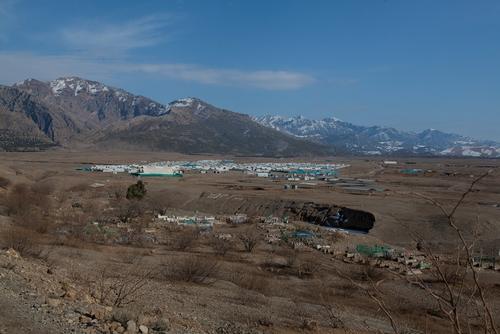
A view of the Durrani Camp, mountains in the backdrop and a cemetery in the foreground.
Pakistan

Crossing mountains to reach a hospital

Harsh winter conditions mean that many vulnerable people cannot access the healthcare they need Project Update - 11 Feb 2014
 
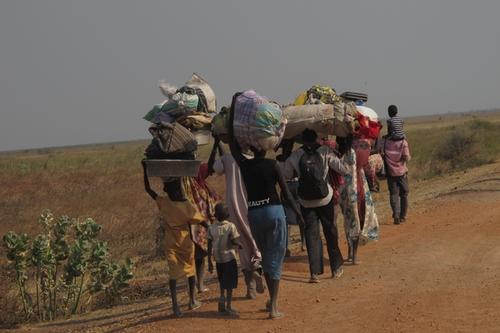
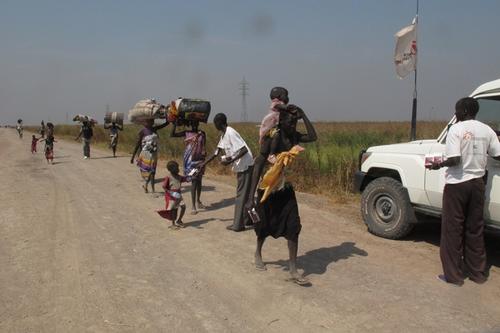
Ongoing insecurity in South Sudan has forced tens of thousands of people to flee their homes. This picture was taken by emergency coordinator, Jean-Pierre Amigo, who was forced to evacuate Bentiu, amid insecurity, along with the MSF team and thousands of displaced South Sudanese people. For ten days MSF returned to the road between Bentiu and Leer to distribute high energy food to the 10,000-15,000 people who walking along it.
South Sudan

Insecurity in Leer has devastating consequences for those hiding in the bush

Worsening security in Leer, South Sudan, makes MSF's job almost too difficult to continue Project Update - 11 Feb 2014
 
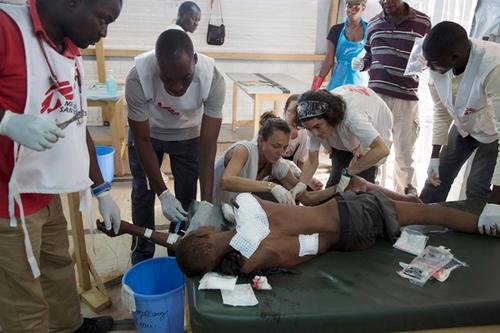
MSF medical staff are treating a man in Mpoko airport camp who was hit by an arrow. The fighters are often using homemade weapons like clubs with spikes, axes, and machetes. Due to lack of protection, the displaced people at the airport camp are too scared to return home, fearful of getting attacked.
Central African Republic

"We saw the ugly consequences of the fighting every day"

Lindis Hurum, MSF coordinator, speaks about her experiences in the camp in Bangui airport. Voices from the Field - 10 Feb 2014
 
Ongoing insecurity in South Sudan has forced tens of thousands of people to flee their homes. This picture was taken by emergency coordinator, Jean-Pierre Amigo, who was forced to evacuate Bentiu, amid insecurity, along with the MSF team and thousands of displaced South Sudanese people. For ten days MSF returned to the road between Bentiu and Leer to distribute high energy food to the 10,000-15,000 people who walking along it.
South Sudan

The day MSF left Bentiu

MSF emergency coordinator Jean- Pierre Amigo describes what happened when MSF was forced to evacuate Bentiu. Voices from the Field - 7 Feb 2014
 
District Matoto, Zone Tombolia, Site Kokoma
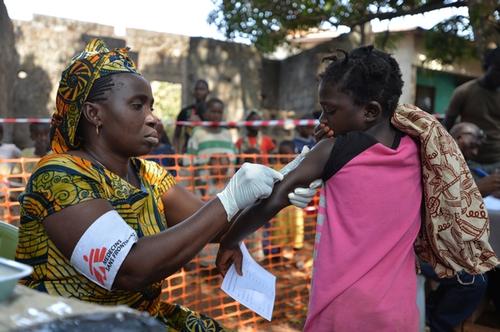
MSF launched a vaccination campaign against measles in an attempt to control the epidemic that was declared by the government of Guinea on 14 January 2014. Together with the Ministry of Health, the teams of MSF should vaccinate around 400 000 children, ages 6 months to ten years, in 3 districts (Matoto, Ratoma, Matam) of the capital Conakry. 400 personnel will be working for two weeks to orchestrate this emergency response.
Guinea

MSF vaccinates 400,000 children against measles

MSF launched a vaccination campaign against measles, expects to vaccinate 394,000 children. Press Release - 7 Feb 2014
Four mothers posing in a corridor of the Hospital in Bili. All four of them are staying in the hospital with their child, that's suffering from a severe case of malaria. Since the beginning of the project in 2016, the pediatric ward already treated more than 4.000 cases of complicated/severe form of malaria.
Médecins Sans Frontières (MSF)

Independent medical humanitarian assistance

We provide medical assistance to people affected by conflict, epidemics, disasters, or exclusion from healthcare. Our teams are made up of tens of thousands of health professionals, logistic and administrative staff - most of them hired locally. Our actions are guided by medical ethics and the principles of independence and impartiality. We are a non-profit, self-governed, member-based organisation.

Learn more