



Ebola disease in DRC: find out how we're responding
Learn more
8015 Results
 
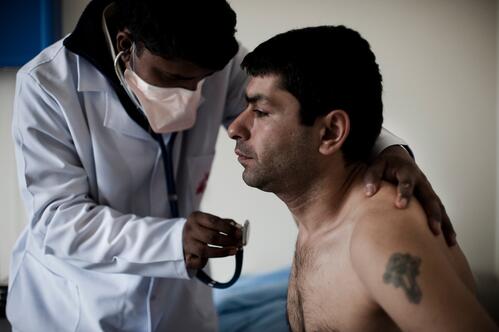
National TB Centre, Abovian, Armenia ¿ February 2010. Dr Shahidul Islam, an MSF TB doctor, examines a patient on the DR TB ward in the national TB centre. Many patients are unable to complete the grueling course of drugs.
Armenia

MSF: 25 years in Armenia

A video illustrating the 25-years presence of MSF in Armenia, from 1988 earthquake to today's DR-TB programme Project Update - 5 Jun 2014
 
*** Local Caption *** En juillet 2005, MSF a reçu l'autorisation de travailler à l'hôpital de district de Salle (zone gouvernementale) et à Rukumkot (zone sous contrôle maoïste). Un dispensaire devrait ouvrir courant 2006 dans le village carrefour de Radidjula, sur la commune d'Arviskot, où ont déjà lieu des cliniques mobiles.<br/>
 Beginning of the activities in the Maoists area (Rukumkot and Baphikot) in May-June 2005. In the mountains controlled by the Maoists, the supply drugs of the structures of health is irregular and the personnel is not always form to practise care of quality. To bring our assistance to the populations which live in these removed areas is thus one of our top priority since the opening of the program in Nepal. In July 2005, MSF received the authorization to work at the hospital of district of Room (governmental zone) and in Rukumkot (zone under control Maoist). A dispensary should open during 2006 in the village crossroads of Radidjula, on the commune of Arviskot, where mobile clinics already take place
Nepal

Factors Affecting Perceived Stigma in Leprosy Affected Persons in Western Nepal

Factors Affecting Perceived Stigma in Leprosy Affected Persons in Western Nepal Journal article - 5 Jun 2014
 
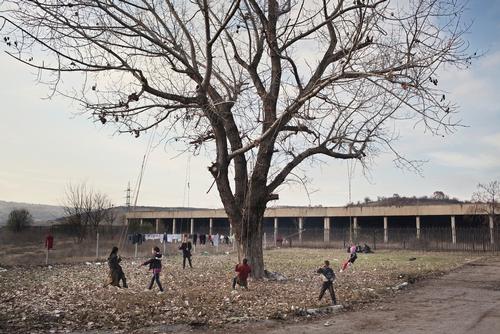
Children playing in Harmanli camp. The biggest of Bulgaria’s emergency centres for refugees is in the town of Harmanli, about 30 kilometres away from the Turkish and Greek borders.

Over the past seven months, teams from Médecins Sans Frontières (MSF) have provided medical and psychological healthcare, distributed essential aid and made improvements to buildings and facilities in three reception centres for asylum seekers in Bulgaria. 

The centres were MSF worked, in Harmanli and in the Bulgarian capital Sofia, are currently home to more than 1,500 refugees, many of whom have fled war-torn Syria, making a long, often dangerous journey to Europe in search of safety and protection. 

MSF started working in Bulgaria last November, after finding appalling conditions that included lack of food, shelter, medical or psychological care. Despite the winter, people were sleeping in unheated tents, and up to fifty people were sharing one toilet. 

Now that the authorities have had the chance to expand their capacity and conditions have improved, MSF is handing over the provision of medical and psychological healthcare services to the Bulgarian government and to other humanitarian organisations.
Bulgaria

MSF projects for refugees in Bulgaria coming to a close

Over the past seven months, teams from Médecins Sans Frontières (MSF) have provided medical and mental healthcare, distributed essential aid and made improvements to buildings and facilities in three reception centres for asylum seekers in Bulgaria. Project Update - 5 Jun 2014
 
msf-placeholder
Ebola and haemorrhagic fevers

Resurgence of Epidemic Ebola in West Africa

While the number of patients appeared to be in decline, new cases of Ebola have been reported in Guinea and Sierra Leone. The virus has already affected more than 300 people in West Africa. Médecins Sans Frontières (MSF) is continuing its work supporting health authorities in the two countries, treating patients and putting measures in place to contain the epidemic. Project Update - 3 Jun 2014
 
msf-placeholder
Central African Republic

Fresh attack on MSF in Ndélé

Following fresh attacks in Ndélé (CAR), MSF evacuated a number of staff members Press Release - 3 Jun 2014
 
msf-placeholder
Website

Cholera Treatment Centre

What is a Cholera Treatment Centre? Médecins Sans Frontières provides information about the key parts of a CTC, and what patients can expect in their treatment. ctc.msf.org
 
Miriam Kastzura, nurse, attends to a patient in the emergency room in Berberati.
Central African Republic

Berbérati, Central African Republic: “I had never seen anything like it before”

Interview with Miriam Kasztura, a nurse just returned from Berbérati, OCG's project in the southwest of CAR. Voices from the Field - 3 Jun 2014
 
Area reserved for the most serious patients at the Cholera Treatment Centre in Minova. Cholera is highly infectious so isolating patients is vital in order to prevent the disease from spreading.
Cholera

An interactive guide to an MSF cholera treatment centre

An interactive guide to an MSF cholera treatment centre Project Update - 3 Jun 2014
 
Khayelitsha, South Africa. Oct. 2003. 
MSF clinic. MSF doctor Eric Goemare preparing ARV drugs.
Currently MSF treats 650 people with antiretroviral drugs, the largest cohort on treatment in the public sector in South Africa. The use of generic antiretroviral drugs in our clinics has been critical for the success of our programs, since it has proven that antiretroviral drugs can be done in an affordable manner.
HIV/AIDS

Clinical Mentorship of Nurse Initiated Antiretroviral Therapy in Khayelitsha, South Africa: A Quality of Care Assessment

Clinical Mentorship of Nurse Initiated Antiretroviral Therapy in Khayelitsha, South Africa: A Quality of Care Assessment Journal article - 2 Jun 2014
 
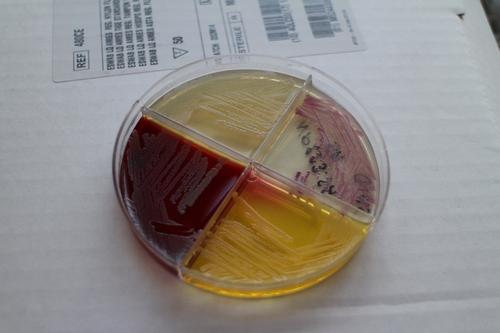
The culture: Bacteria from the collected specimens is grown on specific media before testing their sensitivity to a panel of antibiotics.

MSF has launched for the first time an Antibiotic Resistance Study in Lashkar Gah, Helmand, Afghanistan. A laboratory has been set up in the Boost Hospital where MSF works to carry out the study. The study started in January 2013.
Global

Calling on Europe to support operational research in low-income and middle-income countries

Calling on Europe to support operational research in low-income and middle-income countries Journal article - 2 Jun 2014
Four mothers posing in a corridor of the Hospital in Bili. All four of them are staying in the hospital with their child, that's suffering from a severe case of malaria. Since the beginning of the project in 2016, the pediatric ward already treated more than 4.000 cases of complicated/severe form of malaria.
Médecins Sans Frontières (MSF)

Independent medical humanitarian assistance

We provide medical assistance to people affected by conflict, epidemics, disasters, or exclusion from healthcare. Our teams are made up of tens of thousands of health professionals, logistic and administrative staff - most of them hired locally. Our actions are guided by medical ethics and the principles of independence and impartiality. We are a non-profit, self-governed, member-based organisation.

Learn more