




Ebola disease in DRC: find out how we're responding
Learn more
4636 Results
 
msf-placeholder
Sri Lanka

Sri Lanka- One year operational review

MSF's initial assessments revealed an uneven destruction of the coastal villages and found health practitioners taking care of the wounded, most of whom were treated within the first three days. Local communities organised accommodation and communal kitchens for the displaced people. Project Update - 20 Dec 2005
 
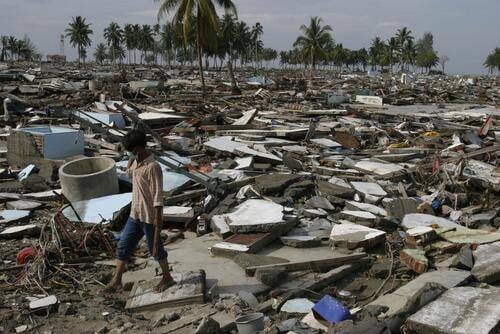
Meulaboh The areas are severely damaged by the tsunami disaster the 26th of December 2004.
View on the ruins of Meulaboh. MSF is working in remote villages along the coastline of Banda Aceh in the northern Sumatra province of Indonesia. Vehicles can be used on the east coast but only helicopters can access the western coastline, the destruction has been so severe.
Natural hazards

One year after the Indian Ocean tsunami disaster

Large parts of the city have been completely washed away by the tsunami. In Meulaboh on the west coast of Aceh, the destruction caused by the tsunami is still there for all to see almost nine months after it struck. Where the town once stood there are now just ruins stretching down to the sea. Report - 20 Dec 2005
 
msf-placeholder
Indonesia

Tsunami one year review

MSF was already active in Indonesia before the tsunami struck, assisting patients suffering from infectious diseases and helping victims of violence and natural disasters. On December 28, the first team arrived in Aceh's regional capital of Banda Aceh. They started seeing patients in a medical clinic and began assessments and relief operations. Project Update - 20 Dec 2005
 
msf-placeholder
India

Tsunami one year operations review

Because of quick government and community mobilization, emergency medical needs caused by the tsunami were mostly covered in this country. The principal problem for many communities was psychological trauma, with some people suffering from post-traumatic stress disorder. Project Update - 20 Dec 2005
 
msf-placeholder
Thailand

Tsunami one year operations review

In general, the Thai emergency response was found to be fast and well-organized. MSF decided to help improve the situation for Burmese migrant workers affected by the tsunami. More than 50,000 Burmese migrants are registered as workers in six provinces along the western coast of southern Thailand, but as many as 500,000 are actually thought to live in the area. Project Update - 20 Dec 2005
 
msf-placeholder
India

Monsoon rains and floods hit tsunami-affected area in Tamil Nadu

MSF targets villages that were spared in the tsunami but now lack essential relief aid. Project Update - 16 Dec 2005
 
msf-placeholder
Malaria

Two new malaria treatments available in 2006

First medicines developed by Drugs for Neglected Diseases Initiative (DNDi) will be easier to use and less expensive than current ACTs, but action is needed to make sure the treatments reach patients. Press Release - 13 Dec 2005
 
msf-placeholder
Access to medicines

WTO sacrifices access to medicines before Hong Kong ministerial meeting

"There is a glaring lack of evidence that the measures proposed by the WTO would actually resolve the difficulties we are facing - not one patient has benefited from its use," said Ellen 't Hoen, Director of Policy Advocacy for the MSF Access Campaign. Press Release - 12 Dec 2005
 
msf-placeholder
Uganda

Reconstructive surgery helps restore vital functions for mutilation victims

NPR feature, Dec 17 NPR Audio: Doctors seek to help Uganda mutilation victims
Sunday Times Uganda mutilation victims: On a hiding to nothing
"There is no greater offence to our sense of humanity than to see people who have been so deliberately and barbarically disfigured," said Christine Schmitz, Head of Mission for MSF in Uganda.
Press Release - 12 Dec 2005
 
msf-placeholder
South Africa

The Lazarus effect

More than five million people are infected with HIV/Aids in South Africa. But while politicians argue and the death toll rises, one extraordinary project is bringing hope to the hopeless. Project Update - 10 Dec 2005
Four mothers posing in a corridor of the Hospital in Bili. All four of them are staying in the hospital with their child, that's suffering from a severe case of malaria. Since the beginning of the project in 2016, the pediatric ward already treated more than 4.000 cases of complicated/severe form of malaria.
Médecins Sans Frontières (MSF)

Independent medical humanitarian assistance

We provide medical assistance to people affected by conflict, epidemics, disasters, or exclusion from healthcare. Our teams are made up of tens of thousands of health professionals, logistic and administrative staff - most of them hired locally. Our actions are guided by medical ethics and the principles of independence and impartiality. We are a non-profit, self-governed, member-based organisation.

Learn more