



Ebola disease in DRC: find out how we're responding
Learn more
7999 Results
 
Operating theatre in Al Shifa hospital Gaza city<<br/>bloc operatoire a l'hopital d'Al Shifa a Gaza. *** Local Caption *** In response to the current emergency, MSF is supporting Al Shifa hospital in Gaza city with a full surgical team and emergency medical equipment. MSF has made donations from its emergency stocks to the central pharmacy for the north and south of the Gaza Strip. MSF’s post-operative clinic in Gaza is running at only 10 to 30 percent of its capacity due to the intensity of the bombing, which is preventing patients from reaching the clinic. MSF’s regular activities in Nasser hospital, Khan Younis, have been interrupted by the conflict. MSF has been working in Gaza for more than 10 years, providing medical, surgical and psychological care; its teams also responded to the emergencies in 2009 and 2012.
Palestine

Medical care through war and truce

Activity in the largest hospital in Gaza continues unabated. Project Update - 27 Aug 2014
 
msf-placeholder
Liberia

MSF’s new Ebola management centres already overwhelmed

MSF’s new Ebola management centres in Liberia already overwhelmed Press Release - 27 Aug 2014
 
msf-placeholder
Ebola and haemorrhagic fevers

MSF deeply saddened by deaths of a Guinean, a Liberian and a Sierra Leonean colleague

MSF deeply saddened by deaths of a Guinean, a Liberian and a Sierra Leonean colleague Statement - 26 Aug 2014
 
Mothers with young children waiting to be seen by the medical doctor in the telemedicine consultation. 
Many international staff were based here in previous years. But due to the insecurity, the hospital is now completely run by Somali staff paied and employed by MSF. It is MSF general policy to have all its structures ‘weapon free’. At the entrance of the Guri-el Hospital, all persons entering the hospital compound are checked with a metal detector. As a result of the ‘weapon free’ policy, the MSF structures are recognized as neutral places where patients feel safe in a country where weapons abound. Nearly all children arrive at the hospital with severe or moderate malnutrition. The paediatric wards are completely full. 
On top of the malnutrition, many have measles. Infectious diseases like watery and bloody diarrhea have recently become more common. The other main issues in children are lower respiratory tract infections, gastroenteritis and malaria. Because of the collapse of the healthcare system, a large proportion of the population has not been vaccinated against measles and other diseases. The combination of acute malnutrition and measles can be deadly for children in Somalia.
Several camps for displaced people are located around the town of Guri-el. People have been fleeing violence (and more recently the drought). They have abandoned everything and live in very basic makeshift shelters. An MSF teamcarries out medical and nutritional consultations several times a week in the camps.
Somalia’s humanitarian crisis continues to be one of the worst in the world. This year, Somalis have faced the devastating effects of drought, compounding a long-lasting conflict and the absence of a functioning health care system. Throughout 2011 Médecins Sans Frontières (MSF) ran medical projects in up to 22 different locations in south-central Somalia, the epicenter of the crisis, as well as large-scale programs in the Somali refugee camps in Ethiopia and Kenya. In the period from May to December 2011, MSF treated over 95,000 patients for malnutrition, and treated over 6,000 patients for measles and vaccinated almost 235,000 children against the disease. Within its various health care structures MSF assisted in over 5,500 deliveries and provided over 450,000 consultations. However, despite intense negotiations with armed groups, access to the most affected regions inside south-central Somalia has remained difficult. MSF first worked in Somalia in 1979 and has been present in the country with few interruptions since 1991, when a civil war erupted following the downfall of the country's dictator, Siad Barre. MSF has worked in several locations: Baidoa, Dinsor, Huddur, Jamaame, Jowhar, Kismayo, Marere, and the capital, Mogadishu, in the south; Galcayo and Guri El in the north-central area; and Belet Weyne in central Somalia. Teams have addressed a host of different crises in their many projects, focusing in particular on nutrition, emergency care for people wounded in conflict, mother and child healthcare, and treatment of infectious diseases, including cholera, measles, kala azar, and tuberculosis (TB). MSF is the only international organization providing medical and nutritional care in Guri-el town in Galgaduud region of South Central Somalia..Previously, more than 15 international staff were based here but they had to be withdrawn due to security threats. Somalis employed and trained by MSF now run the hospital, regional MSF staff from Somali origin ran the emergency projects. Access to health care is a major issue in Somalia. In a circle of 150km around Guri-el, there are no medical doctors except for those at the MSF supported hospital.
Access to Healthcare

The development of a multilingual tool for facilitating the primary-specialty care interface in low resource settings: the MSF tele-expertise system

The development of a multilingual tool for facilitating the primary-specialty care interface in low resource settings. Journal article - 26 Aug 2014
 
MSF experts provide in-house training in Brussels to MSF staff volunteering for Guinea, Sierra Leone and Liberia. 
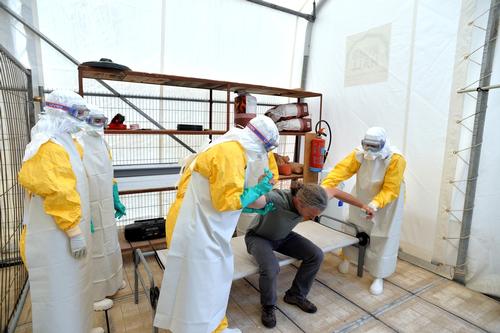
Because Ebola is highly contagious, the main priority is training health staff to reduce the risk of catching the disease while caring for patients. Staff treating patients suffering from the disease must wear personal protective equipment to prevent transmission. 

MSF is carrying in-house training for other NGO's
Democratic Republic of Congo

Ebola Epidemic confirmed in Democratic Republic of Congo: MSF sends specialists and material to the epicentre

Ebola Epidemic confirmed in Democratic Republic of Congo: MSF sends specialists and material to the epicentre Press Release - 26 Aug 2014
 
MSF has conducted a mass immunisation campaign in Ethiopia’s Gambella region, against the risk of cholera spreading across the border from neighbouring South Sudan. In the first round of the campaign (end of July) 151,723 people - South Sudanese refugees living in camps and transit centres and  the host community - were vaccinated against cholera. The second round started mid-August.
Ethiopia

Tens of thousands of South Sudanese refugees receive cholera vaccine

Tens of thousands of South Sudanese refugees receive cholera vaccine in Ethiopia Press Release - 25 Aug 2014
 
msf-placeholder
Central African Republic

"The population does not buy the idea that this is a religious conflict”

Interview with Omar Ahmed, field coordinator for MSF in Ndele, Central African Republic Voices from the Field - 25 Aug 2014
 
Scene de vie au camp. *** Local Caption *** Depuis juillet 2005, MSF apporte une assistance médicale et sanitaire à plus de 8000 Hmongs originaires du Laos ayant trouvé refuge dans un camp (Huai Nam Khao) de la région de Petchabun, au nord de la Thaïlande. Ils ont été transférés sur un nouveau site d'accueil en juillet 2007. MSF, seule ONG présente dans le camp y assure les consultations medicales et obstetricales. MSF distribue de la nourriture, des baches plastiques et du charbon. Elle s¿occupe egalement de l¿assainissement du camp et de son approvisionnement en eau.
 Malgré la volonté des autorités militaires de réinstaller les réfugiés dans de meilleures conditions, ces derniers sont toujours indésirables en Thaïlande où ils sont considérés comme migrants illégaux donc expulsables à tout moment.
Hepatitis B

Hepatitis B virus in the Lao People's Democratic Republic: a cross sectional serosurvey in different cohorts

Hepatitis B virus in the Lao People's Democratic Republic: a cross sectional serosurvey in different cohorts. Journal article - 23 Aug 2014
 
Water fountain.
Iraq

Stories from Bharka Camp

Testimonies from Bharka IDP camp in Iraq Voices from the Field - 20 Aug 2014
 
Baharka Camp in Iraqi Kurdistan
Iraq

“With so many IDPs the challenge is to target our work to the most vulnerable”

Interview with Will Harper, MSF Project Coordinator, Erbil Voices from the Field - 20 Aug 2014
Four mothers posing in a corridor of the Hospital in Bili. All four of them are staying in the hospital with their child, that's suffering from a severe case of malaria. Since the beginning of the project in 2016, the pediatric ward already treated more than 4.000 cases of complicated/severe form of malaria.
Médecins Sans Frontières (MSF)

Independent medical humanitarian assistance

We provide medical assistance to people affected by conflict, epidemics, disasters, or exclusion from healthcare. Our teams are made up of tens of thousands of health professionals, logistic and administrative staff - most of them hired locally. Our actions are guided by medical ethics and the principles of independence and impartiality. We are a non-profit, self-governed, member-based organisation.

Learn more