



Ebola disease in DRC: find out how we're responding
Learn more
4636 Results
 
msf-placeholder
Access to medicines

New MSF report shows up to 500% price rise for less-toxic, WHO recommended, first-line regimen

MSF's experience trying to obtain newer AIDS medicines over the past two years has shown that significant delays persist between when newer treatments become available in wealthy countries, and when they become available in the developing world. Press Release - 23 Jul 2007
 
msf-placeholder
Pakistan

MSF provides vital assistance to areas in Pakistan devastated by floods

"As people are drinking unsafe water, we are now treating people with acute watery diarrhoea who have cholera-like symptoms. In areas where displaced people are taking shelter in tents with inadequate sanitation, temperatures reaching 50 degrees and little available water, the situation is quite serious," said Tony Marchand, MSF Emergency Co-ordinator in Turbat. Project Update - 23 Jul 2007
 
msf-placeholder
Cambodia

Cases of dengue decrease in Takeo hospital but efforts to control outbreak must continue

The shortage of blood for transfusions, needed in case of complications, is also a concern. Project Update - 17 Jul 2007
 
msf-placeholder
Italy

Lampedusa shipwrecks - and the number of victims continues to increase

Each summer, Italy receives thousands of migrants arriving in boats from Africa. Lampedusa, a small island south of Sicily, is a landing spot for more than 18,000 immigrants per year. Médecins Sans Frontières (MSF) provides medical care at the port where boats land after hazardous trips across the Mediterranean Sea. In recent weeks, a series of rather dramatic landings have been recorded in the Canal of Sicily, with people arriving in a very bad state.
Luciano Grisio, a doctor with MSF, describes what he sees during his work on the island.
Project Update - 12 Jul 2007
 
msf-placeholder
Thailand

Hmong refugees in Thailand are a population in danger

Project Update - 10 Jul 2007
 
msf-placeholder
Democratic Republic of Congo

Emergencies in the 'Town of Stones'

During the last days of 2006, the Katanga Province region was affected by terrible floods. We estimate that a total of 32,000 people were affected by the floods - which amounts to half the population of Bukama."
Celine Zegers, MSF nurse and Head of the Emergency Operations in Bukama, has just spent six weeks in Bukama. She describes the difficult survival conditions for the homeless population, but also the positive impact of her team.
Project Update - 3 Jul 2007
 
msf-placeholder
Sudan

Darfur, interview with MSF's International President Dr. Christophe Fournier

Darfur, Sudan, interview with MSF's International President Dr. Christophe Fournier Interview - 25 Jun 2007
 
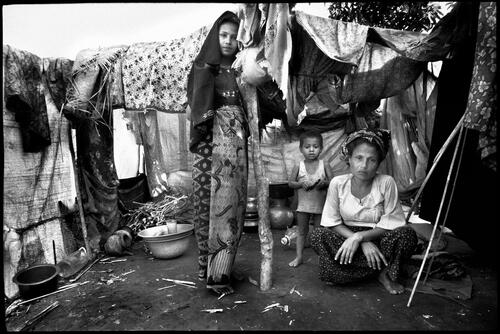
Having fled persecution in Myanmar(Birma) and lived in appalling conditions for many years in Bangladesh, 
 This is the situation facing thousants of families based in a makeshift camp near Teknaf since years. "Tal" camp, as it is commonly referred to, consists of small ramshackle shelters situated in an area between the river Naf and the highway leading to the city of Cox's Bazaar. More than 6,000 men, women and children have sought refuge on a stretch of land 800 meters long and 30 meters wide, where food and potable water is scarce and access to health care limited.
  
 The Muslim refugees, who are ethnically referred to as "Rohingya", have been fleeing Myanmar's Northern Rakhine State for many years from which, they say, they were subject to severe abuses such as forced labour, restrictions on movement and land confiscation. For many years they have lived in extremely vulnerable conditions, stateless within their own country and denied refugee status in Bangladesh. "Going back is like drowning in the sea," says a woman from Tal camp.  "We had lots of sufferings there (Myanmar). If we ate once, we couldn't eat the next seven times."
 
 The situation facing the refugees in Bangladesh is a similar one.
 "We are forced to do the hardest and cheapest work, the work in the brick factories, salt fields  and shipwreck yards are places to find the us Rohingya's at work".
 woman are forced to prostitute themself for survival of their familie.
 
 If no durable solutions are found to improve their living conditions and access to services, thousands of Rohingya people are likely to continue to be exposed to disease and malnutrition, after having suffered displacement, exploitation and abuse throughout their lives, both in Bangladesh and Myanmar.
Bangladesh

Stateless Rohingyas in Bangladesh: No one should have to live like this

The Rohingya people from Myanmar seeking refuge in Bangladesh. An MSF briefing paper. Report - 19 Jun 2007
 
msf-placeholder
Somalia

Stories of people who fled Mogadishu

In March and April, 2007, heavy fighting in Mogadishu resulted in a large number of civilian casualties and thousands of people fleeing the capital. In all of the projects around the country, MSF staff witnessed displaced people arriving from Mogadishu. Although by the end of May it was estimated that two thirds of the people displaced by the fighting had returned to Mogadishu, many are unwilling or unable to do so.
MSF interviewed some of these people who came to its hospital in South Galcayo during the month of May.
Voices from the Field - 11 Jun 2007
 
msf-placeholder
HIV/AIDS

MSF reaction to G8 declaration on Africa and innovation

"G8 leaders have been talking out of both sides of their mouths. No progress was made here on access to medicines." "G8 leaders are sending out contradictory messages: on one hand they pledge more money, and on the other, they want to increase intellectual property protection which is known as a key a barrier to access to affordable medicines." Statement - 8 Jun 2007
Four mothers posing in a corridor of the Hospital in Bili. All four of them are staying in the hospital with their child, that's suffering from a severe case of malaria. Since the beginning of the project in 2016, the pediatric ward already treated more than 4.000 cases of complicated/severe form of malaria.
Médecins Sans Frontières (MSF)

Independent medical humanitarian assistance

We provide medical assistance to people affected by conflict, epidemics, disasters, or exclusion from healthcare. Our teams are made up of tens of thousands of health professionals, logistic and administrative staff - most of them hired locally. Our actions are guided by medical ethics and the principles of independence and impartiality. We are a non-profit, self-governed, member-based organisation.

Learn more