



Ebola disease in DRC: find out how we're responding
Learn more
7999 Results
 
Second testimony: 
We believe that the violence will continue during Ramadan:  a ceasefire won’t be implemented unless the two warring parties respect it.
Jasmin Mohammed Ali (26) is a teacher in the primary school in Qatabah and her sisterAsia Mohammed Ali ( 25)  talk about their daily life in Qatabah since the conflict erupted. 

Because of the ongoing crisis, the school I work in is closed; it has been closed for 3 months. We only   finished the 1st term and had to stop during the 2nd term. I haven’t been paid for the last month.  Recently, the school (which was luckily empty at the time) was affected by the airstrikes as it is close to the central security office which was targeted; all the windows of the school were shattered into pieces. 
Since the new crisis in Yemen started things have become much harder. It is harder to get food and water. It is hard to get food as many shops have closed. On the other hand, some Yemeni families depend completely on the work in the khat (qat) market. If there is bombing or shelling close by, everyone runs away from the khat market and business is lost.  Our father and brother work in the khat market. If they cannot work in the khat market, they won’t have enough money to buy food for the family.  Prices of food, especially basic food, have increased dramatically. For an example, twenty liters of cooking oil used to be 5,000 Yemeni Rial (YER), now they have to pay 9,500 YER.  15 kg of sugar used to be 12,000 YER, now they have to pay 18,000 YER. 
Lack of water is our biggest challenge
Water represents everything and without water there is no life. There isn’t any running water anymore in Qataba as the main water facility for the town and the surrounding villages stopped working due to a fuel shortage. We have no water in our house and cannot fill up the tanks either. There is only one water well in Qataba town that has good water for drinking and is for free. If this well is not working we would walk to another well where there is the main water facility. This trip usually takes between three to four hours round trip by foot and if we go there, we cannot bring that many containers as we can only carry one container, it’s very heavy. Unfortunately, this borehole isn’t working for the moment due to the fuel issue as well.  
Meanwhile, the main well in Qataba is becoming very crowded and women in town fill their containers with a multitude of personal hoses. That would take a long time to fill up all the containers. 
We couldn’t go to the well, today, as it was too crowded. Water trucks are still available but it is only used by rich people, one water truck costs 30,000 YER for 6,000 liters and it only lasts for about 1-2 weeks depending on the size of the family. 
The impact of airstrikes 
 Airstrikes and shelling is making us terrified and we can’t sleep well. Last night, the kids were too afraid as the shelling and fighting was very close by. 
We have been thinking about fleeing Qataba, but the problem is that we are 26 family members living in one house. We don’t know where to go.
It might be better to stay in Qataba since we have a home here. We don’t own a house in any of the surrounding villages where it would be quieter. We have relatives in Damt district in Al-Dhale, which could be an option. If the situation deteriorates, half of the family might go to Damt with the other half staying in Qataba.  If the bombing and shelling continues and if the frontline moves closer, we might decide to leave. 
The holy month in Qatabah 
We never imagined that this could happen. Qataba was very peaceful and didn’t have any problems. People would come to Qataba from different districts of different governorates during the holy month of Ramadan but this year nobody will come. Qataba is perceived to be better than other districts for Ramadan because of its culture during Ramadan. The streets will be filled with markets and people.
Yemen

Testimonies from Al-Dhale

"We believe that the violence will continue during Ramadan: a ceasefire won’t be implemented unless the two warring parties respect it... We never imagined that this could happen." Voices from the Field - 29 Jun 2015
 
msf-placeholder
South Sudan

Activity Update April & May 2015

MSF teams are currently running medical projects in six of South Sudan’s ten states and the Abyei Administrative Area Project Update - 29 Jun 2015
 
Open packages of ‘Plumpy Sup’ supplementary food found strewn all over the ground.  MSF had more than seven tons of stock in its warehouse in Melut, Upper Nile state for patients who suffer from malnutrition.
South Sudan

MSF resumes activities in Melut amid challenges to access the population in parts of Upper Nile state

MSF has resumed activities in Melut, Upper Nile state, 16 days after renewed fighting in mid-May forced the organisation to suspend medical activities and evacuate staff. The ongoing conflict and recurrent periods of shelling in Malakal and Melut are still making it difficult both for MSF teams to access the population to provide medical assistance and for populations to access healthcare facilities. Project Update - 29 Jun 2015
 
Bunyakiri Vaccination Campaign
Democratic Republic of Congo

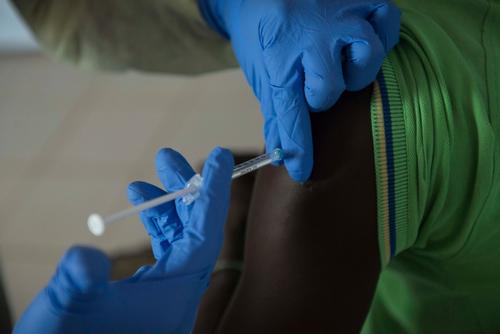
MSF teams vaccinate 42,000 children against measles in the region of Bunyakiri

MSF teams have vaccinated children and young people in the region of Bunyakiri and Tushunguti, an area that is particularly difficult to access and cannot be reached by any kind of vehicle. Project Update - 26 Jun 2015
 
msf-placeholder
Mediterranean migration

Migration: MSF's response to European council meeting

Comments in response to the European Council meeting on migration by Aurelie Ponthieu, Migration Advisor for MSF Speech - 26 Jun 2015
 
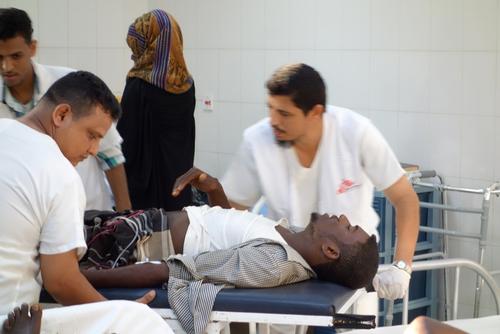
Abdul Wahab is a farmer and he was caught in a crossfire in his own field trying to harvest. He was taken from his district of Imam Sahib to Kunduz City by local villagers. The road was very unsafe and it took more than an hour.
Afghanistan

Scores of wounded treated after heavy fighting in Kunduz province

Heavy clashes between Afghan security forces and armed opposition groups in the north-eastern province of Kunduz have led to a surge in wounded arriving at Médecins Sans Frontières’ (MSF) trauma centre in Kunduz city. Press Release - 25 Jun 2015
 
msf-placeholder
Yemen

Crisis update – 25 June 2015

In Yemen, MSF works in Aden, Al-Dhale’, Taiz, Sa’ada, Amran, Hajja, Ibb and Sana’a. MSF has brought into the country 105 tons of humanitarian aid to the facilities it is running and supporting in Yemen. Crisis Update - 25 Jun 2015
 
Thousands of families in desperate need of food and water have trekked for days from Somalia to the Dadaab refugee camp in eastern Kenya. The drought is the worst in East Africa for 60 years. The UN described it as a "humanitarian emergency". The already overcrowded complex received 1,000 new refugees a day in June, five times more than a year ago. About 30,000 people arrived at the Dadaab refugee camp in northern Kenya in June, according to UNHCR, the UN's refugee agency, compared to 6,000 in June 2010.
Kenya

Dadaab refugees - a plea for dignity

"People in Dadaab remain nearly 100 percent dependent on humanitarian aid. (..) Now is the time to make some tough choices and define some permanent solutions." An op-ed by Charles Gaudry, Head of Mission for MSF, Kenya Voices from the Field - 23 Jun 2015
 
usually, once rescued, people sit peacefully and rest under the shadow netting on the Phoenix’s main deck.
Mediterranean migration

EU leaders orchestrating humanitarian crisis on Europe’s shores

MSF calls on EU leaders to radically rethink their policies to offer safe and legal ways for people to seek refuge and asylum in Europe. Press Release - 23 Jun 2015
Kailahun. Sierra Leone. Médecins Sans Frontières (MSF) Ebola Treatment Centre. A nurse enters the high-risk area after getting dressed with protective clothing.

International Activity Report 2014

Annual Report - 22 Jun 2015
Four mothers posing in a corridor of the Hospital in Bili. All four of them are staying in the hospital with their child, that's suffering from a severe case of malaria. Since the beginning of the project in 2016, the pediatric ward already treated more than 4.000 cases of complicated/severe form of malaria.
Médecins Sans Frontières (MSF)

Independent medical humanitarian assistance

We provide medical assistance to people affected by conflict, epidemics, disasters, or exclusion from healthcare. Our teams are made up of tens of thousands of health professionals, logistic and administrative staff - most of them hired locally. Our actions are guided by medical ethics and the principles of independence and impartiality. We are a non-profit, self-governed, member-based organisation.

Learn more