




Ebola disease in DRC: find out how we're responding
Learn more
4635 Results
 
msf-placeholder
Kenya

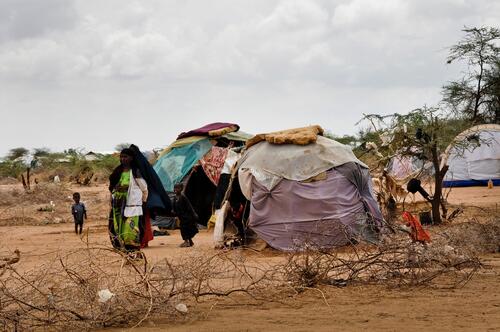
The biggest refugee camp in the world is full

As more and more people crowd the camps and the surrounding desert, the availability of essential services – such as water, sanitation and education – is shrinking, and living conditions are getting rapidly worse. Project Update - 10 Jun 2011
 
Newly arrived refugees stand outside their makeshift shelters, near Dagahaley refugee camp, Dadaab, Kenya.
Kenya

No Way In: The biggest refugee camp in the world is full

The three camps – Dagahaley, Hagadera and Ifo – known collectively as the ‘largest refugee camp in the world’ – were established 20 years ago to house up to 90,000 people escaping violence and civil war in Somalia. With no end to the conflict in sight, there are now more than 350,000 people crowded into the camps’ perimeters, while the number of new arrivals is surging. Report - 10 Jun 2011
 
msf-placeholder
Côte d'Ivoire

Fear persists even after violence subsides in Ivory Coast

“In Ivory Coast, terrified people in the bush must make the cruel choice to travel to villages where they don’t feel safe, in search of food or medicine. It’s crucial that emergency aid comes closer to where people have chosen to seek safety." - said Xavier Simon, MSF Country Representative in Ivory Coast. Project Update - 9 Jun 2011
 
msf-placeholder
Liberia

Liberia testimonies - Man, 40, New Yourpea transit camp

In the bush, there was no medicine, so we had to treat the children with traditional medicine for their gunshot wounds. Only weeks later did we make it Liberia, where MSF took them to the hospital. Project Update - 8 Jun 2011
 
msf-placeholder
Côte d'Ivoire

Ivory Coast testimonies - Woman, 21, village by Blolequin, western Ivory Coast

Two months ago, we were all in our village when armed men entered. They started to shoot and kill people and burn houses. I fled into the bush with my baby. Voices from the Field - 8 Jun 2011
 
msf-placeholder
HIV/AIDS

MSF response to UNAIDS release of new number of people on treatment in developing countries

Publication in The Lancet of UNAIDS projections that 12 million new infections and 7 million deaths could be averted by 2020 if universal access to treatment is achieved. In the Media - 3 Jun 2011
 
msf-placeholder
Pakistan

MSF treats 58 victims after suicide attack in Hangu, Pakistan

On Thursday, May 26, 2011, a suicide attack left 36 people dead and approximately 60 wounded near a police station in the city of Hangu in northwest Pakistan, just a few blocks from the hospital where MSF teams staff the emergency and surgery departments. Working with the hospital's teams, MSF treated 58 victims. Project Update - 28 May 2011
 
msf-placeholder
Access to Healthcare

UNICEF makes vaccine prices public in move likely to have major impact on developing country market

“This is a real step forward - until now it was difficult for countries to find out
what companies were charging for specific vaccines,” said Daniel Berman, Deputy Director of the Campaign for Access to Essential Medicines at Médecins Sans Frontières (MSF). “Full price transparency facilitates
competition and will allow buyers to make the best choices for immunisation
programmes.”
Project Update - 27 May 2011
 
msf-placeholder
Libya

MSF evacuates team from Zintan, Libya

MSF evacuated its team from the western Libyan city of Zintan on Friday 27 May, following repeated shelling.
Project Update - 27 May 2011
 
msf-placeholder
Uganda

Suffering from chronic neglect in Kaabong, Uganda

The people of Kaabong have the unenviable title of being amongst the poorest in Uganda.
Large parts of the population suffer from violence and chronic neglect. Seventy percent of the population here cannot access health care.
Project Update - 27 May 2011
Four mothers posing in a corridor of the Hospital in Bili. All four of them are staying in the hospital with their child, that's suffering from a severe case of malaria. Since the beginning of the project in 2016, the pediatric ward already treated more than 4.000 cases of complicated/severe form of malaria.
Médecins Sans Frontières (MSF)

Independent medical humanitarian assistance

We provide medical assistance to people affected by conflict, epidemics, disasters, or exclusion from healthcare. Our teams are made up of tens of thousands of health professionals, logistic and administrative staff - most of them hired locally. Our actions are guided by medical ethics and the principles of independence and impartiality. We are a non-profit, self-governed, member-based organisation.

Learn more