



Ebola disease in DRC: find out how we're responding
Learn more
4635 Results
 
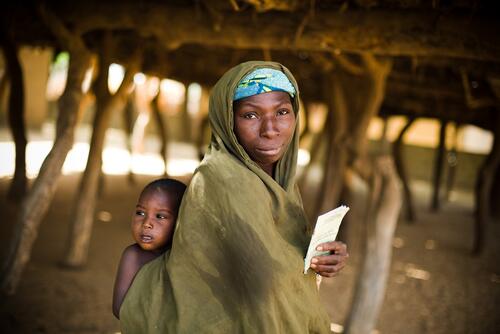
A woman who took her child to get vaccinated against meningitis holds the child's vaccination card at a vaccination site in Safa Dougoumi, Dosso Region, Niger on Monday April 20, 2009.<br/><br/>MSF teams working with the Ministry of Health are treating patients suffering from meningitis and are vaccinating in the Dosso, Maradi and Zinder regions. So far a total of 2,135,000 people have been vaccinated by MSF and the Ministry of Health in these three affected southern regions. Meningitis is a contagious disease that kills half of infected people if they are not treated. Since the beginning of this year an area of sub-Saharan Africa known as the meningitis belt has been heavily affected by an epidemic of meningitis. In Nigeria, Niger, and Chad alone, medical teams of MSF are vaccinating a total population of about eight million people. This is the biggest vaccination MSF has ever carried out. Each day, MSF teams are also travelling to urban and remote health centres in order to collect data, review and treat patients and to donate drugs to the health facilities.
Access to medicines

The Right Shot: Extending the reach of affordable and adapted vaccines

This publication seeks to remedy some of the existing knowledge gaps by raising awareness on existing price differentials, exploring what factors drive fluctuations in vaccine prices, and discussing where development of better adapted vaccines could reduce barriers to immunisation and increase coverage levels of traditional and newer vaccines. Report - 15 May 2012
 
msf-placeholder
Mauritania

Nearly one thousand Malian refugees pour into the Mbera camp every day

Since late January, some 57,000 Malians have entered the Mbera refugee camp in Mauritania. Refugee numbers are steadily increasing, from 200 arrivals on April 5 to 1,500 a day. In response to this massive influx, Médecins Sans Frontières (MSF) is bolstering its activities and emergency medical aid in this desert area, where access to medical care is extremely limited. Press Release - 19 Apr 2012
 
msf-placeholder
South Sudan

MSF assists patients wounded in aerial bombardment in Unity state

The international medical organisation Médecins Sans Frontières (MSF) is treating patients wounded during aerial bombardments of Abiemnom, Unity state, South Sudan. Press Release - 12 Apr 2012
 
msf-placeholder
Democratic Republic of Congo

Civilians and aid workers are victims of renewed fighting in the Kivus

Civilians and aid workers are the main victims of a recent intensification of armed conflict and troop movements in eastern Democratic Republic of the Congo (DRC).
The national and international stabilisation forces in Kivu have never been so important, but given the worsening of the situation, the medical humanitarian organisation Médecins Sans Frontières (MSF) questions its effectiveness.
Press Release - 12 Apr 2012
 
msf-placeholder
Democratic Republic of Congo

Armed robbery at MSF compound in eastern DRC

MSF strongly condemns intimidation against humanitarian aid workers working in the east of the Democratic Republic of Congo, after its compound was robbed and staff threatened yesterday. Statement - 10 Apr 2012
 
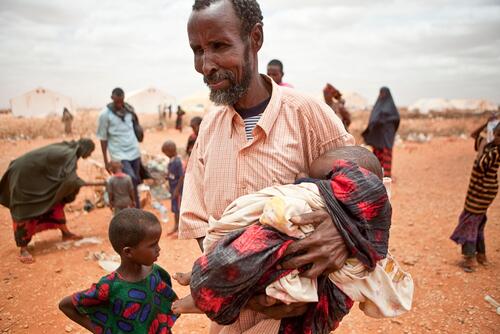
All new arrivals are screened for diseases and malnutrition crossing the border into Ethiopia.
Refugees, IDPs and people on the move

Assisting the Somali population affected by the humanitarian crisis of 2011

This report provides an overview of MSF activities in Somalia and neighbouring Kenya and Ethiopia, both of which received large numbers of Somali refugees in 2011. The data presented, though provisional, account for MSF’s medical activities, financial income and expenditures. The narrative sketches how MSF as a medical aid organisation responded to this evolving crisis. Report - 29 Mar 2012
 
msf-placeholder
South Sudan

Window of opportunity closing fast to provide assistance to 80,000 Sudanese refugees from Blue Nile state

Tens of thousands of Sudanese refugees in South Sudan urgently need humanitarian aid to be scaled up in a short window of opportunity that is rapidly closing before the rainy season starts. In the camps at Doro and Jamam, only an emergency approach to provide urgently needed aid can still ensure the health and dignity of refugees seeking shelter from violence. Press Release - 14 Mar 2012
 
msf-placeholder
Democratic Republic of Congo

MSF staff Returns to Shamwana, Katanga, to resume medical care

MSF returned to continue its medical care in Shamwana, Katanga province, in the eastern Democratic Republic of Congo (DRC) on Saturday, after it suspended its operations two days earlier due to fighting in the town that displaced the entire population. Press Release - 6 Mar 2012
 
msf-placeholder
Mauritania

Food insecurity threatens as thousands of Malian refugees gather in desert

More than 28,000 Malian refugees have been forced to seek refuge in the border region of Mauritania following the conflict between the Malian army and Tuareg rebels that broke out in northern Mali last month. Some refugees travelled days without sustenance to get to makeshift camps in Fassala and Mbéré in the south east of Mauritania. Project Update - 29 Feb 2012
 
msf-placeholder
Greece

Migrants suffer in border police stations amid recent extreme weather conditions

The constant arrival of migrants in Greece’s Evros region, coupled with the extreme weather conditions of the past few weeks, has been putting pressure on the already fragile system for receiving migrants in the border police stations of Soufli, Tychero and Feres and the detention centre of Filakio. Project Update - 28 Feb 2012
Four mothers posing in a corridor of the Hospital in Bili. All four of them are staying in the hospital with their child, that's suffering from a severe case of malaria. Since the beginning of the project in 2016, the pediatric ward already treated more than 4.000 cases of complicated/severe form of malaria.
Médecins Sans Frontières (MSF)

Independent medical humanitarian assistance

We provide medical assistance to people affected by conflict, epidemics, disasters, or exclusion from healthcare. Our teams are made up of tens of thousands of health professionals, logistic and administrative staff - most of them hired locally. Our actions are guided by medical ethics and the principles of independence and impartiality. We are a non-profit, self-governed, member-based organisation.

Learn more