



Ebola disease in DRC: find out how we're responding
Learn more
4635 Results
 
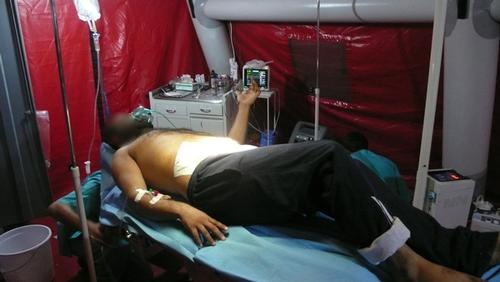
A wounded patient lies on the operating table at a MSF field hospital in northern Syria.
Syria

"In addition to many civilians, we treated both wounded rebel fighters and soldiers from the Syrian army"

Dr Martial Ledecq is a surgeon who is just back in Belgium from a one-month mission in one of the four makeshift medical facilities set up by MSF in the north of Syria. Since the end of June 2012, MSF teams have treated more than 2,500 patients and carried out some 550 surgical procedures. Voices from the Field - 15 Nov 2012
 
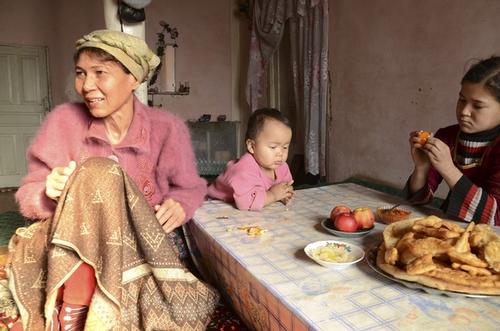
MDR-TB patient Rohatay Abdullaeva at her home with a grandson Atabek and daughter Nadira, town of Hojeily, Karakalpakstan (Uzbekistan).
Tuberculosis

DR-TB Drugs Under the Microscope: 2nd Edition

This report focuses on just some of the many factors that hamper the scaling up of DR-TB treatment – the limited availability and high cost of quality-assured medicines for resistant strains of the disease, owing to an insecure market and insufficient demand; and the research questions that remain unsolved with existing medicines. Report - 13 Nov 2012
 
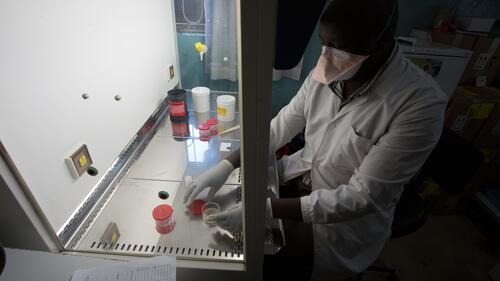
Xpert MTB/RIF laboratory test, used to diagnose tuberculosis (TB) and TB strains resistant against the primary TB drug rifampicin. Kibera South Health Center, Kenya.
Tuberculosis

Results from new TB test reveal urgent need to scale up treatment

Results from the largest multi-country implementation of the new rapid tuberculosis (TB) diagnostic test reveal an urgent need to address the growing global crisis of drug-resistant TB. The data was collected from 25 MSF projects in 14 countries over a nearly 18-month period. It shows an overall 50 per cent increase in the diagnosis of TB using Xpert MTB/RIF. Press Release - 13 Nov 2012
 
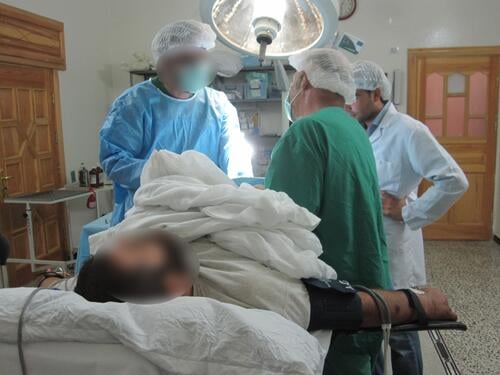
 *** Local Caption *** MSF has been providing surgical care to victims of violence, in a hospital set up in the north of Syria, since June 2012.
Syria

MSF increases medical activities

MSF is increasing its medical activities to help victims of the conflict in Syria. MSF is providing emergency and surgical treatment for the wounded, as well as medical care for people displaced from their homes within Syria and for refugees who have escaped to neighbouring countries. Project Update - 6 Nov 2012
 
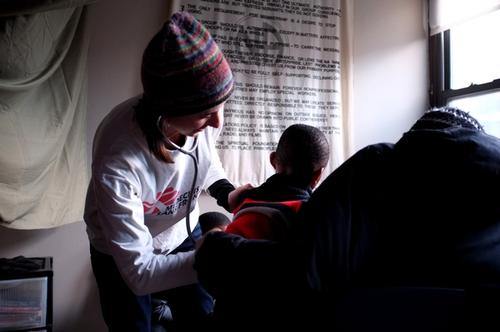
Dr. Lucy Doyle, a physician with Doctors Without Borders, examines a patient in a makeshift medical clinic in a building at the Ocean Village housing complex in Rockaway, Queens, November 5, 2012.  Electrical power, heat and plumbing were cut in the entire five-building complex following Superstorm Sandy.  The organization established the clinic in a room normally used for Narcotics Anonymous meetings.
United States of America

MSF filling gaps in medical aid for people affected by Hurricane Sandy

MSF teams, working alongside local community groups, are providing medical and mental health care to Hurricane Sandy-affected communities in the New York City boroughs of Brooklyn, Queens, and Staten Island, as well as Hoboken, New Jersey. The vast majority of the patients treated by MSF in the shelters and underserved communities have been elderly, homeless, or physically or mentally impaired. Project Update - 5 Nov 2012
 
msf-placeholder
Myanmar

MSF prevented from reaching most communities affected by violence in Rakhine State

As MSF medical teams work to reach communities affected by the violence in Rakhine State they face ongoing antagonism generated by deep ethnic divisions. Press Release - 5 Nov 2012
 
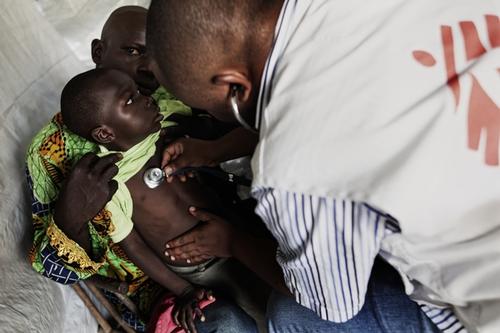
A young patient is seen by an MSF staff during a mobile clinic. DR Congo, Haut Uele, Dungu area/Nadogolo.
Democratic Republic of Congo

Congolese aid workers return to Pinga

All of the Congolese personnel employed by Médecins Sans Frontières (MSF) in its Pinga project in the North Kivu province of the Democratic Republic of the Congo have now returned to their positions, a month after active fighting between armed groups forced many to flee the area in search of safety. Project Update - 5 Nov 2012
 
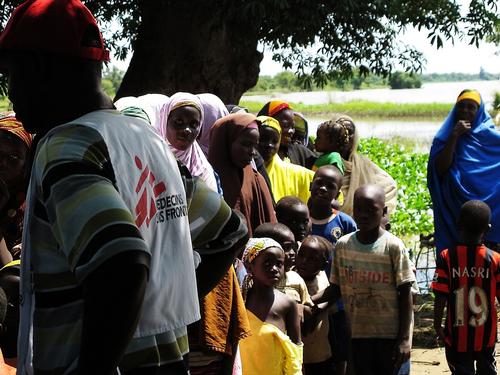
After severe floods hit eastern Nigeria in september 2012, Doctors Without Borders/Médecins Sans Frontières (MSF) provided medical assistance and distributed aid kits to populations in need.
Hundreds of villages were destroyed and thousands of people were affected by the floods, which occurred after heavy rainfall caused the Benue River to rise above its banks. The situation was worsened because additional water was released from a dam in neighbouring Cameroon. In some places, houses were totally submerged, their residents forced to flee.
MSF’s intervention began early September 2012, when medical and logistics teams were deployed in Adamawa and Taraba states. MSF used motorboats to reach isolated and displaced populations in remote flooded areas that were left without access to medical attention.
MSF teams exercised vector control, carried out mobile clinics, provided primary and emergency health care and distributed NFI kits and mosquito nets. In Taraba state, MSF mobile clinics carried out 1,430 consultations in Mayorenewo and 10 nearby villages. In Adamawa state, MSF mobile clinics treated 5,500 patients in 33 flooded villages and two internally displaced people’s camps in Numan and Borong. Soaps and mosquito nets were also distributed to 2,200 beneficiaries.
Nigeria

MSF provides medical assistance in flood-affected areas

After severe floods hit eastern Nigeria in September, MSF provided medical assistance and distributed aid kits to populations in need. Hundreds of villages were destroyed and thousands of people were affected by the floods. MSF staff also found high rates of malaria, particularly in the Mayorenewo area, where more than 80 per cent of the patients tested positive. Project Update - 2 Nov 2012
 
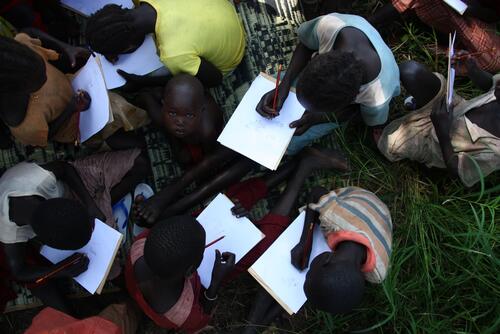
Children drawing as part of MSF's mental health activities. The mental stress of being a refugee can disable a person, making an already difficult situation even harder to cope with. Depression, anxiety and fear are common symptoms, as are unexplained physical complaints. In Doro camp, set up for refugees who crossed from Sudan’s Blue Nile State into South Sudan’s Maban County, MSF is supporting its medical activities with psychosocial work.
South Sudan

Mental healthcare for refugees

The mental stress of being a refugee can disable a person – even the whole family – making an already difficult situation even harder to cope with. Depression, anxiety and fear are common symptoms, as are unexplained physical complaints. In the camps for refugees who have crossed from Sudan’s Blue Nile State into South Sudan’s Maban County, Médecins Sans Frontières (MSF) is supporting its medical activities with psychosocial work. Project Update - 30 Oct 2012
 
msf-placeholder
Pakistan

MSF treats patients with acute watery diarrhoea

During the monsoon season, Khyber Pakhtunkhwa saw an increase in the number of people diagnosed with acute watery diarrhoea, a condition caused by dirty drinking water, poor sanitation, and poor hygiene conditions. In response to the growing number of cases, the teams from MSF and the Ministry of Health set up temporary treatment centres in Timergara, Hangu and Sadda. Project Update - 23 Oct 2012
Four mothers posing in a corridor of the Hospital in Bili. All four of them are staying in the hospital with their child, that's suffering from a severe case of malaria. Since the beginning of the project in 2016, the pediatric ward already treated more than 4.000 cases of complicated/severe form of malaria.
Médecins Sans Frontières (MSF)

Independent medical humanitarian assistance

We provide medical assistance to people affected by conflict, epidemics, disasters, or exclusion from healthcare. Our teams are made up of tens of thousands of health professionals, logistic and administrative staff - most of them hired locally. Our actions are guided by medical ethics and the principles of independence and impartiality. We are a non-profit, self-governed, member-based organisation.

Learn more