


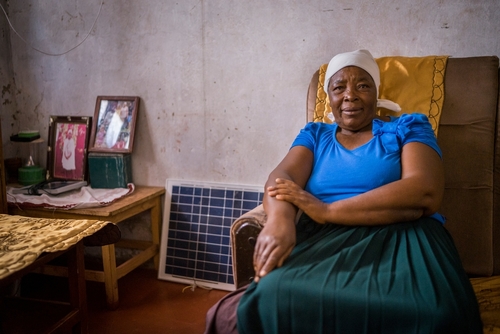
![Sinethemba takes her daily regimen for XDR-TB at 10am each day. She also takes two additional delamanid tablets at night.
Sinethemba, 16 years, lives with her grandmother, Vuyisiwa Madubela, and four other family members in a two-bedroomed home in Zone C29, Khayelitsha, Western Cape, South Africa.
Her grandmother’s determination and love, combined with receiving a six-month trial of one the newest DR-TB drugs on the market likely saved her life this year.
Current regimen: delamanid, linezolid, pyrazinamide, ethambutol, clofazimine, high dose levofloxacin, terizidone.
Grandmother Vuyisiwa Madubela:
“Sinethemba’s mother died when she was 6 months old, she was taken [raised] by my elder daughter who also died last December.
She’s from PE (Port Elizabeth) and when I arrived there for the funeral I saw Sinethemba was very sick – thin, weak, shaking, very pale, sleeping, very high temperature . She was very quiet. I hadn’t seen her for a long time, nearly three years.
On the day of the funeral, the senior sister in the area called me – “Can you take her? This child is sick… “
I thought I was going to lose her. It was painful as I’ve lost three children. I used say ‘if I lose one child, I’ll die; I was thinking: I’ve lost her mum, and she’s going to die too.’
During her first month with us in Khayelitsha, it was terrible - she wouldn’t eat. We’d all just watch her. Everyone was sad. When I wanted to cry, I had to go outside.
On 12 December 2015, she had X-rays, and they took sputum. They called and said I had to come immediately, she had MDR-TB and they were putting her in Brooklyn Chest Hospital.
That day, I lost hope. I thought she was going to die. If she stayed in PE, she would have died.
By end December 2015 she started MDR treatment with kanamycin injections, as well as the other drugs – they said she could go deaf because of the side effects of the injection. She had to go to the clinic Monday to Friday, every day.
It was painful and some days she asked not to go. In February 2016, her sputum showed that she was resistant to the injection, so they applied for new drugs to change her treatment.
In February 2016, MSF came and explained that they could apply for a new drug for Sinethemba called delamanid if I gave my permission for her to take part, because the drug is not usually available for TB patients in South Africa. We met with a counsellor, and got a lot of information.
The first few days she had nausea, wanting to vomit. I sat her down and I said: “You have to accept this; you must talk to your tablets. You must give them an order: ‘I am in charge.’”
Not even a month later, she started speaking, even dancing. She’s going to church, she’s singing in the church choir. Everyone could see there was an improvement and they wanted to know what happened. She’s going for an electrocardiogram (ECG) every month and it’s normal.
Last year was very hard for the whole family, but from February when she started delamanid, she didn’t take a long time to get better.
The only problem is now she eats everything. We have to dish up twice! She’s gained weight.
When she went for her last x-ray they told me they don’t see any signs of TB in her chest.
Sinethemba hasn’t been to school this year, I was told that she wouldn’t cope, that the treatment would make her drowsy, sleepy. We’ve been told she can go next year.
Everyone could see there was improvement. Everyone wanted to know.
What would I like to tell the manufacturer of delamanid?
I would ask the manufacturer of delamanid to give it to every patient who really needs it. I see lots of TB patients at the TB clinic. If people got this drug, they could really control DR-TB. TB is a giant but not a killer. TB can be cured.”](https://img.msf.org/AssetLink/ctbko87h67w7os0ga5ny5o5661m27040.jpg "Sinethemba- MSF Treatment For TB in South Africa.")

Médecins Sans Frontières (MSF)
Independent medical humanitarian assistance
We provide medical assistance to people affected by conflict, epidemics, disasters, or exclusion from healthcare. Our teams are made up of tens of thousands of health professionals, logistic and administrative staff - most of them hired locally. Our actions are guided by medical ethics and the principles of independence and impartiality. We are a non-profit, self-governed, member-based organisation.
Learn more