



Ebola disease in DRC: find out how we're responding
Learn more
7998 Results
 
18-year-old Abuk Akuoc, semi-conscious and still letting out soft moans of pain, receives an IV treatment of quinine for her severe malaria at the government-run health center in Panthou. Abuk's family brought her to the health center from their village, called Malithbuol, by motorcycle, which they hired for 30 SSP.  The journey took 15 minutes, but it would have taken one hour on foot. This wasn't the first time she had been at the health center: the previous week they had brought her in, suffering from malaria. She had been prescribed ACT but at the time, the health center had none in stock. It had run out back on August 17th. So, they instructed her to purchase it in the market. But the family couldn't find any ACT there either. It wasn't in stock. So they bought only paracetamol. Last night, Abuk didn't eat and complained of a headache. This morning, when she was cooking, she collapsed. Her family had never seen anything like this and didn't know what malaria looked like until now. Panthou health care center is the only one in Aweil South county and is currently treating about 150 malaria patients per day. They had just received a supply of ACT oral medication for malaria; their previous stock had ran out on August 17. This new stock will likely run out in one or two weeks. They have quinine, but not a lot, so they reserve it for serious cases. They have no RDT (rapid detection tests), so diagnosis is only done clinically based on observed symptoms.
South Sudan

Malaria preparedness vital as rains begin

Hundreds of thousands of people in South Sudan are at risk of contracting malaria in the coming months during the annual peak of the disease, which begins in the country’s rainy season. Project Update - 12 Jul 2017
 
msf-placeholder
Central African Republic

Baby brutally killed at a hospital

“The callousness of this attack highlights both the indiscriminate nature and disturbing escalation in violence in CAR against civilians" Statement - 12 Jul 2017
 
MSF works with a network of local organisations, who work with young girls and vulnerable children. Solidarité fanm pou yon lavi miyò (Sofalam) is one of them. They provide shelter to twelve girls, who have been refered to them by governmental social agency. Those girls are seperated from their families and have been living in a extremely vulnerable situation. Sexual abuse has been identified in some case. One of the main challenge that SOFALAM faces is the lack of means to hire competent psycologist and social workers who could help children who have been victim of sexual abuse.
Haiti

Against their will: New report on sexual violence

In Haiti, the number of young people, especially women and girls, who report experiencing sexual and gender based violence is alarmingly high. Report - 12 Jul 2017
 
GISELE, 20 years old (name changed)
My cousin told me that I had bad luck, that something was wrong with me. A friend of my parents said that he was a mason and therefore could help remove the “bad eye”. He took me to an isolated place and asked me to get naked. He touched me and raped me. I even gave him 1000 gourds. I told my family what happened. Now he is hiding, and he is under the protection of a women judge. I want justice to be done. I also know he is a recidivist. He did the same to two little girls from my neighbourhood. The parents are scared so they don’t do anything. Both girls are 15 and 12.
Haiti

Against their will

In Haiti, the number of young people, especially women and girls, who report experiencing sexual and gender-based violence (SGBV) is alarmingly high, especially in the densely populated capital Port-au-Prince. Yet, the issue is not widely discussed, and SGBV cases are likely underreported due to stigma and shame, as well as fear of reprisal from perpetrators or the community. At the same time, the services that are available for survivors, especially for minors (under the age of 18), are insufficient and inadequate. Photo Story - 12 Jul 2017
 
La route entre les village de Kinyandoni et Kiwanja, situés à environ 70km au nord de Goma, dans la province du Nord-Kivu, en République démocratique du Congo, le 19 décembre 2015.     /     The road between the villages of Kinyandoni and Kiwanja, located about 70km north of Goma in the province of North Kivu, in the Democratic Republic of Congo, on December 19th, 2015.
Democratic Republic of Congo

Release our colleagues abducted four years ago

Despite our efforts, and the escalation in violence in DRC and more particularly in North Kivu, MSF has still not ascertained the whereabouts of our three colleagues. Press Release - 11 Jul 2017
 
 “In Abs hospital, the wards are bursting at the seams, as our medical teams do everything they can to meet people’s urgent health needs. What’s happening in Abs sums up the current state of Yemen. More than two years after the conflict escalated, the country has been torn apart. Many health facilities are not functioning, or are short of staff and medical supplies, and the health system has collapsed.” Roger Gutiérrez, MSF field coordinator in Abs, Yemen
Yemen

“Some families have to choose between taking a child to hospital or feeding the others”

In Abs hospital, the wards are bursting at the seams, as our medical teams do everything they can to meet people’s urgent health needs. Voices from the Field - 10 Jul 2017
 
Saleh Mohammed, aged 57, from Sa’ada, is living in a displaced setting near Abs, Hajjah governorate. He is in Al Khamees health centre holding his two-year-old daughter, who has been exposed to war for most of her life: she was born in January 2015. Most of her siblings are dead.
Yemen

Urgent need for improved water and sanitation to curb cholera

“In Abs district, our teams are seeing an extremely poor sanitation situation and insufficient access to clean drinking water” Press Release - 10 Jul 2017
 
Displaced people arrive in the town of Pulka, in the northeast of Nigeria.
Nigeria

On the move and unable to move because of conflict

“We settled here because we thought it was a safer place. We don’t think it is safe enough to go back there yet.” Voices from the Field - 7 Jul 2017
 
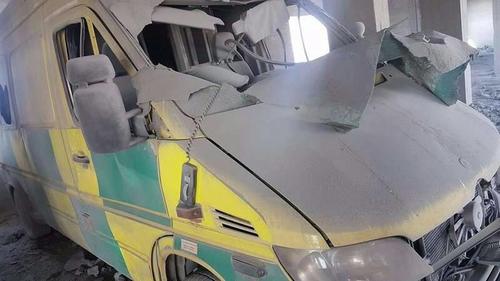
The last two functional ambulances in Al-Marj neighbourhood (in the East Ghouta besieged area near Damascus) were destroyed beyond repair in an aerial bomb attack on Monday 05 December 2016. They were parked in the hospital’s warehouse/garage, very near to the makeshift hospital’s location. Two hospital cars, used to transporting supplies and medical personnel, were also destroyed in the blast. The lack of ambulances will have an impact on the ability to quickly treat wounded when there is bombing or shelling in the area, but above all it will affect the capacity to refer the most sick patients to larger secondary referral hospitals. The makeshift hospital in Al-Marj is not equipped for complex or long-term in-patient hospital care, and this could have a big impact on the ability to refer patients for appropriate secondary care.
Global health

MSF urges G20 to take action on health issues

“The G20 leaders need to improve people’s access to medical care and turn their words into action.”
Press Release - 6 Jul 2017
 
Khansa hospital destroyed during the battle for Mosul.
Iraq

Medical care in West Mosul: “There are no heroes in this story, only victims”.

When Ahmed* arrived at MSF’s field hospital south of Mosul, Iraq, many of the hospital’s staff burst into tears. For years, Ahmed, a skilled nurse, had been their colleague, caring for the sick and injured of West Mosul but now he was their patient and in need of urgent medical care. Voices from the Field - 6 Jul 2017
Four mothers posing in a corridor of the Hospital in Bili. All four of them are staying in the hospital with their child, that's suffering from a severe case of malaria. Since the beginning of the project in 2016, the pediatric ward already treated more than 4.000 cases of complicated/severe form of malaria.
Médecins Sans Frontières (MSF)

Independent medical humanitarian assistance

We provide medical assistance to people affected by conflict, epidemics, disasters, or exclusion from healthcare. Our teams are made up of tens of thousands of health professionals, logistic and administrative staff - most of them hired locally. Our actions are guided by medical ethics and the principles of independence and impartiality. We are a non-profit, self-governed, member-based organisation.

Learn more