



Ebola disease in DRC: find out how we're responding
Learn more
7997 Results
 
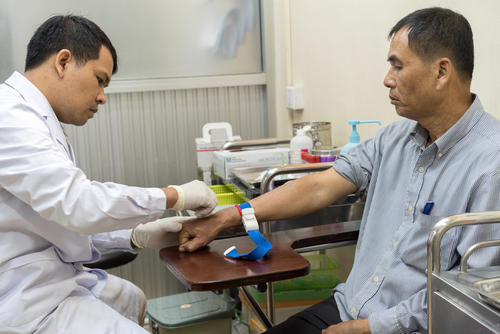
People wait for their appointment at the MSF Hepatitis C clinic at Preah Kossamak Hospital in Phnom Penh, Cambodia, 19, April 2017.
Hepatitis C

MSF secures lower price for generic hepatitis C treatment

“History is repeating itself with hepatitis C –the medicines we need are again too expensive, but we are finding ways to make treatment affordable so that our patients can be cured.” Press Release - 31 Oct 2017
 
Jean Paul Buana, nurse and director of the Mayi Munene health centre, examines the damage to the operating theatre. 
“When we first saw what they had done to the centre, we cried. There was nothing else to do but cry. All our work has been lost. Between March and June, the centre did not function at all. We only came back in July because the security improved. Now there are six of us working here, but the needs are huge. We lack medicines and equipment, and safe space to work.”
Democratic Republic of Congo

Testimonies from Kasai

Although the violence that has affected the central Greater Kasai region of the Democratic Republic of Congo for more than a year has abated, the humanitarian needs of local communities and the hundreds of thousands of displaced people are immense. Project Update - 31 Oct 2017
 
From October 19 2012, following the suspicious deaths of five people from the same family, cases of Marburg have been confirmed in Kabale District, southwest Uganda. In support of the Ministry of Health, a team of Doctors Without Borders (MSF) ensure health checks and care for infected patients to the hospital Kabale.In banda and Mbarara where few cases of fever were detected MSF has provided some trainings to medical staff and made donations of equipment and drugs.
Uganda

MSF responds to an outbreak of Marburg fever

MSF is focusing its intervention around case management, and support to contact tracing and mapping. Project Update - 30 Oct 2017
 
Michele Kabeya on his bed at the Ditekemena health centre, where he was admitted for a surgery. Michele is from Senge village. He had been hiding in the bush after the village was attacked by militias, but decided to return when the police confirmed it was safe again. However, a couple days later he was shot in his right arm. His family brought him to Tshikapa for surgery. They had to walk for four days to reach the centre. “I have never seen so many people die,” he recalls of the attack on Senge.
Democratic Republic of Congo

“Months later, they still can’t remove the bloodstains from the soil”

"I can confirm that the humanitarian response to this crisis has been vastly inadequate for a crisis of this magnitude.” Voices from the Field - 30 Oct 2017
 
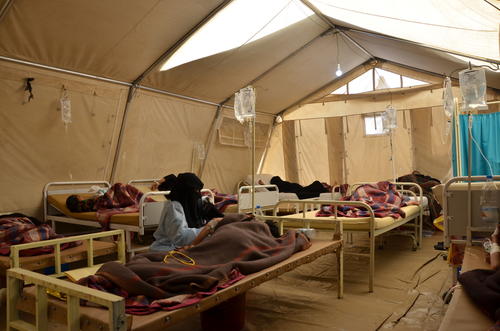
In the recovery tent of the cholera treatment centre at the Qaeda hospital, MSF health promotion team teaches former patients and caretakers some good practices to avoid cholera. Here, patients are taught the best way to wash their hands. Al Thawra hospital / Qaeda / Ibb Governorate.
Yemen

MSF reduces its cholera response as admissions drop

“The cholera outbreak is not over but it is no longer our medical priority in Yemen." Press Release - 30 Oct 2017
 
Noor Alam with his second son Noor. 
Noor Alam is the first patient to be cured of Hepatitis C at MSF’s Machar Clinic. Noor Alam is a resident of Machar Colony, Saddam Chowk, Karachi. He lives with his wife and six children in a rented house midway down a narrow ally. 
Approximately seven years ago Noor Alam started to experience severe pain in his body. He went to a local clinic for tests and discovered he had contracted Hepatitis C. To sustain his treatment he subsequently had to sell his house. The series of treatment was not successful. Despite facing financial ruin and with a young family to feed, Noor Alam was not cured after two courses of treatment. His situation started to deteriorate. As a migrant from Bangladesh, Noor Alam does not have access to advanced medical treatment in the government health system. 
Last year, Noor Alam heard about the MSF clinic in Machar Colony. He visited the clinic and was soon after added to the treatment program. 
During his time of treatment he would have to send his eldest three children (girls) to work in the shrimp peeling market so that the family would have food for the day. The girls were unable to continue their education because of this. One bucket of shrimps can take up to one hour to peel generating 20 Pakistani Rupees (USD0.19). They work for a minimum of six hours a day. Noor Alam’s eldest son is still attending the local school, he wishes for his son to be educated and to be able to build a future other than fishing or fishery. 
“I am unsure how I contracted Hepatitis C, I think it is the water that made me ill” he says. “The water here is polluted” he adds. It is a common misconception amongst residents of Machar Colony that they can contract Hepatitis C via polluted water. To Noor Alam’s delight he is now cured of Hepatitis C.

Noor Alam's wife sits on the floor on the first floor in the hope of catching a little sun with her youngest daughter and her second eldest son.
Access to medicines

Hepatitis C - Not even close

This issue brief provides information on currently available HCV diagnostics and treatments, including pricing and registration information from manufacturers of DAAs. msfaccess.org - 30 Oct 2017
 
Nurse Maria Blanco examines a malnourished child in Masanga Anai.

.
Democratic Republic of Congo

Urgent need for aid in rural areas of Kasai

“The Kasai crisis has been completely neglected... people returning to their villages and towns have been left on their own to rebuild destroyed homes.” Press Release - 30 Oct 2017
 
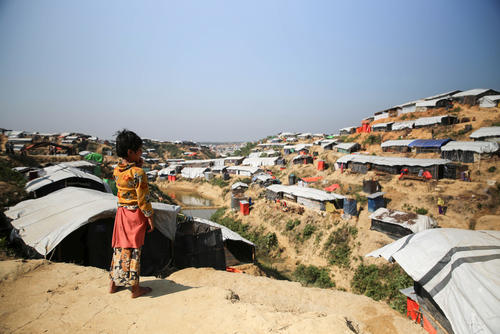
MSF’s President Joanne Liu meets a ten year old girl at Kutupalong Health Facility, who has just started making a miraculous recovery from tetanus, after her third week in hospital. Doctors had not expected the young Rohingya girl to survive.  'Tetanus is a disease that has been eliminated throughout most parts of the world by vaccination.' But not in North Western Myanmar, the home of this girl's family, where they recently fled from.

MSF’s President Joanne Liu reflected about why she was drawn to the little girl, as her father proudly helped her walk around the facility: “Tetanus can have such a high case fatality rate that seeing someone who survived and was walking, it’s always, I would say a victory over so this is why I thought it was quite amazing to see her walking around in the clinic.” 

[Left to right: Doctor Nina Goldman, MSF President Dr Joanne Liu and Nurse Activities Manager Jacqueline Murekezi meet with a tetanus survivor]
Rohingya refugee crisis

“The scars of this atrocity will run generations deep”

MSF International President Dr Joanne Liu recently returned from a visit to Bangladesh, where she saw the Rohingya crisis unfolding firsthand. On 23 October 2017, Dr Liu attended a Pledging Conference in Geneva, organised by OCHA, IOM and UNHCR and co-hosted by the European Union and Kuwait, to discuss the plight of refugees sheltering in informal settlements in Cox’s Bazar. Speech - 30 Oct 2017
 
msf-placeholder
Syria

Thousands could die if Syrian-Iraq Kurdistan border closes to humanitarian aid

MSF calls on all parties to ensure continued access, without let or hindrance, for the delivery of humanitarian aid across borders. Statement - 28 Oct 2017
 
Shattered side mirror and cracked windshield of an MSF ambulance after it was attacked by protestors.
Kenya

MSF calls for safe access to wounded by medical teams

“I call on all communities to provide and ensure unconditional and safe access to those affected and to medical teams." Project Update - 26 Oct 2017
Four mothers posing in a corridor of the Hospital in Bili. All four of them are staying in the hospital with their child, that's suffering from a severe case of malaria. Since the beginning of the project in 2016, the pediatric ward already treated more than 4.000 cases of complicated/severe form of malaria.
Médecins Sans Frontières (MSF)

Independent medical humanitarian assistance

We provide medical assistance to people affected by conflict, epidemics, disasters, or exclusion from healthcare. Our teams are made up of tens of thousands of health professionals, logistic and administrative staff - most of them hired locally. Our actions are guided by medical ethics and the principles of independence and impartiality. We are a non-profit, self-governed, member-based organisation.

Learn more