



Ebola disease in DRC: find out how we're responding
Learn more
8000 Results
 
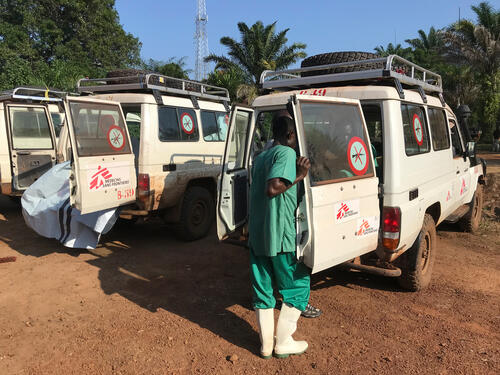
Preparation of the outreach teams in Bikoro.
DRC Ebola outbreaks

Ninth Ebola outbreak in 40 years hits urban area

An outbreak of Ebola has been declared in Equateur province, Democratic Republic of Congo (DRC). The outbreak, in the northeast of the country, has affected 44 people who have presented symptoms of haemorrhagic fever in the region; 3 confirmed as Ebola, and and 23 deaths have been notified by the national health authorities. Project Update - 17 May 2018
 
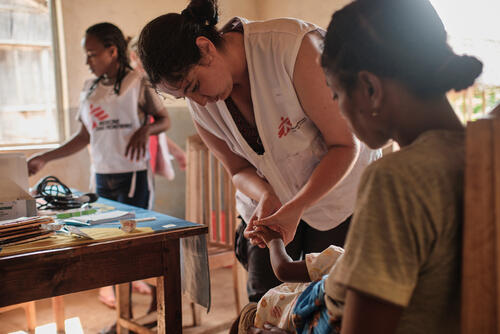
Patients consultation in the health centre of Ambodrian i’Sahafary, a village only accessible by boat where MSF set-up a moblie clinic.

MSF is rehabilitating health structures damaged by the cyclones in Nosy Varika and the surrounding area, as well as supporting the medical activities in this region which had already poor access to healthcare.

Resource centre

At MSF, we publish evaluations, critical reviews and guidelines detailing our activities and research. While you will find some of these in-depth resources on our website, most can be found on separate websites, specially designed for the specific resource. Discover them all, from medical resources like our Medical Field Guidelines, to those focusing on analysis, reflection and evaluation, such as those from our Research & Evaluation Centres.
 
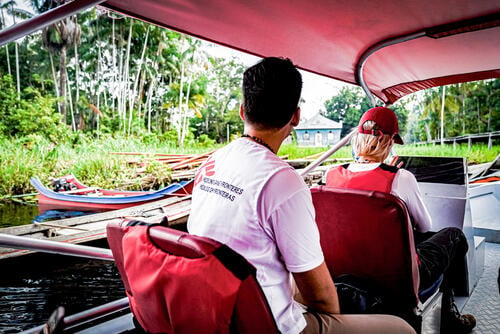
A boat taking MSF staff to the rural area of Portel travels through a river in the Brazilian Northern state of Pará. MSF is supporting local authorities in order to improve healthcare access to the town’s population. Portel has dealt historically with a lack of health professionals and facilities, particularly in hard-to-reach remote areas which are home to vulnerable river dweller communities.

Where we work

In more than 75 countries, Médecins Sans Frontières provides medical humanitarian assistance to save lives and ease the suffering of people in crisis situations. Learn more about all our programmes around the world.
 
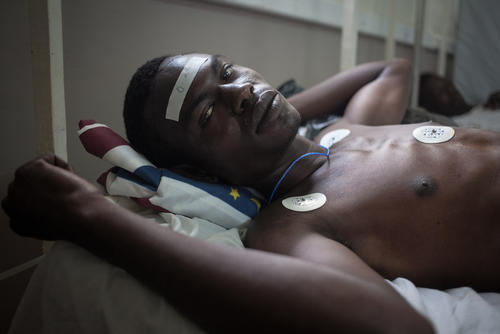
Ali, a student, was shot in the stomach during the events of April 10th. The bullet is still lodged in his body, he is waiting for surgery.

Ali, étudiant, a reçu une balle dans le ventre durant les événements du 10 avril. La balle est encore logée dans son corps, il attend d'être opéré.
Central African Republic

Days of violence and mass casualties in Bangui

For over 18 months, Central African Republic (CAR) has yet again been subjected to extreme violence inflicted on a population left traumatised by the civil war in 2013 and 2014. Until recently, the capital city Bangui appeared to have been spared the attacks and fighting that have erupted in the provinces. Project Update - 17 May 2018
 
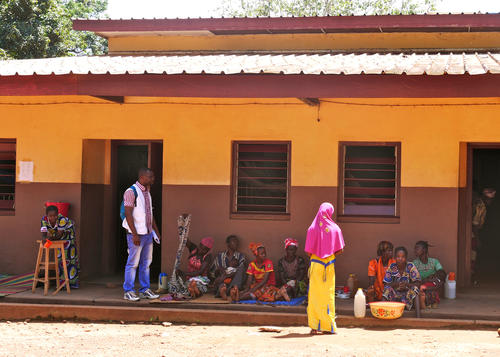
People waiting in front of the Bambari general hospital, Central African Republic. In Bambari, second city of CAR, MSF supports the paediatric and maternity wards and the national surgery team. MSF teams in Bambari treated 22 people for violence-related injuries in May 2017, in contrast to just eight in April. Four children were among the wounded from Alindao treated by MSF, including a three-year-old who had been shot in the face. Most of those injured in Alindao had gunshot wounds, but some had knife injuries and burns.
Central African Republic

Fire and bloodshed in Bambari, a town symbolising peace

Since 14 May 2018, a new cycle of inter-community violence has taken hold in Bambari, a city in the Central African Republic (CAR) that, in 2017, remained relatively stable while the rest of the country spiralled into increasingly fractured conflict. MSF’s surgery team, which supports the local hospital, cared for 17 wounded, two of whom unfortunately succumbed to their injuries. Project Update - 17 May 2018
 
msf-placeholder
Tuberculosis

Conflict and tuberculosis in Sudan

This study will be the first to describe TB case notifications, characteristics and outcomes over a ten-year period in Darfur in comparison with the non-conflict Eastern zones within Sudan. Conflict and Health - 16 May 2018
 
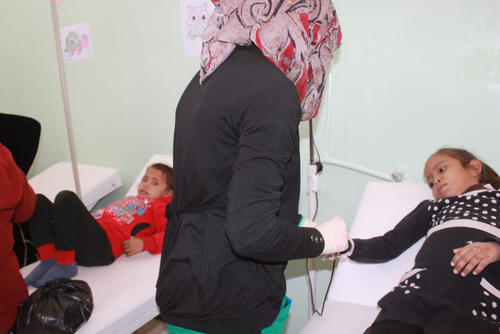
Noora is ten years old girl that is diagnosed with thalassemia.  The MSF team in Syria met Noora and her mother, Jawhara, in Tal Abyad hospital. 

Noora’s mother said: "We started doing blood transfusion for Noora when she was two months old."

"We fled from Deir ez-Zor to Tal Abyad. It takes us 15 minutes to arrive to the hospital for the blood transfusion sessions. Noora has a blood transfusion session once every 14 days, but it’s still quite a challenge. The most worrying part is not finding the medication to reduce the iron in her blood. There is limited awareness about the disease in the country and due to conflict in the country sometimes the medication or the blood units are not available."

"Noora couldn't play like other kids, sometimes she used to come back home crying." 

"We hope we will find a bone marrow transplantation donor but so far we haven’t and we can't afford it."

MSF has started providing chelation treatment to children with thalassemia in Tal Abyad national hospital.
Syria

Treating patients with chronic conditions in a war context

Médecins Sans Frontières (MSF) has started providing chelation treatment to children with thalassemia in Tal Abyad national hospital, northeast Syria. After seven years of war, patients with this chronic disease have not received the regular treatment or blood transfusions they need. Project Update - 16 May 2018
 
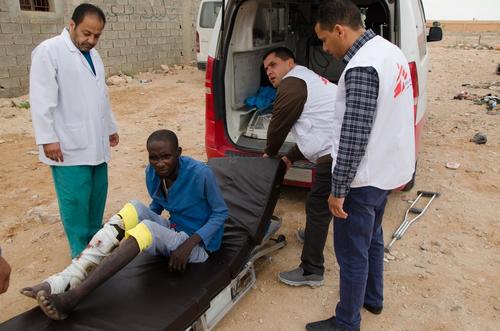
L’équipe médicale MSF réfère un patient depuis Bani Walid vers une structure de soin secondaire. Il souffre d’une fracture ouverte et infectée du tibia. La très grande majorité des patients pris en charge à Bani Walid ont réchappé  de prisons clandestines présentes dans la région. Ils ont été kidnappés, torturés, et retenus captifs par des réseaux criminels qui leur font vivre un calvaire pour obtenir d’eux une rançon. Ces rescapés sont profondément affaiblis, avec des plaies qui se sont infectées, et de multiples traumatismes. 

MSF medics refer a patient from Bani Walid to a secondary health facility. The patient suffers from open and infected fracture of the shin. The vast majority of patients taken care of in Bani Walid manage to survive and escape  secret prisons in the region. They were kidnapped, tortured, and held captive by criminal networks which make them live an ordeal to obtain ransom from them and their relatives. These survivors are profoundly weakened, with infected wounds and  multiple traumas.
Libya

The dangers refugees face fleeing

Trafficking, clandestine prisons and intercepted boat journeys – the dangers refugees face fleeing
Interview - 14 May 2018
 
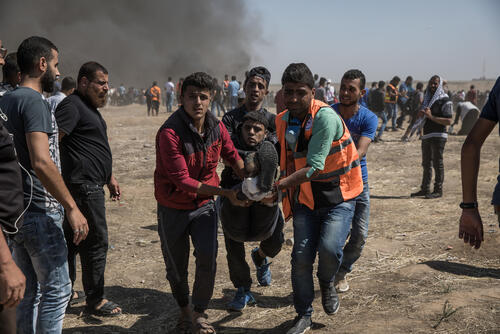
Gaza, 14 mai 2018, Manifestation contre l'ouverture de l'ambassade à Jérusalem à gaza, dans la zone de Malaka. 52 palestiniens ont été tués et environ 2410 blessés sont à déplorer.

Gaza, in May 14th, 2018, Demonstration against the opening of the embassy in Jerusalem in Gaza, in the zone of Malaka. 52 Palestinians were killed and approximately 2410 wounded persons are to regret.
Palestine

Violence on demonstrators in Gaza is 'unacceptable and inhumane'

MSF statement on violence on protestors in Gaza strip. Statement - 14 May 2018
 
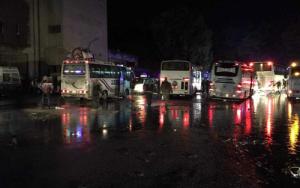
Qalaat al-Madiq buses
Syria

Newly displaced Syrians face multiple challenges in Idlib and northern Hama

Over the past two months, huge numbers of Syrians have been displaced from formerly besieged areas to northwest Syria, with more than 60,000 of them arriving in the governorate of Idlib and in northern Hama. Médecins Sans Frontières (MSF) is providing assistance throughout the area, and has strengthened the medical response in Qalaat al-Madiq in northern Hama, a location known as ‘zero point’ where new arrivals descend from buses. Project Update - 14 May 2018
Four mothers posing in a corridor of the Hospital in Bili. All four of them are staying in the hospital with their child, that's suffering from a severe case of malaria. Since the beginning of the project in 2016, the pediatric ward already treated more than 4.000 cases of complicated/severe form of malaria.
Médecins Sans Frontières (MSF)

Independent medical humanitarian assistance

We provide medical assistance to people affected by conflict, epidemics, disasters, or exclusion from healthcare. Our teams are made up of tens of thousands of health professionals, logistic and administrative staff - most of them hired locally. Our actions are guided by medical ethics and the principles of independence and impartiality. We are a non-profit, self-governed, member-based organisation.

Learn more