



Ebola disease in DRC: find out how we're responding
Learn more
7996 Results
 
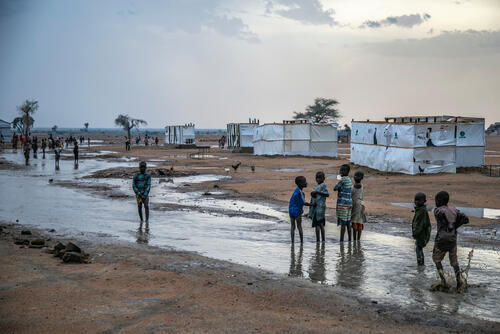
Rising waters in MSF’s primary healthcare centre and compound in Pibor town forced us to reduce life-saving activities and discharge patients.
South Sudan

“The only way to move around the hospital now is by boat”

Severe floods in Pibor, eastern South Sudan, are continuing to impact people and MSF’s ability to provide lifesaving services. Voices from the Field - 25 Oct 2019
 
On an aerial assessment from Bor to Pibor, areas can be seen completely submerged by flooding.
South Sudan

People stranded, cut off from care in severe flooding in South Sudan

MSF teams are responding as thousands of people have been left stranded in parts of east and northeast South Sudan in the wake of severe flooding. Press Release - 21 Oct 2019
 
MSF teams assessing the refugee camp of Bardarash. The camp was initially used to host refugees fleeing from Mosul during the siege of 2017. Its capacity is estimated to around 11 000 individuals. The camp is empty since a while, but some shelters can be rehabilitated and used to allow potential medical activities. Moreover, the former Health Centre structure had been already used in the past by NGOS (MSF amongst them). The facility is in good shape and has enough space and capacity for carrying on primary health care activities.
Iraq

MSF providing medical care in Iraq to people fleeing northeast Syria

MSF teams have started working inside two areas in Iraq, responding to the medical needs - including mental health needs - of people fleeing the conflict and Turkish incursion in northeast Syria. Statement - 21 Oct 2019
 
A year ago, the only shelter providing assistance to the migrant population was almost empty. Today, that place, which can accommodate 180 people, has been forced to take in more than 400.
Mexico

Migration policies that kill

Carol Bottger, MSF medical coordinator has just spent a year in Mexico. In this interview, she discusses the impact of regional migration policies. Interview - 18 Oct 2019
 
Jamal, 62, is a Palestinian residing in Nahr Al-Bared camp, in North Lebanon. Jamal studied mechanical engineering in the United States of America, but he could not practice the profession when he came back to Lebanon. He was forced to find any job to support his family, which had an impact on his mental health.
“I suffered from anxiety, depression, and phobia. I was scared to go out of the house. One day, a friend told me about Médecins sans Frontières, so I visited their clinic. I’ve received psychological support sessions from their psychologist, and a doctor prescribes my medication,” says Jamal. “I don’t have to worry about buying my medication because MSF provides them for me on a monthly basis, or else I would have to pay more than 100 USD per month. After one year of therapy, I am now much better. I can go out on my own; my fears disappeared.”
Jamal received mental health consultations and pharmacological treatment in MSF clinic in Abdeh, Akkar, as part of the Mental Health Gap program which MSF is implementing since 2017. This program is based on training physicians on how to prescribe medication for some of the patients suffering from mental disorders where needed, under the supervision of an external psychiatrist and in collaboration with a multidisciplinary team.
Mental health

Treating mental health outside of specialised settings

In an effort to address challenges of providing adequate mental health support to people, MSF has implemented the Mental Health Gap programme in two clinics in northern Lebanon. Project Update - 17 Oct 2019
 
Refugees in Zintan DC at the gate of the main warehouse where 700 of them were detained. 
A tuberculosis outbreak has likely been raging for several months in the detention centre and some wear masks for fear of contamination. 
The main warehouse was emptied in June 2019, and the remaining people distributed among the other buildings within the detention centre compound.
Libya

Closure of detention centre exposes migrants and refugees to even worse conditions

Following the closure of a detention centre in Misrata, refugees and migrants moved to other facilities in Libya are exposed to increasingly inhumane conditions.

Press Release - 17 Oct 2019
 
CENTRAL AFRICAN REPUBLIC, BAMBARI, 27 SEPTEMBER 2014 An MSF staff takes the temperature of a young boy. In the villages around Bambari MSF has established so called 'points palu' or malaria stations, where people get examined to detect malaria in an early stage, especially children. Between 80 and 90% of the patients are tested positive to malaria.
Medical resource

International medical guides: practical tools for the field

MSF has launched new editions of "Clinical guidelines" and "Essential drugs", available in several languages for use in MSF projects and beyond. MSF medical resource - 17 Oct 2019
 
The sign indicating MSF’s clinic in Lashio, Shan state. MSF opened its first clinic in Shan state in 2001, and today provides HIV, TB (including DRTB), Hepatitis C care, as well as primary health care. In addition to its two clinics in Lashio and Muse, MSF also runs mobile clinics at Lashio and Hsipaw prisons and has emergency response capacity in case of natural disasters or population displacements as a result of fighting in Shan’s longstanding conflict.
Myanmar

Displaced couple cured of multidrug-resistant tuberculosis in Shan state

Treatment for multidrug-resistant tuberculosis patients is rare in Myanmar's conflict-affected communities. This story illustrates hardships patients face. Project Update - 17 Oct 2019
 
As the only actor in the area, MSF has built these shelters for the internally displaced families in Mbawa Camp, where currently about 3,800 people are sheltering.

MSF is also running a daily mobile clinic, offering basic health care to the displaced population in Mbawa Camp, near the state capital of Makurdi in Benue state.
Nigeria

Working with displaced people in Benue state, Nigeria

Interview with Simona Onidi, MSF project coordinator in Benue state, Nigeria, where our teams support some of the thousands of people displaced by violence. Voices from the Field - 16 Oct 2019
 
Displaced families now live in an abandoned building in Anka. Parts of the roof have collapsed and need reparation for people to stay dry during the rainy season.

In the town of Anka, around 7,000 displaced people have found shelter in abandoned buildings, schools and construction sites, such as the unfinished new palace of the local traditional ruler, the Emir. Mainly women and children live in the unofficial settlements, as the husbands often return to their looted villages to work on the fields.
Nigeria

On the run from violence in Zamfara state

Violence in Nigeria's Zamfara and Benue states has forced thousands of people from their homes. Their medical and humanitarian needs are great. Project Update - 15 Oct 2019
Four mothers posing in a corridor of the Hospital in Bili. All four of them are staying in the hospital with their child, that's suffering from a severe case of malaria. Since the beginning of the project in 2016, the pediatric ward already treated more than 4.000 cases of complicated/severe form of malaria.
Médecins Sans Frontières (MSF)

Independent medical humanitarian assistance

We provide medical assistance to people affected by conflict, epidemics, disasters, or exclusion from healthcare. Our teams are made up of tens of thousands of health professionals, logistic and administrative staff - most of them hired locally. Our actions are guided by medical ethics and the principles of independence and impartiality. We are a non-profit, self-governed, member-based organisation.

Learn more