



Ebola disease in DRC: find out how we're responding
Learn more
4633 Results
 
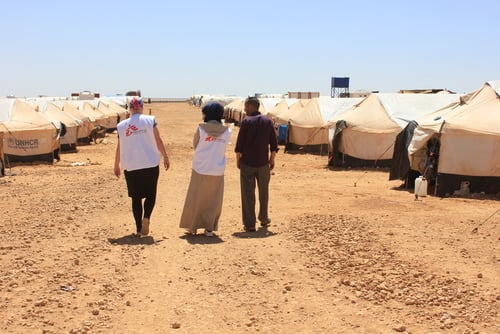
MSF teams  working in Menbij camp to provide humanitarian assistance for Syrian IDPs, north Syria.
Syria

Airstrikes or minefields – Raqqa’s residents face a deadly choice

As fighting intensifies for control of the Syrian city of Raqqa, people must decide whether to remain in the city and surrounding villages under heavy bombardment, or leave the area by crossing active frontlines and minefields, says international medical organisation Médecins Sans Frontières (MSF). Press Release - 9 Jun 2017
 
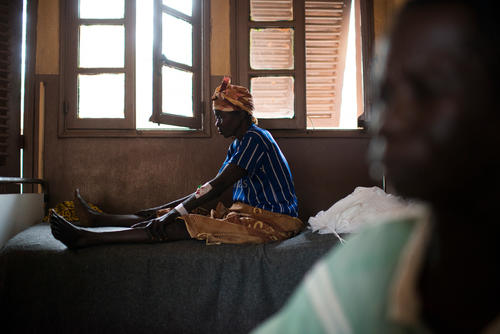
Thérèse Erede, 45, wounded by gunfire. Bambari's hospital.
Central African Republic

Will Bambari be next?

‘Will Bambari be next?’ This is the question on everyone’s lips in Central African Republic’s second city and commercial hub. Its residents worry that the violence engulfing the cities of Bangassou and Bria since early May – in the form of brutal massacres – could soon spread to Bambari, a repetition of the bloodshed of the 2013-2014 war. Project Update - 8 Jun 2017
 
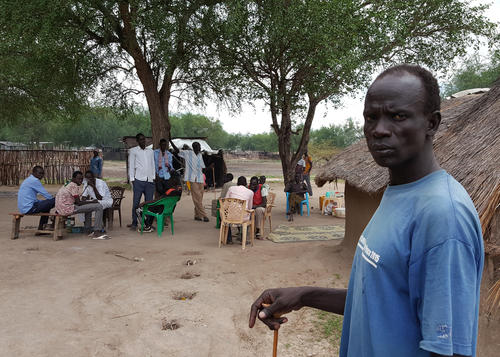
William Nyuon Kuolang, 41, is a father of 5. He used to live in Yuai, a place he fled on the 15th of February 2017 following some fighting between the SPLA and opposition groups. Since then, he lives with his family in a village near Pieri.
South Sudan

“They killed the women, the girls, everybody in the town”

"I left Yuai on 15 February because of the fighting. I left running, there was no time to take anything," says William Nyuon Kuolang, 41, a father of five. Voices from the Field - 2 Jun 2017
 
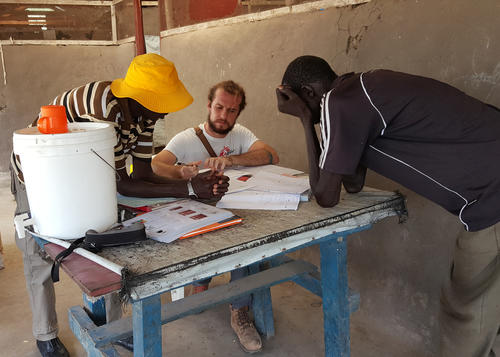
Jonathan Skillen, a MSF nurse, gives explanations to Chuol Gatweck Leo and John Malith Reath, two freshly recruited MSF staff, on how to fill the register book.
South Sudan

Thousands at risk of cholera and malnutrition after fleeing attacks in Yuai and Waat

More than 27,000 people have fled their homes since mid-February after clashes between the Sudan People’s Liberation Army (SPLA) and opposition groups. Press Release - 2 Jun 2017
 
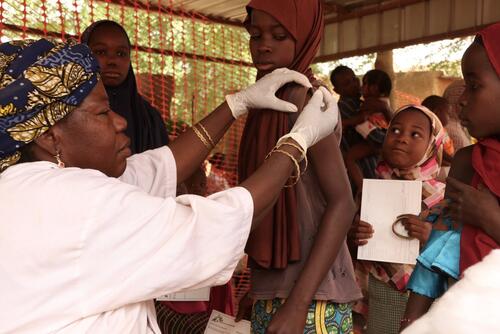
April 2017. Meningitis vaccination campaign in Niamey region. A teenager is being vaccinated at a site installed by MSF’s emergency team. 

MSF emergency teams in April 2017 seen here supporting the meningitis vaccination campaign in Niamey region. 
In response to an outbreak of meningitis C, MSF supported the Ministry of Health’s vaccine response in the regions of Niamey, Tahoua, Dosso and Tillabéry. Over 358,800 people aged between 2 and 20 were vaccinated.
Meningitis

MSF responds to declared outbreaks in Nigeria and Niger

In Niger, MSF conducted vaccination campaigns with local authorities for more than 463,800 people – aged between two and 20 years – in 28 health areas Project Update - 30 May 2017
 
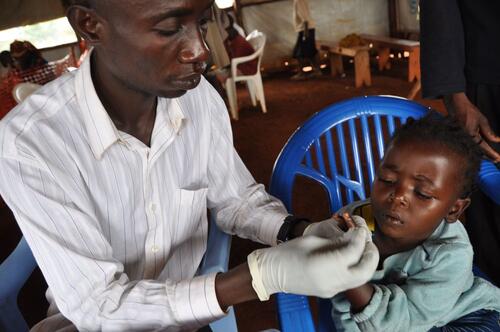
b)	Billy`s symptoms are typical of malaria, which is often characterised by a fever, headache, joint pains, vomiting and other flu-like symptoms. Saidi Lukozi, MSF Nurse Assistant at Nyarugusu camp, therefore tests Billy for the disease. Billy receives a small pin-prick to her finger to extract a drop of her blood, which is then tested immediately, on-site, to see if malaria parasites are present. 
This kind of testing is the most reliable way of diagnosing malaria in the camp`s remote and basic environment: little training is needed in order to administer the tests; no additional laboratory equipment is required; and the results are fast and simple to interpret.
Tanzania

Departing Nyarugusu camp, MSF continues refugee response at nearby Nduta

“While it is never an easy decision to leave healthcare services, our work in Nyarugusu was always intended to be a temporary measure” Press Release - 30 May 2017
 
Narcisse Wega, MSF deputy emergency cell manager.
Democratic Republic of Congo

“If we sit back and do nothing, these people will die”

"As a result of intercommunal conflict, villagers left their homes in the hope of finding safety elsewhere." Voices from the Field - 26 May 2017
 
MSF mobile clinic in Kalonda.
Democratic Republic of Congo

Malnutrition and disease ravage the settlements around Kalémie

Displaced people living in the settlements around the city of Kalémie in Democratic Republic of Congo (DRC) have limited access to healthcare and face alarming shortages of food, water and shelter, said international medical humanitarian organisation Médecins Sans Frontières (MSF) today. Press Release - 26 May 2017
 
An Medecins Sans Frontieres (MSF) truck on the streets of Bangassou.
Central African Republic

Unacceptable violence in Bangassou hospital

In the evening of 24 May 2017, an armed man entered Bangassou hospital, which is managed by Médecins Sans Frontières (MSF) and the Central African Republic Ministry of Health. He inflicted violence on an MSF nurse, before seizing a patient and her caretaker. Respect for patients and medical facilities must be unequivocally maintained to permit a continued minimum level of healthcare in the country. Project Update - 26 May 2017
 
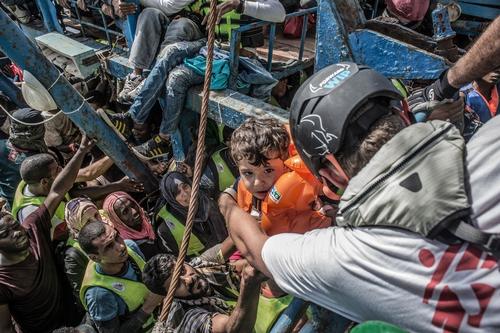
26th August 2015. A young child is lifted from a boat containing approximately 650 people by Sebastian Stein (MSF Coordinator) during a rescue in the Mediterranean Sea by the Bourbon Argos.
Global

G7 countries must make bold commitments to humane migration policies

Concrete measures must be taken: safe and legal channels to seek protection; safe and humane reception conditions in countries of destination and transit; early detection of vulnerabilities; and the implementation of a dedicated search and rescue system in the Mediterranean Press Release - 25 May 2017
Four mothers posing in a corridor of the Hospital in Bili. All four of them are staying in the hospital with their child, that's suffering from a severe case of malaria. Since the beginning of the project in 2016, the pediatric ward already treated more than 4.000 cases of complicated/severe form of malaria.
Médecins Sans Frontières (MSF)

Independent medical humanitarian assistance

We provide medical assistance to people affected by conflict, epidemics, disasters, or exclusion from healthcare. Our teams are made up of tens of thousands of health professionals, logistic and administrative staff - most of them hired locally. Our actions are guided by medical ethics and the principles of independence and impartiality. We are a non-profit, self-governed, member-based organisation.

Learn more